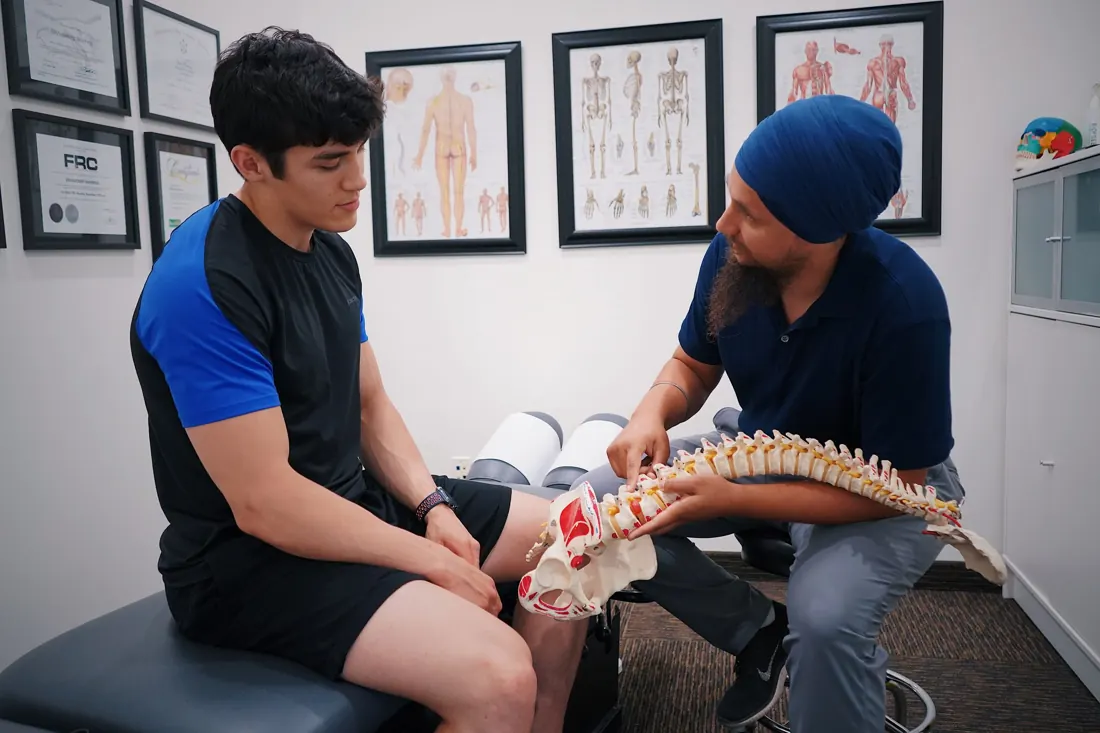
Lumbar decompression removes bone, bone spurs or ligament that crowd the nerves in the lower spine, giving them more room. It is generally reserved for people with stenosis or nerve compression whose leg pain, weakness or limited walking persists despite nonsurgical care. It addresses nerve pressure, not the underlying wear in the spine.
When the spinal canal in the lower back narrows, the nerves that run through it can become crowded. The result may be leg pain, numbness or heaviness that comes on with walking and eases with sitting. Lumbar decompression is the family of operations that makes more room for those nerves. This page explains who it is for and what to expect.
What decompression means
Decompression is a goal more than a single procedure. The surgeon removes whatever is pressing on the nerves, which may be bone spurs, thickened ligament, part of the bony arch of the vertebra, or a piece of disc. AAOS describes the laminectomy as removing the bone, bone spurs and ligaments that are compressing the nerves, and notes that it can be done as open surgery or with a minimally invasive method using several smaller incisions. Related approaches include:
- Laminotomy, which removes only part of the bony arch on one or both sides.
- Foraminotomy, which widens the opening where a nerve exits the spine.
- Discectomy, which removes a herniated piece of disc; see microdiscectomy.
- Endoscopic or tubular techniques, which use smaller corridors; see endoscopic spine surgery.
The full laminectomy operation has its own page: laminectomy.
Who it is generally considered for
Surgery for lumbar stenosis, AAOS explains, is generally reserved for people who have poor quality of life because of pain and weakness, including difficulty walking for extended periods. Typical diagnoses are spinal stenosis, lumbar radiculopathy from a disc or spur, and some cases of spondylolisthesis. The deciding factors are the match between symptoms and imaging, how much function you have lost, and your overall health. Imaging that looks severe without matching symptoms is not by itself a reason to operate.
Urgent evaluation is different. Sudden loss of bladder or bowel control, numbness in the groin, or rapidly worsening leg weakness can signal a severe compression that needs emergency assessment.
What is usually tried first
- Activity modification and short, frequent walks, and forward-leaning positions that often ease stenosis symptoms.
- Physical therapy for core, hip and leg strength; see physical therapy for back pain.
- Medicines such as anti-inflammatories, where suitable for you.
- Injections such as an epidural steroid injection, which may calm inflammation for a period.
- Time, since many episodes of nerve irritation settle, although stenosis caused by bone is less likely to resolve on its own.
NIAMS and MedlinePlus list medications, physical therapy, braces and surgery as the main treatment categories, with surgery generally coming after the others.
How the operation is done
- You have a pre-operative review, imaging such as MRI or CT, and instructions about medicines, including blood thinners.
- Under general anesthesia, you lie face down. A small to moderate incision is made over the affected level or levels.
- Muscles are moved aside, or dilated through a tube in minimally invasive techniques. Bone, ligament and spurs pressing on the nerves are removed, and the surgeon checks that each nerve moves freely.
- If the spine is unstable, a fusion with screws and rods may be added, as described in spinal fusion.
- The incision is closed and you move to recovery.
Operating time depends on how many levels are treated. Ask us whether this is offered at the office nearest you and which techniques each surgeon uses.
Recovery, in general terms
According to AAOS, healthy people who undergo decompression alone may go home the same or next day and may return to normal activities after only a few weeks, while fusion generally adds two to three days to the hospital stay. Most people go back to a desk job within a few days to a few weeks, and normal activities after about two to three months, though your surgeon's instructions override any general range. Walking is encouraged early, and most people need some physical therapy to build strength. Leg symptoms often change first, while numbness can take longer to fade, and in some people it does not fully resolve.
Risks in plain terms
- Bleeding, infection, blood clots and reactions to anesthesia, which AAOS describes as usually very low risks, higher in older people, people with diabetes, smokers and those with multiple medical problems.
- A tear in the sac covering the nerves (dural tear), which may need repair and sometimes causes headache or fluid leakage.
- Nerve injury.
- Return of symptoms, failure to relieve symptoms, or a need for further surgery.
- Instability or slippage at a decompressed level, which is a reason fusion is sometimes added.
- If fusion is done, failure of the bone to heal or failure of screws or rods.
Weighing the decision
Surgery makes more sense when walking tolerance, sleep or work are being limited, when nonsurgical care has had a fair trial, and when imaging explains the symptoms. It makes less sense if the main complaint is back pain without leg symptoms, if symptoms are mild, or if medical conditions raise the risk. Get your questions answered: how much of the benefit is expected for leg versus back pain, what happens if we wait, and what the surgeon would do if symptoms return. A second opinion is reasonable for any elective spine operation.
Cost for out-of-network and self-pay patients
A decompression produces separate bills. There is the surgeon's professional fee, a facility fee from the hospital or surgery center, an anesthesia professional fee, and charges for imaging, lab work, any assistant surgeon, bracing and physical therapy. A planned fusion adds implants and a longer stay. Plans often require prior authorization and documented nonsurgical care, so check your plan early.
With out-of-network benefits, each service is paid from the plan's own allowed amount, which the allowed amount guide explains. The out-of-network cost calculator estimates your share. Self-pay patients are entitled to a Good Faith Estimate before scheduled care, covered in the Good Faith Estimate guide.
When to seek emergency care after surgery
Call 911 or go to the nearest emergency room for chest pain, sudden shortness of breath, new loss of bladder or bowel control, or sudden leg weakness. Call your surgeon the same day for fever, drainage or spreading redness at the incision, calf swelling with pain, or a severe headache that worsens when upright.
Sources
- American Academy of Orthopaedic Surgeons, OrthoInfo. Lumbar Spinal Stenosis
- NIAMS (NIH). Spinal Stenosis
- MedlinePlus (NIH). Spinal Stenosis
- American Academy of Orthopaedic Surgeons, OrthoInfo. Spinal Fusion
This page is general health information and is not medical advice. It does not create a physician-patient relationship. Consult a qualified clinician about your own symptoms and treatment.