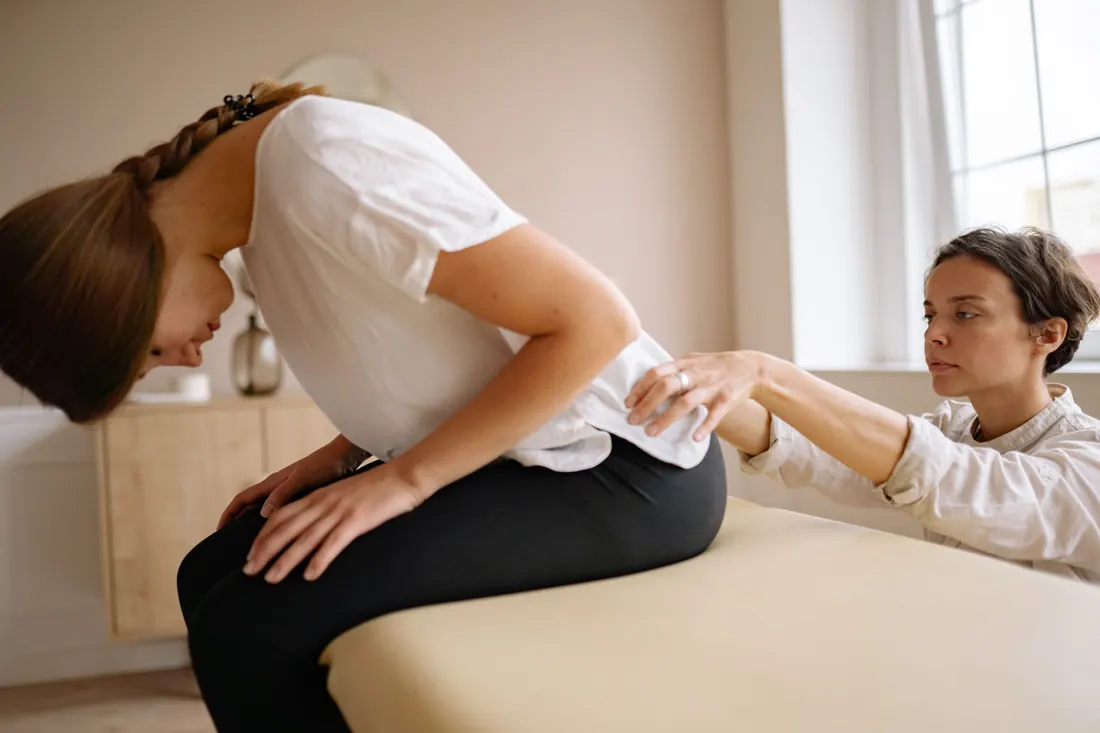
Lumbar radiculopathy is compression or irritation of a nerve root in the low back, causing leg pain, tingling or weakness, often below the knee. Most cases ease within weeks to months without surgery; injections and decompression procedures are options when nerve symptoms persist.
Radiculopathy is the word for what is happening to the nerve, while sciatica is the word for what it feels like. A person with lumbar radiculopathy may have little back pain and a lot of leg pain, and the exact area of tingling or weakness helps point to the nerve root involved.
How the nerve gets irritated
Nerve roots leave the lumbar spine through openings on each side, then join to form the sciatic and other leg nerves. The roots at L4, L5 and S1 are most often affected. A herniated disc can push into the root's path and release chemicals that inflame it. Bone spurs and thickened ligaments can narrow the openings, a process described under spinal stenosis. A slipped vertebra described under spondylolisthesis may do the same.
Symptoms and patterns
- Pain from the low back or buttock traveling into the leg, often below the knee, usually on one side.
- Tingling, burning or numbness in a specific part of the leg or foot.
- Leg or foot weakness, such as a foot that catches when walking or difficulty rising on the toes.
- Pain that worsens with sitting, coughing or bending forward, particularly with a disc cause.
- Leg pain that comes on with walking and eases when sitting or leaning forward, typical of narrowing.
Different roots produce different patterns. For example, pain across the top of the foot and weak big-toe lift often implicate L5, while the outer foot and calf are more typical for S1.
Who gets it
Disc herniation is a leading cause in adults in their thirties to fifties, while spinal narrowing is more common after sixty. Heavy lifting, long sitting, smoking, excess weight and prior back problems raise risk, but it can occur without a clear trigger.
When to see a specialist, and when to go to the emergency room
An evaluation is recommended if leg pain persists beyond a week or two, wakes you at night, or comes with numbness or weakness, and sooner if daily life is limited.
Go to an emergency room or call 911 for new loss of bladder or bowel control, numbness around the groin or inner thighs (saddle area), rapidly worsening weakness in one or both legs, or severe back pain after significant trauma. These can mean cauda equina syndrome, which needs urgent treatment. Fever with severe back pain, or back pain in someone with a history of cancer and unexplained weight loss, also warrants emergency evaluation.
How it is diagnosed
The physician examines strength, reflexes and sensation in the legs, and performs the straight-leg raise to see whether lifting the leg reproduces nerve pain. MRI shows discs and nerve compression and is ordered when weakness is present, symptoms persist beyond several weeks, or a procedure is planned, as explained under MRI for back pain. CT may add bone detail. EMG and nerve conduction studies can help when the diagnosis is unclear or when other nerve conditions such as diabetic neuropathy are possible. Imaging findings are common in people without pain, so they are interpreted alongside the examination.
Treatment from conservative to surgical
Conservative care
Most people are advised to stay as active as pain allows, since bed rest slows recovery. Physical therapy uses movement preferences, core and hip strengthening and nerve mobility work. Heat, short courses of anti-inflammatory medication if suitable, and in some cases nerve-pain medicines are used. For more on how recovery works after injury, see physical therapy after injury.
Injections
If leg pain is significant after a few weeks, a transforaminal or interlaminar epidural steroid injection places anti-inflammatory medicine near the irritated root. It may provide relief lasting days to months for some people and little for others, and it is usually combined with therapy. Selective nerve root blocks can both treat and help confirm which root is responsible.
Surgery
Surgery is considered for progressive weakness, cauda equina syndrome, or persistent disabling leg pain matching the imaging after a trial of non-surgical care. A microdiscectomy removes the part of the disc pressing on the nerve. Laminotomy or foraminotomy widens the space for the root, and some are done endoscopically. Fusion is reserved for instability.
What recovery usually looks like
A large share of people improve substantially within six to twelve weeks. Injection benefits vary. After microdiscectomy, leg pain often eases soon after surgery, with desk work in about one to three weeks and heavy labor later. Numbness can take longer to clear than pain. These are general ranges, not individual predictions.
Protecting your back while recovering
- Walk in short, frequent bouts, and change positions often.
- Lift with bent knees and hips, keeping loads close.
- Avoid prolonged unsupported sitting and heavy twisting.
Our guide to sciatica and herniated disc describes closely related patterns.
What to bring to the visit
Be ready to describe where the leg pain travels, whether it passes the knee, which positions ease it and whether walking or sitting is worse. Mention any weakness, such as tripping on a toe, and any bladder or bowel change. Bring earlier MRI or X-ray images, a record of treatments tried, and your medicine list, including blood thinners, since those affect whether an injection can be scheduled safely.
If symptoms fail to improve, or if weakness appears or worsens at any point, tell your physician promptly rather than waiting out the full recovery window. Progressive weakness is the one finding that shortens the timeline for imaging and a surgical opinion.
Out-of-network and self-pay care
This pathway may include an exam, MRI, therapy, injections and a surgical opinion. Elite MD Care is out-of-network and also welcomes self-pay patients, so you can weigh each step against your benefits or a direct payment.
See how out-of-network visits work, how self-pay is handled, use the out-of-network cost calculator, and browse spine care.
Sources
- American Academy of Orthopaedic Surgeons, OrthoInfo. Sciatica
- American Academy of Orthopaedic Surgeons, OrthoInfo. Herniated Disk in the Lower Back
- MedlinePlus (National Library of Medicine). Sciatica
This page is general health information and is not medical advice. It does not create a physician-patient relationship. Consult a qualified clinician about your own symptoms and treatment.