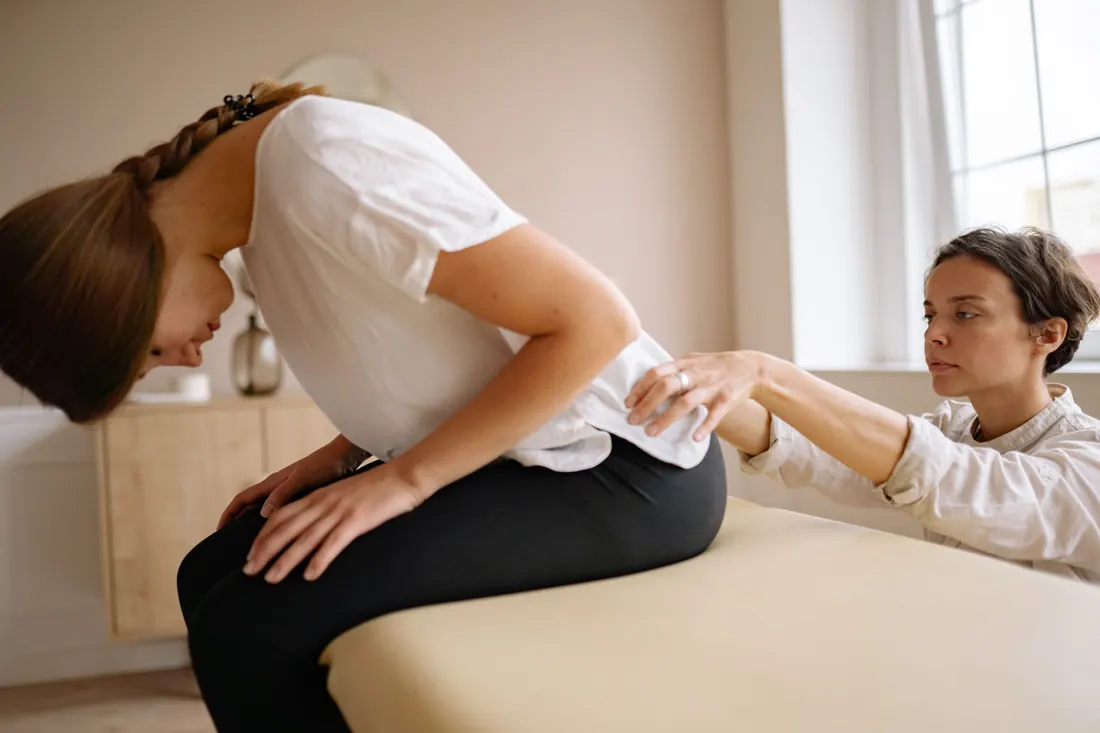
Spondylolisthesis is when one vertebra slips forward over the one below it. It can cause low back pain, leg symptoms and stiffness, but many people have mild slips with little trouble. Treatment begins with therapy, medication and sometimes injections. Surgery is considered for persistent symptoms or instability.
Spondylolisthesis is a mechanical description: a vertebra has shifted out of its usual alignment. How much that matters depends on the degree of slip, whether it is stable, and whether nerves are being squeezed. Many slips are found by accident on an X-ray and never cause trouble, while others produce back pain, leg symptoms or both.
Types of slip
- Isthmic. A small stress fracture in a part of the vertebra called the pars interarticularis (spondylolysis) lets the vertebra slide. It is often seen in adolescents and young adults who do repetitive back extension sports such as gymnastics, football lineman play and diving, and may only cause symptoms later in life.
- Degenerative. Arthritis in the facet joints and wear of the disc allow slipping, most often at the L4-L5 level in people over 50. It is more common in women.
- Other forms include congenital, traumatic and pathologic slips, which are less common.
Doctors grade slips by percentage of forward movement. Grade I is up to 25 percent, grade II 25 to 50 percent, and higher grades are rarer. Lower grades are often managed without surgery.
Symptoms
- Low back pain, often worse with standing, extension or activity and better with sitting or bending forward.
- Stiffness and tight hamstrings, sometimes with a change in posture or gait.
- Leg pain, numbness or weakness if a nerve is compressed. This may resemble sciatica or spinal stenosis.
Emergency care is needed for loss of bladder or bowel control, numbness in the saddle area, or rapidly worsening leg weakness.
Diagnosis
Standing lateral X-rays show the slip and its grade. Flexion and extension views can show whether the segment moves abnormally, a sign of instability that influences the surgical decision. MRI shows nerve compression and disc and joint changes, and CT can show the pars fracture clearly. Examination looks for tenderness, hamstring tightness, motion limits and nerve signs.
Treatment
Non-surgical care
- Activity modification, with a temporary break from sports that load the lower back in extension.
- Physical therapy emphasizing core stabilization, hamstring flexibility and posture. Therapy aims to improve support around the slip because the bone itself does not realign.
- Anti-inflammatory medication, and in some cases a brace for a limited time, especially in young athletes with a fresh pars injury.
- Epidural steroid injections for leg pain from nerve irritation.
Surgery
Surgery is usually considered after months of non-surgical treatment have failed to control pain, when neurologic symptoms persist or progress, when slippage is high-grade, or when imaging shows clear instability. The most common operation combines decompression of the nerves with a spinal fusion that stabilizes the segment using screws and rods and bone graft. Minimally invasive and robotic-assisted techniques are used by some surgeons. Not every slip needs a fusion, so ask what the specific plan is meant to accomplish.
Recovery expectations
Many people with mild slips improve within weeks to a few months of therapy and activity changes, though symptoms can recur. In young athletes with a pars stress fracture, healing and return to sport commonly take a few months under medical guidance. After a fusion, hospital stays are usually a few days or fewer, walking starts early, and many people resume desk work within weeks to a couple of months, while the bone typically takes several months to fully unite. Individual recovery varies, and surgeons set restrictions according to the procedure and your health.
Living with a slip
A slip that is stable usually does not need to be re-imaged constantly. People are generally encouraged to stay active, keep trunk muscles strong, maintain a healthy weight and avoid smoking, which impairs fusion healing if surgery is ever needed. Anyone with a known slip who develops new leg weakness or bladder changes should be seen promptly.
Why young athletes are a special case
Adolescents who train hard in sports that repeatedly arch the lower back can develop a stress fracture in the pars interarticularis. Typical signs are one-sided or central low back pain that is worse with extension and improves with rest. An early fracture may heal with several weeks to months of activity restriction and sometimes bracing, so early evaluation matters. Missing it can allow the fracture to become a lasting defect. Parents and coaches should take persistent back pain in a young athlete seriously rather than attributing it to growing pains.
Questions to ask before surgery
If fusion is recommended, it is reasonable to ask which segment is slipped, how much movement was seen on flexion and extension X-rays, whether nerve compression is present and how the surgeon expects the operation to address your specific symptoms. Ask what non-surgical options remain, what recovery restrictions apply, and what the risks are, including that a fusion shifts some load to adjacent levels over time. A second opinion with your images is a normal part of this decision.
Why the diagnosis can be easy to overlook
Because mild slips are common and many produce no symptoms, back pain in a person with a slip is not always caused by the slip. Hip problems, muscle strain and disc disease can coexist. A careful examination that matches symptoms to the imaging helps avoid treating the picture instead of the patient.
Being seen out-of-network or self-pay
Decisions about spondylolisthesis often depend on dynamic X-rays and MRI, and on how your symptoms behave over time. Having imaging reviewed alongside an examination helps avoid both over-treatment and delay.
Elite MD Care sees patients who use out-of-network benefits and patients who pay directly. Read how out-of-network visits and self-pay care work, learn about spine care, and find an office through locations.
Sources
- American Academy of Orthopaedic Surgeons, OrthoInfo. Spondylolysis and Spondylolisthesis
- National Institute of Arthritis and Musculoskeletal and Skin Diseases (NIH). Back Pain
- American Academy of Orthopaedic Surgeons, OrthoInfo. Lumbar Spinal Stenosis
This page is general health information and is not medical advice. It does not create a physician-patient relationship. Consult a qualified clinician about your own symptoms and treatment.