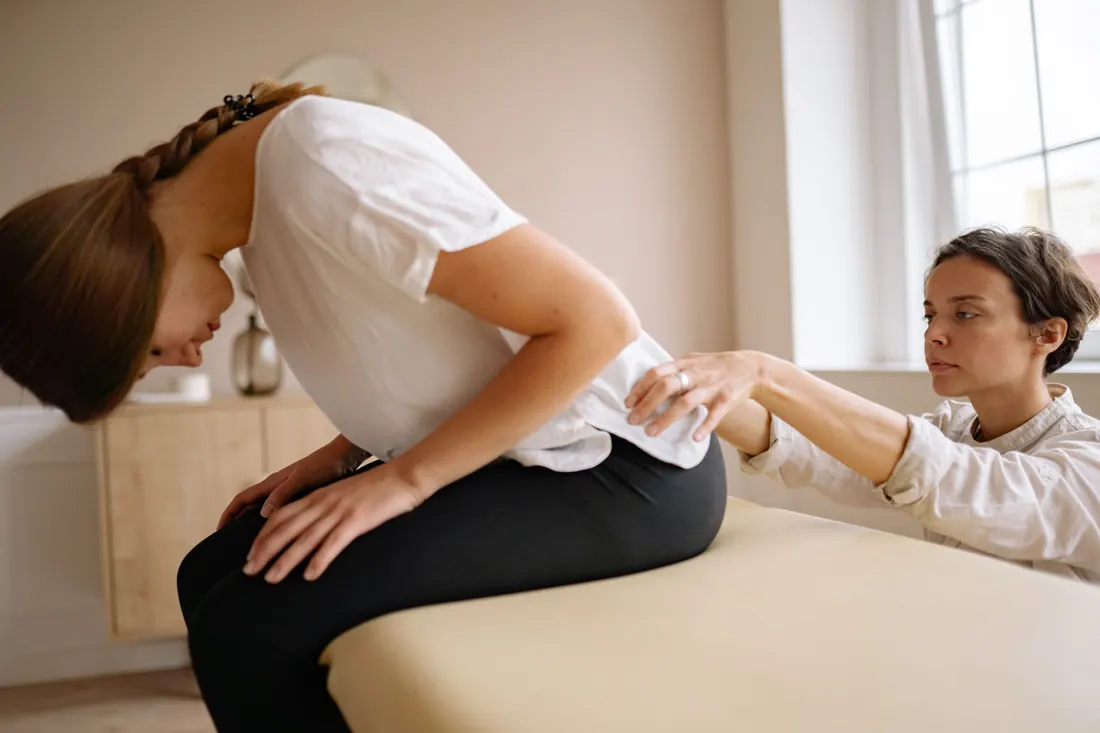
Spinal stenosis is a narrowing of the spinal canal or the openings where nerves exit, usually from age-related wear. It typically causes leg pain, numbness or heaviness when standing or walking that eases with sitting. Treatment starts with exercise, medication and injections, and surgery is considered when symptoms stay disabling.
Spinal stenosis is one of the most common spine diagnoses after age 50, and it often behaves differently from a herniated disc. The pain usually develops gradually, it tends to affect both legs or both sides, and it is closely tied to posture: standing and walking provoke it, sitting or leaning forward relieves it.
What is happening in the spine
The spinal canal is the channel that carries the spinal cord and, lower down, the cauda equina nerve roots. Stenosis means that channel, or the smaller side openings called foramina, has become tighter. Common contributors are thickened ligaments, bone spurs from arthritic facet joints, and discs that have lost height and bulge outward. Most stenosis is in the lower back (lumbar). The neck (cervical) is the next most common site, and there the spinal cord itself can be affected.
Symptoms
Lumbar stenosis
- Cramping, aching or heaviness in the buttocks and legs while standing or walking, called neurogenic claudication.
- Relief when sitting, bending forward or leaning on a shopping cart.
- Numbness or tingling in the legs or feet, sometimes with weakness or a sense that the legs will not hold up.
Cervical stenosis
- Neck stiffness or pain, with numbness, tingling or weakness in the arms and hands.
- Clumsiness with buttons or handwriting, or a change in balance and walking.
Seek emergency care for sudden loss of bladder or bowel control, numbness in the groin or inner thighs, or fast-worsening weakness in the legs. In the neck, rapidly progressive arm or leg weakness or loss of coordination also needs urgent assessment.
Who gets it, and why
Age-related degeneration is the usual cause, so stenosis is uncommon before 50. Some people are born with a narrower canal. Others develop stenosis after a previous spine surgery or injury, or alongside spondylolisthesis and degenerative disc disease. Several of these changes often exist together.
Diagnosis
A clinician will ask how far you can walk, what position eases the pain and whether symptoms involve one leg or both. Examination checks strength, sensation, reflexes and gait. Because pain from hip arthritis or poor circulation in the legs can look similar, those possibilities are considered too.
MRI is the main imaging test, since it shows the canal, nerves and soft tissue. CT, sometimes with contrast, is an option when MRI cannot be used. Standing X-rays show alignment and slippage, and flexion and extension views can reveal movement between vertebrae. As with other spine conditions, a narrow canal on a scan only matters if it matches your symptoms.
Treatment options
- Activity and exercise. Physical therapy often emphasizes flexion-based movement, core and hip strength, and walking programs. A stationary bike is often more comfortable than walking because the posture opens the canal.
- Medication. Anti-inflammatory medicines or nerve-pain medicines may help some people. They are chosen with your other conditions in mind.
- Epidural steroid injections. Image-guided injections can reduce inflammation around compressed nerves and make exercise easier. Effects vary and may be temporary.
- Minimally invasive procedures. In selected patients with lumbar stenosis, a procedure that removes a small amount of thickened tissue or an implant placed between the spinous processes may be discussed.
- Surgical decompression. A laminectomy or laminotomy removes bone and ligament pressing on the nerves. When a spine is unstable, a fusion may be added. Surgery is typically considered when symptoms limit daily life despite non-surgical care, or when weakness or other nerve findings progress.
Recovery expectations
Stenosis is a long-term, mechanical condition, so the goal of non-surgical care is usually better walking tolerance and fewer flare-ups rather than a cure. Many people notice gradual improvement over weeks to a few months with therapy and activity changes. After a decompression, hospital stays are often short and walking begins quickly, with many people returning to light activity within a few weeks and fuller activity over about two to three months. Fusion generally takes longer. These ranges are general, and your surgeon will tailor them to your health and the procedure.
Conditions that can be confused with stenosis
Leg pain with walking has more than one cause. Peripheral artery disease, where narrowed leg arteries limit blood flow, produces calf cramping with walking too, but it is usually relieved by simply stopping, without needing to sit or lean forward, and the pulses in the feet may be weak. Hip arthritis causes groin or thigh pain with weight bearing. Diabetic neuropathy produces numbness and burning in both feet regardless of position. Telling these apart matters because their treatments are completely different, which is why the history of what brings on and relieves your symptoms carries so much weight.
Everyday strategies
- Use a stationary bike or a walker-style cart at the store to keep the spine slightly flexed while staying active.
- Pace walking in segments, resting before pain becomes severe.
- Keep body weight in a healthy range, since extra weight increases lumbar load and lordosis.
- Ask about water-based exercise, which many people tolerate well.
Questions to bring to your appointment
Write down how far you can walk before symptoms start, what position helps, and whether both legs are affected. Bring any prior MRI or CT images as well as the written report. If surgery is being discussed, ask which levels are involved, whether fusion is part of the plan and what the alternatives are.
Being seen out-of-network or self-pay
Stenosis care can involve imaging, therapy, injections and a surgical consult, so it helps to know what is likely before you start.
Elite MD Care sees patients who use out-of-network benefits and patients who pay directly. See how out-of-network visits and self-pay care work, read about spine care, and find an office through our locations.
Sources
- American Academy of Orthopaedic Surgeons, OrthoInfo. Lumbar Spinal Stenosis
- National Institute of Arthritis and Musculoskeletal and Skin Diseases (NIH). Spinal Stenosis
- MedlinePlus (National Library of Medicine). Spinal Stenosis
- American Academy of Orthopaedic Surgeons, OrthoInfo. Cervical Spondylosis (Arthritis of the Neck)
This page is general health information and is not medical advice. It does not create a physician-patient relationship. Consult a qualified clinician about your own symptoms and treatment.