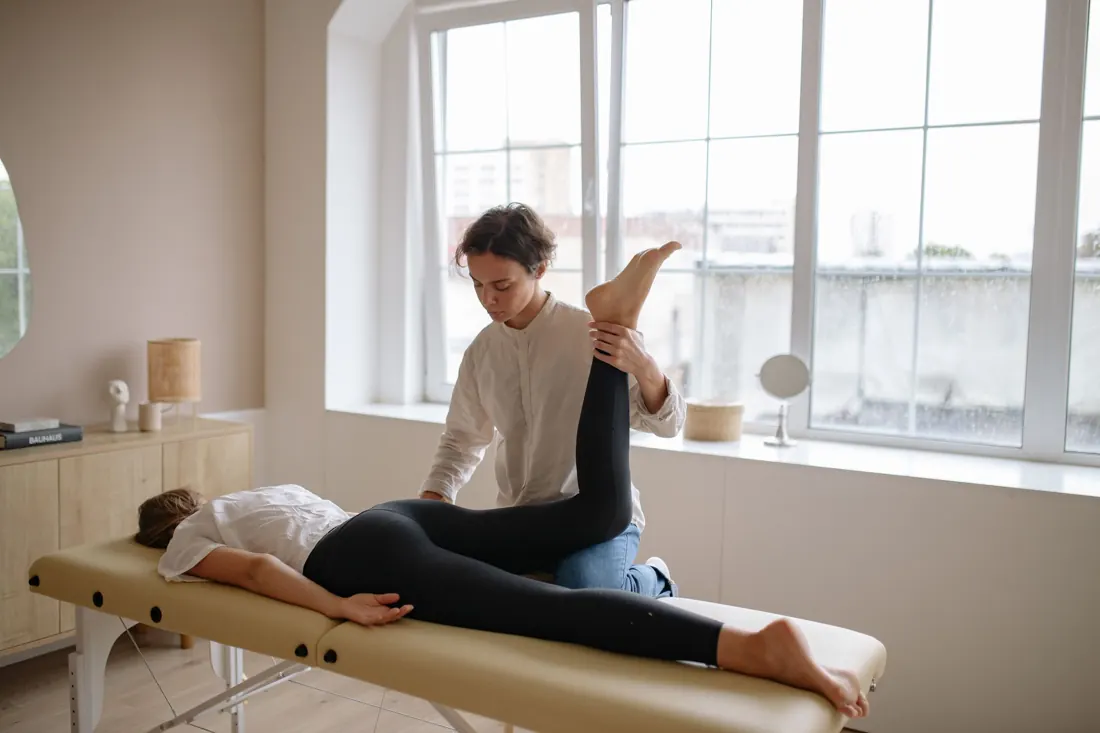
IT band syndrome is irritation near the outer knee, where the iliotibial band along the thigh is repeatedly loaded, common in runners and cyclists. It causes sharp pain on the outside of the knee partway into activity. Most cases improve with load changes and hip strengthening, while injections or surgery are rarely needed.
The iliotibial band, or IT band, is a thick strip of connective tissue that runs along the outside of the thigh from the hip to just below the knee. IT band syndrome is the most common cause of pain on the outer side of the knee in runners and cyclists, and it also affects hikers and people who suddenly raise their training load.
What is going on
The band has long been described as rubbing back and forth over the bony bump on the outer thigh bone, the lateral femoral epicondyle, as the knee bends and straightens. A newer view is that the band is compressed against a pad of fat and tissue beneath it near the knee, especially when the knee is bent about 30 degrees, the angle at which the foot strikes the ground in running. Either way, the picture is irritation of sensitive tissue from repeated load that exceeds what the area is ready for. The band itself does not stretch much, which is why tight-band explanations are only part of the story.
Contributing factors
- A sudden jump in mileage, hills or speed work.
- Weakness of the hip abductors and gluteal muscles, so that the thigh drops inward during stance.
- Running on a banked or cambered surface, or always on the same side of the road.
- Worn shoes or a change in footwear.
- Cycling with a saddle set too high or cleats that rotate the foot.
- Differences in leg length or foot mechanics.
Symptoms
- Sharp or burning pain on the outer knee that appears after a predictable time or distance into a run.
- Pain that eases when you stop, then returns with the same activity.
- Pain going downhill or on stairs.
- Tenderness a finger-width above the joint line on the outside of the knee.
- Sometimes a snapping feeling or mild swelling over the outer knee.
- Outer hip or thigh ache in some people.
Red flags
Call 911 or go to the emergency room after a fall or collision with severe knee pain, a visibly deformed leg, inability to bear weight, or a hot, red, swollen knee with fever. Calf swelling, warmth and pain with shortness of breath or chest pain needs emergency care. Arrange to be seen within a few days if you have a locked knee, giving way, pain at rest or at night, marked swelling in the joint, or pain that does not ease after a couple of weeks of backing off, since meniscus injury, a stress fracture or a ligament problem can mimic IT band pain.
How it is diagnosed
This is mostly a diagnosis by history and examination. A clinician looks at your training pattern, tests for tenderness on the outside of the knee, checks hip strength and the way you stand on one leg, and rules out other sources of pain. Imaging is not usually needed. X-rays or MRI are used when the findings suggest something else, such as a meniscus tear, cartilage injury or a stress fracture, or when symptoms are not improving as expected. Ultrasound may be used to look at the soft tissue and to guide an injection.
Treatment
- Adjust load. Reduce distance or intensity to a level that does not provoke symptoms, rather than stopping all activity. Cross-training such as swimming or pool running maintains fitness.
- Strengthening. Hip abductor, gluteal and trunk exercises are the core of most programs and are generally done for several weeks. See physical therapy after injury.
- Gait and equipment review. Cadence, stride length, shoe condition and, for cyclists, bike fit can all contribute.
- Soft-tissue work. Foam rolling and manual therapy may relieve discomfort for some people, though the evidence is limited.
- Anti-inflammatory medication. Over-the-counter products may help short term in some cases; ask a clinician if you have stomach, kidney, heart or blood pressure concerns.
- Injection. A corticosteroid injection near the painful area may be considered for stubborn pain, sometimes with ultrasound guidance. See ultrasound-guided injections.
- Surgery. Rarely needed. It is considered only after many months of well-run non-surgical care, and typically involves releasing or removing a small portion of the band or the irritated tissue. Ask us whether this is offered at the office nearest you.
A practical plan for the first weeks
In the first week or two, the aim is to calm the area while keeping the rest of the body active. That usually means shorter, flatter and slower runs or none at all, with swimming, cycling at a low saddle-friendly setting or pool running as substitutes. Strengthening starts right away rather than waiting for pain to vanish: side-lying and standing hip work, single-leg balance and step-down control. Once you can walk, climb stairs and do single-leg squats without outer-knee pain, a graded return to running begins, often with run-walk intervals on a soft, flat surface.
Recovery ranges
Many runners improve over about four to eight weeks of reduced load and strengthening, and return gradually to their previous mileage over several more weeks. Stubborn cases can take three months or more, and symptoms are likely to recur if the underlying hip weakness and training errors are not corrected. Timelines vary widely between people.
Related knee and hip problems
Pain around the kneecap is a different problem; see runner's knee. Other causes of lateral knee or outer hip pain include meniscus injury and hip bursitis. The page on knee pain after running lists additional possibilities.
Being seen out-of-network or self-pay
Runners and cyclists often want a gait and training review, not just a diagnosis. That kind of extended visit and any follow-up therapy planning are worth discussing in advance with an out-of-network or self-pay office so expectations match.
Elite MD Care sees patients who use out-of-network benefits and patients who pay directly. Ask which parts of the visit are billed together and which separately, and bring your recent training log and running shoes if you can. Read how out-of-network visits and self-pay care work, estimate your own share with the out-of-network cost calculator, and see our sports medicine page.
Sources
- MedlinePlus (National Library of Medicine). Knee Injuries and Disorders
- MedlinePlus (National Library of Medicine). Sports Injuries
- National Institute of Arthritis and Musculoskeletal and Skin Diseases (NIH). Sports Injuries
This page is general health information and is not medical advice. It does not create a physician-patient relationship. Consult a qualified clinician about your own symptoms and treatment.