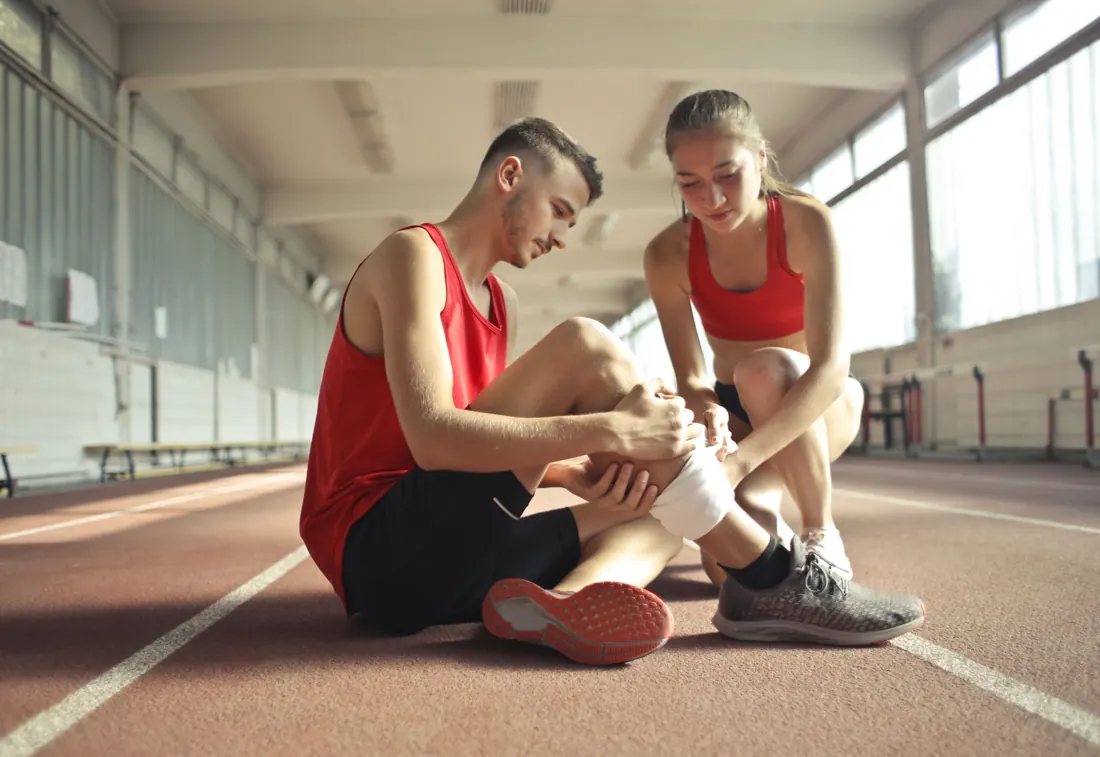
Knee pain after running most often comes from runner's knee at the kneecap, iliotibial band irritation on the outer knee, patellar tendon strain or a meniscus problem. A knee that locks, gives way, swells fast after a twist, or a hot swollen joint with fever, needs prompt medical attention.
Running sends several times your body weight through each knee on every stride. Most of the time the knee handles that well. When training ramps up quickly, shoes are worn out, or mechanics shift as you tire, one structure takes more than it can bear and complains afterward, often later that evening or the next morning. This page is a guide to the common patterns and not a diagnosis.
Know the warning signs first
Go to an emergency room if your knee is visibly deformed after a fall, you cannot put weight on the leg, or the knee swelled up immediately with a pop during a twist. Seek emergency care for a hot, red, swollen knee with fever, and for a calf that is swollen, warm and painful, which can indicate a blood clot. Call 911 for pain with chest pressure or shortness of breath.
Be seen within days if the knee locks and will not fully straighten, buckles under you, is swelling repeatedly, hurts at night or at rest, or if pain has lingered beyond two to three weeks despite reduced running. Pain with a specific spot of bone tenderness is worth checking for a stress injury.
Match the location
- Around or behind the kneecap. Runner's knee is the usual suspect.
- Outer side of the knee. Think iliotibial band irritation.
- Just below the kneecap. Patellar tendon strain.
- Inner or outer joint line, with catching. Think the meniscus.
- Inner side, below the joint, near the shin. The pes anserine tendons or bursa.
Common causes
Runner's knee
Patellofemoral pain develops when the kneecap does not glide smoothly in its groove. It is a dull, aching pain around the kneecap that gets worse with downhill running, stairs and sitting with the knees bent. See runner's knee. Weak hip and thigh muscles, a sudden jump in mileage and changes in footwear are frequent contributors.
Iliotibial band syndrome
The IT band is a thick strip of tissue running down the outer thigh. Irritation near the outer knee causes a sharp or burning pain after a consistent distance, often easing when you stop. The overview under knee pain places it among other common causes.
Patellar tendon strain
Pain right under the kneecap that builds with jumping and fast running may be patellar tendinitis. The tendon is tender to touch and can ache after sitting.
A meniscus tear
A twist during a run or an older, worn meniscus can cause pain along the joint line, swelling and catching. See meniscus tear. Locking or giving way raises the possibility.
Arthritis and other conditions
In runners over forty, worn cartilage can show up as swelling and stiffness after runs. Knee arthritis is not a reason to stop running for everyone, but a symptomatic knee should be examined before a plan is made.
What runners often try first
- Cut mileage or intensity for a while, or swap in cycling or swimming, rather than stopping all activity at once.
- Check shoes for wear. Many are worn out after several hundred miles, though the range varies.
- Increase training gradually. A common rule of thumb is not to raise weekly mileage too quickly.
- Use ice after a run if the knee is sore or puffy.
- Work on hip, glute and thigh strength and calf flexibility.
Over-the-counter pain relievers are widely used. Follow the label and use them only if appropriate for you.
What a sports clinician checks
You will be asked about your weekly mileage, recent changes, surfaces, shoes and when the pain starts. The exam includes watching you walk and stand on one leg, hip and thigh strength, kneecap tracking and tenderness, ligament stability tests and meniscus maneuvers such as joint line palpation and rotation tests. Some clinicians watch you run on a treadmill or review video.
X-rays show alignment and arthritis. MRI shows menisci, ligaments, cartilage and bone stress and is used when there is locking, instability, persistent swelling or suspected tear. Ultrasound can help with tendons. Most overuse knee problems are addressed with a graded return to running, therapy and load management, with procedures reserved for structural problems.
Shoes, surfaces and mileage
Overuse injuries are rarely one-cause problems. Hard surfaces, banked roads that tilt one leg lower than the other, a new pair of shoes with a very different shape, and a sudden addition of hills or speed work all change how the knee is loaded. If you can name a change in the last month, write it down. Often the fix is as simple as returning to the earlier routine and then building more slowly. Running with a partner who can watch your form, or filming a short clip from behind, can show a knee that collapses inward or a stride that lands far in front of the body.
Coming back to running
When pain has settled with daily activity, many runners return in steps, alternating short run and walk intervals, then lengthening the run segments. A clinician can set a plan. Pain that returns at the same distance suggests the underlying cause has not been addressed. Cross training helps maintain fitness in the meantime, and a gait review or footwear check may add information. Starting again at full volume is a common reason for relapse.
Which specialist
Sports medicine is built for running injuries, and orthopedics covers structural knee problems. The which-specialist tool may help you choose. Related pages: knee pain when bending and ankle pain after running.
Out-of-network and self-pay
If you plan to submit a claim, read about out-of-network visits. For direct payment, see self-pay care. Ask beforehand whether imaging might be advised.
Sources
- American Academy of Orthopaedic Surgeons, OrthoInfo. Patellofemoral Pain Syndrome
- American Academy of Orthopaedic Surgeons, OrthoInfo. Meniscus Tears
- MedlinePlus (National Library of Medicine). Knee Injuries and Disorders
- MedlinePlus (National Library of Medicine). Sprains and Strains
This page is general health information and is not medical advice. It does not create a physician-patient relationship. Consult a qualified clinician about your own symptoms and treatment.