An AC joint separation is a ligament injury where the collarbone meets the shoulder blade at the top of the shoulder, usually after a fall onto the shoulder. It causes pain, swelling and sometimes a visible bump. Most cases heal with a short period in a sling and rehabilitation, with surgery reserved for severe grades.
An AC joint separation is an injury to the acromioclavicular joint, the small joint at the top of the shoulder where the collarbone meets the shoulder blade. Despite the name "shoulder separation," the main shoulder joint is not involved. It is a ligament injury, and it commonly follows a fall onto the point of the shoulder or onto an outstretched arm, as in cycling, hockey, football, skiing and martial arts.
What gets injured
Two sets of ligaments hold the collarbone in place. The AC ligaments sit directly over the joint and keep it aligned. The coracoclavicular ligaments run from the collarbone down to a hook of the shoulder blade called the coracoid and keep the collarbone from rising away. When a blow drives the shoulder blade downward, these ligaments stretch or tear. The weight of the arm then pulls the shoulder down, and the end of the collarbone can look as if it is sticking up.
How injuries are graded
- Grades I and II. The ligaments are sprained or partly torn. The joint stays mostly in line or sits slightly out of position.
- Grade III. Both ligament sets are torn and the collarbone sits clearly higher than the shoulder.
- Grades IV to VI. Less common, higher energy injuries in which the collarbone is displaced backward, markedly upward or downward. These more often need surgery.
Symptoms
- Pain at the top of the shoulder immediately after the fall, with swelling and bruising.
- Tenderness directly over the AC joint.
- A visible step or bump where the collarbone end sits high.
- Pain reaching across the body, lifting overhead or carrying a bag.
- A sagging or drooping look to the shoulder in higher grades.
Red flags
Call 911 or go to the emergency room after a high-energy fall or collision if there is severe pain, difficulty breathing, chest pain or a collarbone that tents the skin. Go to the emergency room if the hand becomes cold, pale, numb or weak, if there is an open wound over the joint, or if the shoulder looks deformed and cannot be moved. See a clinician within a few days for any fall with a new bump at the top of the shoulder, so that fractures of the collarbone or shoulder blade can be excluded.
How it is diagnosed
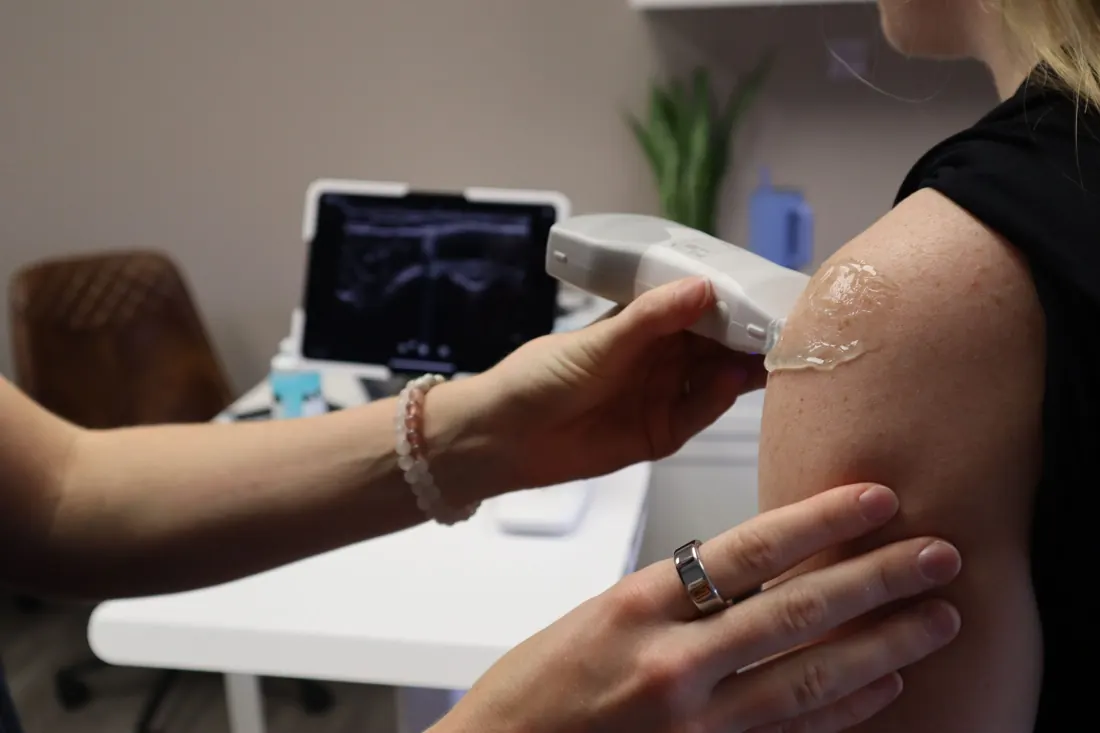
An examination looks for tenderness, swelling and the shape of the shoulder, and tests how the joint behaves when the arm is moved across the chest. X-rays of the shoulder are the standard test. They are taken with and sometimes without weight in the hand to see whether the gap between collarbone and shoulder blade widens, and they screen for fractures. Ultrasound can show ligament injury in real time, and MRI is used if other injuries such as a labral or cuff tear are suspected.
Treatment
Most AC separations, including many grade III injuries, are managed without surgery.
- Sling and protection. A sling is used briefly for comfort, usually days to a couple of weeks, since long immobilization causes stiffness.
- Cold and pain control. Ice and, if appropriate, over-the-counter pain relievers can help the first week. Check with a clinician if you have stomach, kidney or heart conditions.
- Motion, then strength. Therapy starts with gentle motion, moves to shoulder blade and rotator cuff strengthening, and finishes with sport-specific loading. See physical therapy after injury.
- Injection. A guided injection into the AC joint is sometimes used for persistent pain, particularly if arthritis develops later.
- Surgery. Considered for higher grades, for some grade III injuries in people whose work or sport involves heavy overhead or contact use, and for persistent pain or weakness despite rehabilitation. Procedures reconstruct the stabilizing ligaments, often with tendon graft or suture devices, and a painful arthritic joint can have the end of the collarbone trimmed. Ask us whether this is offered at the office nearest you. See shoulder arthroscopy for how some of this work is done.
Recovery ranges
Grade I and II injuries often settle over roughly two to six weeks, though soreness with heavy lifting or contact can last longer. Grade III injuries commonly need several weeks to a few months before full strength returns, and many people are left with a permanent bump that is cosmetic and causes no trouble. After a surgical reconstruction, a sling is typically worn for several weeks and a return to contact sport is generally not considered before about four to six months. Individual timelines vary with the grade, the demands of the sport and how closely rehabilitation is followed.
What a visit usually involves
Expect questions about how you fell, which way the arm was forced, and whether you felt a pop. The examination compares both shoulders, checks the collarbone and the nerves of the arm, and tests strength. If an emergency room or urgent care provided X-rays, bring the images rather than only the report, because a second look is often useful. Sport and work demands guide how aggressive the plan should be, so mention them early.
Long-term issues to know about
A small number of people develop persistent pain or arthritis in the AC joint years later, often felt as an ache with bench pressing, push-ups or reaching across the body. These can be managed with activity changes, therapy, injections or, rarely, a limited operation on the joint. Other shoulder pain after a fall may come from elsewhere, so see our pages on shoulder pain and sports injuries for other causes.
Being seen out-of-network or self-pay
Athletes and active adults often want an answer fast after a shoulder injury, and speed can run into insurance steps. Out-of-network and self-pay arrangements can mean a shorter path to an examination and imaging, though costs still vary and are worth clarifying up front.
Elite MD Care sees patients who use out-of-network benefits and patients who pay directly. Bring any urgent care or emergency room paperwork and X-ray images with you if you have them. Read how out-of-network visits and self-pay care work, estimate your own share with the out-of-network cost calculator, and see our sports medicine page.
Sources
- American Academy of Orthopaedic Surgeons, OrthoInfo. Shoulder Separation
- MedlinePlus (National Library of Medicine). Shoulder Injuries and Disorders
- National Institute of Arthritis and Musculoskeletal and Skin Diseases (NIH). Sports Injuries
This page is general health information and is not medical advice. It does not create a physician-patient relationship. Consult a qualified clinician about your own symptoms and treatment.