An Achilles tendon rupture is a partial or complete tear of the tendon at the back of the ankle, often with a sudden pop and difficulty pushing off. It needs prompt evaluation. Treatment may be a boot-based nonoperative program or surgical repair, chosen with your physician.
Many people who tear an Achilles describe the same moment: they thought someone had kicked the back of their heel, and no one was there. The injury often happens during a sudden push-off in a pickup game, and the shock of it is unforgettable. Speed matters in the first days, because the position of the foot in early treatment influences how the tendon heals.
What a rupture is
The Achilles tendon transmits the force of the calf muscles to the heel bone. A rupture happens when the tendon fibers fail, most often two to six centimeters above the heel, where blood supply is relatively limited. Tears can be partial or complete. In a complete rupture, the calf can no longer lift the heel normally, though some people can still point the foot using other muscles, which is why a tear can be missed.
Signs and symptoms
- A sudden pop or snap, sometimes with a sensation of being struck on the back of the leg.
- Sharp pain at the back of the ankle or calf that may ease quickly, leaving weakness rather than severe pain.
- Swelling and bruising at the back of the ankle and lower calf.
- A palpable gap above the heel.
- Inability to stand on tiptoe on the injured leg or to push off when walking.
Who is at risk and why
Ruptures cluster in men in their thirties to fifties who play intermittent sports such as basketball, tennis or soccer. Sudden acceleration, jumping and stepping into a hole all load the tendon. Previous Achilles pain, tendon degeneration, certain fluoroquinolone antibiotics, repeated or recent corticosteroid exposure, and some inflammatory or metabolic conditions raise risk. Not everyone has warning signs.
When to be seen, and when to go to the emergency room
Any suspected rupture should be assessed within a day or two. Rest the leg, avoid walking on it more than necessary, and use crutches if you have them. Early assessment helps a clinician choose between treatment paths while options are widest.
Go to an emergency room or call 911 if the injury came with a major fall or crash, the foot is cold, pale or numb, you cannot bear any weight, or an open wound is present. Calf swelling and tenderness with shortness of breath or chest pain can signal a blood clot in the leg or lung and also needs emergency care.
How it is diagnosed
Physical examination is highly informative. The clinician looks for a gap in the tendon, checks for loss of calf strength, and performs the Thompson test, squeezing the calf with you lying face down: the foot should point down, and failure to do so suggests a complete tear. Ultrasound can confirm the tear and its size and can be done at the visit. MRI is used if the diagnosis is uncertain, a partial tear is suspected, or the injury is old. X-rays rule out bone injury near the heel.
Treatment: nonoperative and surgical
Nonoperative care
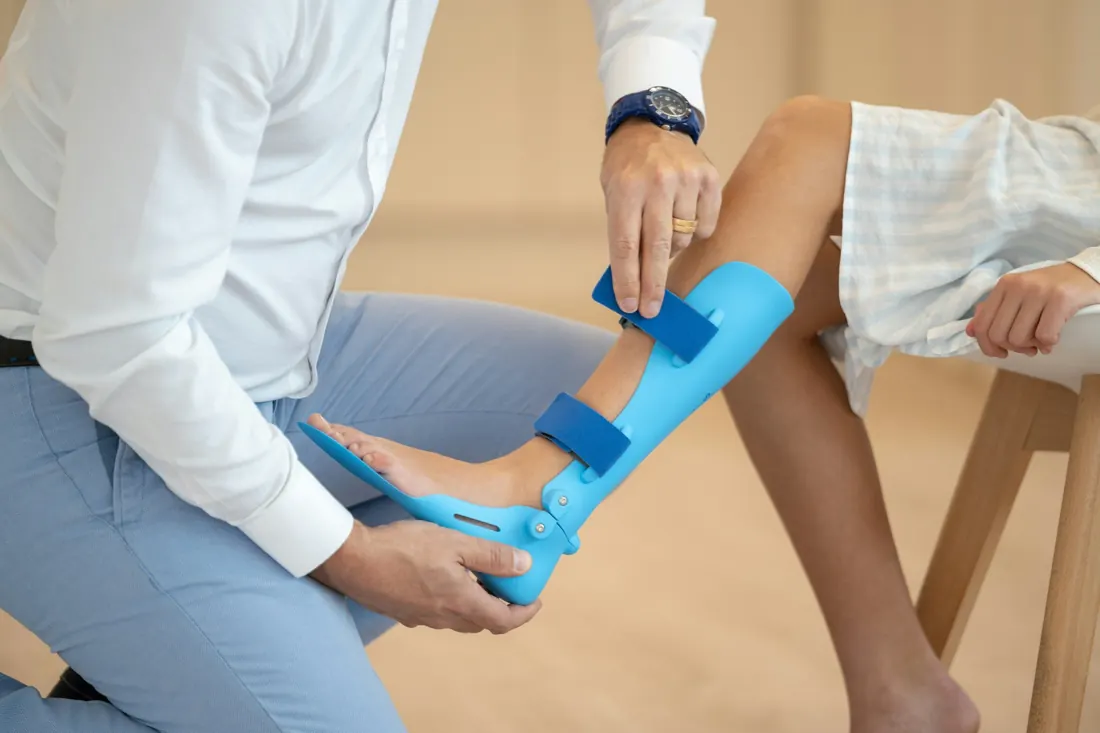
Treatment without surgery uses a boot with heel wedges that hold the foot pointed downward at first. The wedges are removed gradually over weeks as the tendon heals. It is guided by a structured early weight-bearing protocol and followed by physical therapy. Modern studies suggest that a carefully supervised nonoperative program can give outcomes similar to surgery for many people in terms of overall function, with differences in re-rupture risk and in how fully strength returns. Which approach suits a person depends on age, activity goals, timing and health factors.
Surgical repair
Surgery sews the torn ends together through an open or smaller incision. It is often discussed for younger, more active patients or athletes, for tears that have been present for some time, and for people who want the lowest chance of re-rupture, with the tradeoff of surgical risks such as wound healing problems, infection, nerve irritation and blood clots. Chronic or neglected tears may need tendon transfer or grafting.
Rehabilitation and recovery
Either route is slow. People typically wear a boot for about six to twelve weeks, with progressive weight-bearing, then work through therapy to restore ankle motion, calf strength and balance. Return to jogging often takes about four to six months, and a return to cutting sports commonly takes six to twelve months or longer. Calf strength can stay slightly reduced on the injured side for a long time. These are general ranges, and your own plan will depend on your physician and how your tendon responds.
Questions to bring to the visit
Because there is more than one reasonable path, it helps to arrive with priorities. Tell the clinician what you want to get back to and by when, whether you have had Achilles pain before, which medicines you take, and whether you have diabetes, smoke, or have a history of blood clots, since each changes the risk of either route. Ask about expected boot time, when walking is allowed, how your calf strength will be tested before sport, and what warning signs after treatment should prompt a call.
Ask also about blood clot prevention while you are less mobile. Some people are advised to move the toes and calf as allowed, and in higher-risk cases a clinician may discuss medication.
Reducing the risk of re-injury
- Follow your protocol for boot use and loading rather than speeding ahead because the leg feels good.
- Build calf strength and hop tolerance in stages before you return to sport.
- Warm up thoroughly, especially if you play only on weekends.
- Report early heel cord pain before it becomes a tear, as outlined under Achilles tendinitis.
More on sprains and tendon injuries appears under sports injuries and ankle sprain, which can look similar in the first hours.
Out-of-network and self-pay care
A rupture can involve urgent imaging, a boot, possible surgery and months of therapy. Elite MD Care is out-of-network and also sees self-pay patients, so you can understand how each step might be covered, or paid directly, before choosing a path.
Read about out-of-network benefits, how self-pay care works, and use the out-of-network cost calculator. See also sports medicine.
Sources
- American Academy of Orthopaedic Surgeons, OrthoInfo. Achilles Tendinitis
- MedlinePlus (National Library of Medicine). Foot Injuries and Disorders
- MedlinePlus. Tendinitis
- National Institute of Arthritis and Musculoskeletal and Skin Diseases (NIH). Sports Injuries
This page is general health information and is not medical advice. It does not create a physician-patient relationship. Consult a qualified clinician about your own symptoms and treatment.