An ankle sprain is a stretched or torn ligament, usually on the outer ankle after the foot rolls inward. Most sprains improve in weeks with protection, early movement and strengthening. Get an X-ray if you cannot bear weight or have bone tenderness, and see a specialist if the ankle keeps giving way.
Ankle sprains are among the most common injuries in athletes and non-athletes alike, from a basketball landing to a missed curb. They are often brushed off, which is part of the problem: a sprain that is treated casually and not rehabilitated is a leading cause of repeat sprains and a chronically unstable ankle.
What gets sprained
Ligaments are strong bands that connect bones and keep a joint stable. About 85 percent of ankle sprains involve the lateral ligaments on the outside of the ankle, injured when the foot rolls inward (an inversion injury). The anterior talofibular ligament is the most commonly torn. A "high ankle sprain," in which the ligaments between the two shin bones are injured, happens with forced outward rotation and takes longer to heal. Sprains on the inside of the ankle are less common and often come with a fracture.
Grades of sprain
- Grade I. Stretched ligament with mild swelling and tenderness. You can usually walk.
- Grade II. Partial tear with moderate swelling, bruising and pain, and some looseness. Walking is painful.
- Grade III. Complete tear with significant swelling and bruising and an unstable joint. Walking is difficult or impossible.
Symptoms
Pain, swelling and bruising around the ankle, tenderness over the ligaments, stiffness and difficulty putting weight on the foot. A pop at the time of injury is common. Because a fracture can look the same, the examination matters.
When an X-ray is needed, and when to go to the ER
Clinicians often use the Ottawa ankle rules: an X-ray is advised if there is pain near the ankle bones and you cannot take four steps right after the injury or in the evaluation room, or if there is tenderness over the back edge of the lower fibula or tibia, or over certain bones in the foot. Go to urgent care or an emergency room if the ankle looks deformed, if you cannot bear any weight, if the foot is numb, pale or cold, or if the pain is severe. A hot, red ankle with fever is also an emergency.
Diagnosis
The clinician examines swelling, palpates the bones and ligaments, and tests stability with maneuvers such as the anterior drawer and talar tilt tests, often more informative several days after swelling has eased. X-rays exclude fracture. MRI is reserved for severe injuries, suspected cartilage damage or high ankle sprains, or when pain persists beyond a few weeks. Ultrasound can assess ligaments in some settings.
Treatment
The first days
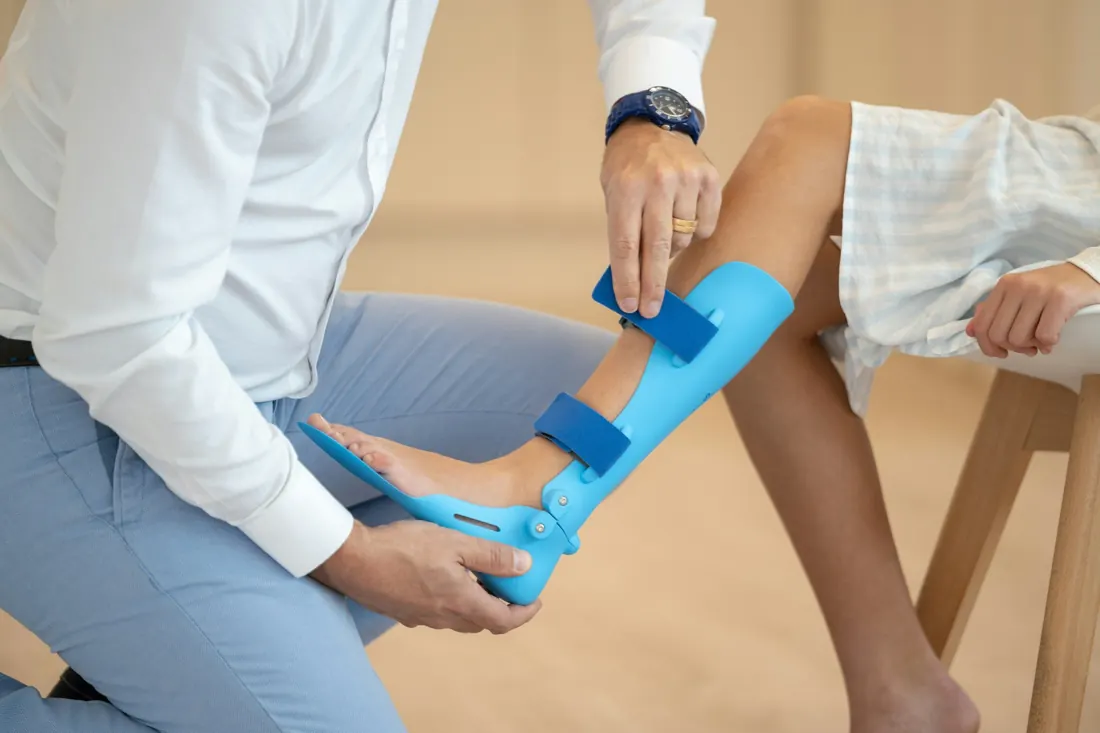
Protect the ankle, use relative rest with crutches if needed, apply ice, use compression and elevate the leg. Avoid prolonged immobilization, since early, gentle motion and weight bearing within comfort improve recovery. A brace, lace-up support or short-term walking boot may be used depending on severity. Over-the-counter pain relievers can help if safe for you.
Rehabilitation
Rehabilitation is the treatment that prevents the next sprain. It begins with restoring motion, then strengthens the muscles that support the ankle, especially the peroneals, then retrains balance and proprioception with single-leg standing and wobble boards, and ends with sport-specific drills. A physical therapist can guide the progression. Skipping this stage is a common reason the ankle remains weak.
Chronic instability and surgery
Some people continue to have repeated giving way, a feeling of looseness and recurring sprains after a lateral sprain, called chronic ankle instability. After a trial of rehabilitation and bracing, MRI can look for associated injuries such as peroneal tendon tears or cartilage lesions. Surgery to repair or reconstruct the lateral ligaments is considered when instability persists despite good non-surgical care, and arthroscopy may address cartilage or impingement. Acute surgery is uncommon but may be used for severe injuries in high-demand athletes or when a fracture accompanies the sprain.
Recovery in general terms
Mild sprains often feel better in one to three weeks, and moderate sprains in about four to eight weeks, with sport resuming after strength and balance are restored. Severe sprains and high ankle sprains can take several months. Some people continue to have stiffness or swelling for a while. These are general ranges, and the right timeline for you depends on the grade and your sport.
Preventing repeat sprains
Do the balance and strengthening exercises even after the pain is gone. Wear supportive shoes and consider a brace or taping during sport for the first months after an injury. Warm up before activity, avoid uneven surfaces when fatigued, and replace worn athletic shoes. Athletes with repeated sprains benefit from neuromuscular training programs.
High ankle sprains and other injuries that hide behind a sprain
A sprain that stays painful, or hurts more when the foot is rotated or the calf is squeezed, can be a syndesmosis (high ankle) injury, a small fracture, a tendon tear or a cartilage injury of the ankle bone. These are easy to miss when the problem is called a "bad sprain." If pain and swelling have not clearly improved after about two weeks, or you cannot push off the foot normally, a repeat examination and further imaging are reasonable.
A simple home progression
- Days 1 to 3: protect, ice, compress, elevate and walk as comfort allows.
- Week 1 to 2: ankle circles and alphabet motions, calf stretches and light band work.
- Weeks 2 to 6: heel raises, resisted eversion and single-leg balance, first on firm ground and then on softer surfaces.
- Later: hopping, cutting and sport drills once strength and balance feel equal to the other side.
Being seen out-of-network or self-pay
A sprain that is examined early, X-rayed if necessary and then rehabilitated properly is much less likely to turn into a chronic problem.
Elite MD Care sees patients who use out-of-network benefits and patients who pay directly. See how out-of-network visits and self-pay care work, read about sports medicine, and see our locations. Related reading includes sports injuries and plantar fasciitis.
Sources
- American Academy of Orthopaedic Surgeons, OrthoInfo. Sprained Ankle
- MedlinePlus (National Library of Medicine). Ankle Injuries and Disorders
- National Institute of Arthritis and Musculoskeletal and Skin Diseases (NIH). Sports Injuries
This page is general health information and is not medical advice. It does not create a physician-patient relationship. Consult a qualified clinician about your own symptoms and treatment.