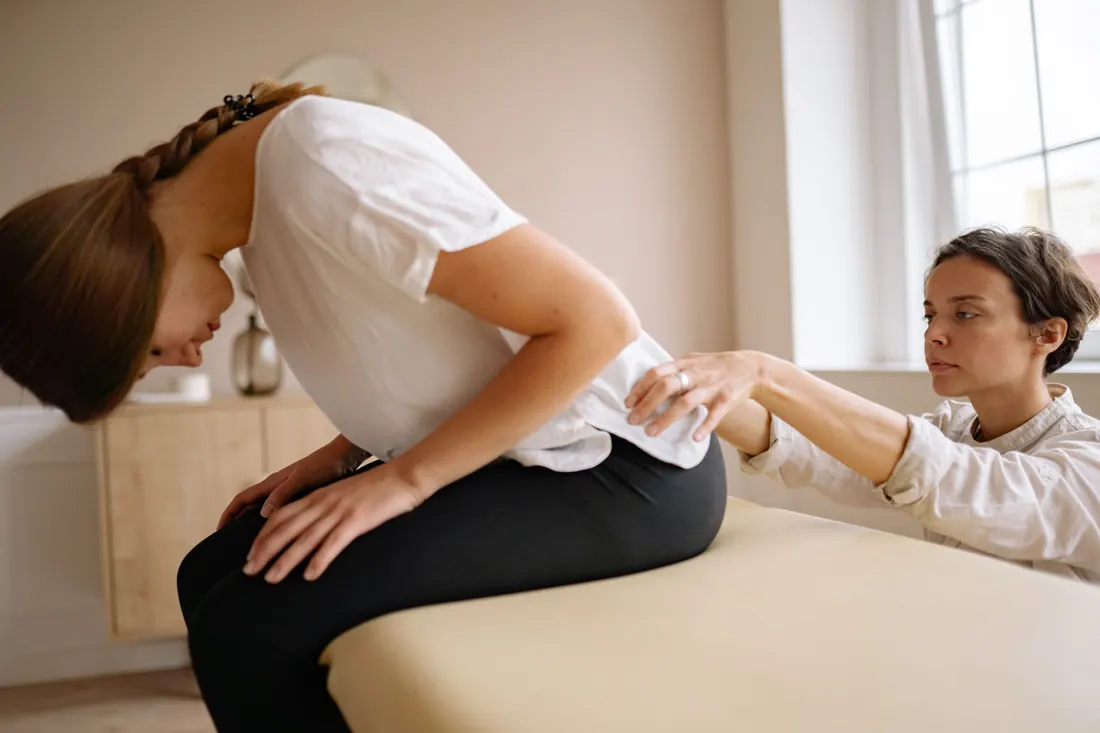
Lower back pain when sitting commonly comes from a worn or irritated disc, a herniated disc, the sacroiliac joint, or tight muscles around the hip and buttock. Pain that travels down the leg or comes with numbness points to a nerve. Loss of bladder or bowel control or numbness in the groin is an emergency.
The sitting problem, in plain terms
Standing and walking spread load through the spine and make the muscles work. Sitting, especially slumped, rounds the lower back, raises pressure inside the discs and keeps the same muscles tense for hours. For a back that is already irritated, that is enough to turn a quiet ache into pain. If sitting is your trigger, the pattern is useful. This page explains what it often points to and what to do about it. It is not a diagnosis. Only an exam can tell what applies to your back.
Likely causes when sitting is the trigger
A worn or irritated disc
Discs are the cushions between vertebrae. With age they lose water and height, a normal process that is sometimes painful. Degenerative disc disease often produces a deep central ache that builds with sitting, bending forward and long drives, and eases with walking or changing position.
A herniated disc
If the soft center of a disc pushes through its outer wall, a herniated disc may irritate a nearby nerve. Sitting often aggravates it, and the pain may spread into the buttock or leg, sometimes with tingling. Coughing and sneezing may sharpen the pain.
The sacroiliac joint
The sacroiliac joints link the base of the spine to the pelvis. Sacroiliac joint pain is typically felt low, to one side of the spine and in the buttock, and it often hurts when you sit on one side, stand from a chair or climb stairs.
Muscles around the hip and buttock
Tight hip flexors, weak gluteal muscles or a stiff piriformis can make sitting uncomfortable and refer pain into the buttock. This is a diagnosis of exclusion, made after the spine and joints are looked at. For general background on the broader topic, the lower back pain guide may help.
A few useful observations
- Which sits worse, a soft sofa or a firm chair? Soft seats tend to encourage slumping.
- Does standing up and walking for a minute relieve it? That favors disc or muscle related pain.
- Does the pain move into the leg? If it goes below the knee, a nerve root may be involved.
- Does coughing, sneezing or straining make it sharper? That raises the possibility of a disc.
- Is one side worse than the other? Think of the sacroiliac joint.
When sitting pain is not routine
Call 911 or go to an emergency room now for new loss of bladder or bowel control, numbness in the groin, genitals or inner thighs (saddle numbness), weakness or numbness in both legs, or leg weakness that is worsening quickly. These can be signs of cauda equina syndrome, which needs urgent treatment. Go as well for back pain with fever, back pain after a significant fall or accident, or back pain in someone with a history of cancer who also feels unwell.
Arrange an in-person evaluation within days for pain that wakes you from sleep, a foot that catches or drags, numbness that is spreading, or pain not improving after several weeks of sensible changes. Anyone with osteoporosis who has sudden back pain after a minor strain should also be examined promptly, because a vertebral compression fracture is possible.
What people commonly try first
- Stand up and walk for a few minutes every 30 to 45 minutes. Set a reminder if you forget.
- Adjust the chair so feet rest flat, knees are about level with the hips and the lower back is supported.
- Try a rolled towel or lumbar cushion at the small of the back and see whether it helps.
- Alternate sitting with standing, if your workplace allows it.
- Use heat for stiff muscles or ice after an aggravating day, whichever feels better.
- Take short walks daily. Gentle activity is generally preferred to bed rest.
Over-the-counter pain relievers are common but should be used only as labeled and only if they suit your health history.
Habits that tend to matter
Desk work is not harmful in itself, but long unbroken sitting is. People who commute by car and then sit at a desk can pass many hours with the lower back in the same bent position. Drivers are a special case, because vibration adds to the load. If you drive for work, check that the seat supports your thighs, keep the wheel close enough that your arms are not stretched, and take real breaks to walk. Body weight, smoking and low fitness are linked with more back pain, which is one reason general activity is so often part of the advice.
What a spine specialist checks
The clinician asks about the pain pattern, timing and leg symptoms, then watches how you stand, bend and walk. They test back motion, press along the spine and sacroiliac joints, check hip motion, and test strength, reflexes and sensation in the legs. Leg raising maneuvers, performed lying down, help tell whether a nerve root is irritated. A thorough exam of the hip is part of the visit, because hip problems can mimic back pain.
Imaging is not always needed in the first weeks if there are no red flags. Standing X-rays show alignment and disc space, and an MRI shows discs and nerves clearly. Imaging is more useful when pain has persisted, when there is leg weakness or numbness, or when a procedure is being considered. Many people without symptoms show disc changes on MRI, so the scan is interpreted alongside the exam.
Which specialist to see
Spine care is the natural fit, and pain management is useful when the pain is persistent and a procedure such as an injection is being considered. The which-specialist tool helps if you are unsure which door to try first.
Out-of-network and self-pay
If you have out-of-network benefits, read how out-of-network visits work. If you are paying yourself, see how self-pay care is handled. Both are worth reading before you book.
Sources
- American Academy of Orthopaedic Surgeons, OrthoInfo. Low Back Pain
- National Institute of Arthritis and Musculoskeletal and Skin Diseases (NIH). Back Pain
- MedlinePlus (National Library of Medicine). Back Pain
- American Academy of Orthopaedic Surgeons, OrthoInfo. Herniated Disk in the Lower Back
This page is general health information and is not medical advice. It does not create a physician-patient relationship. Consult a qualified clinician about your own symptoms and treatment.