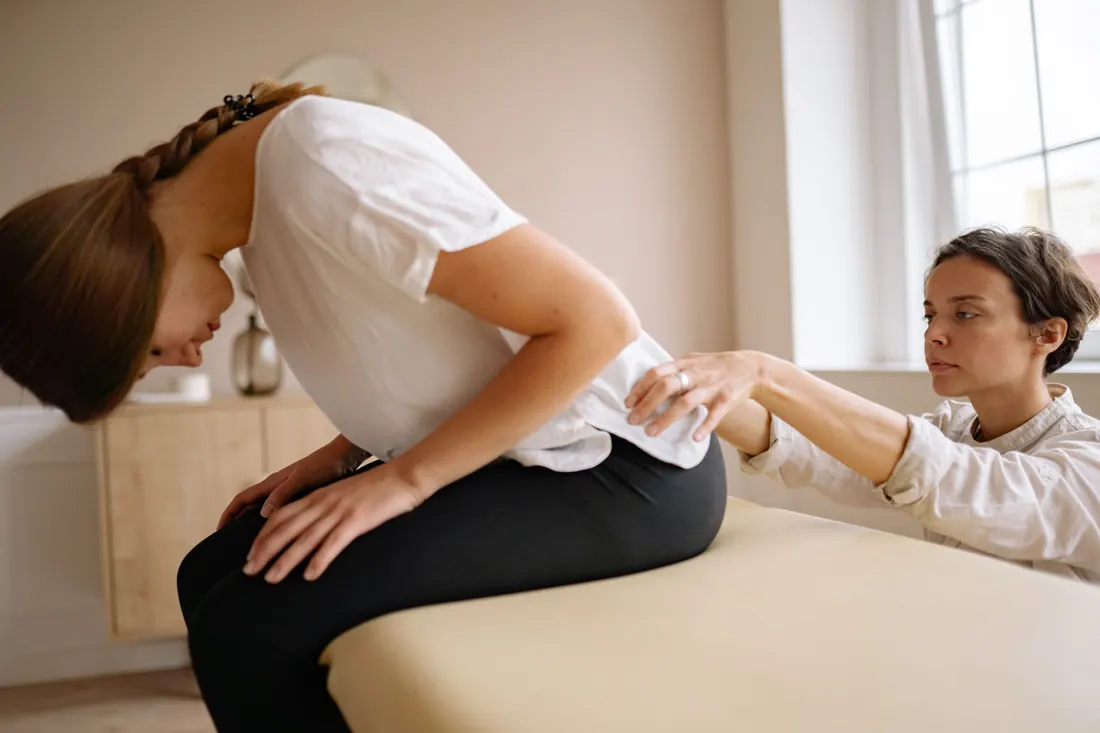
Back pain that grows with standing or walking, and eases when you sit or lean forward, most often comes from spinal stenosis, irritated facet joints or a vertebra that has slipped forward. Pain with new leg weakness, numbness in the groin or loss of bladder or bowel control is an emergency and needs the ER right away.
Standing puts the lower spine into a slightly arched position. That small arch narrows the openings where nerves leave the spine and loads the small joints at the back of each vertebra. If something in that area is already crowded or worn, an upright posture is what brings the pain on. Sitting or bending forward opens the space again, which is why many people feel relief on a stool or leaning on a shopping cart. This page describes common patterns. It is a guide, not a diagnosis.
Red flags before anything else
Go to an emergency room or call 911 for back pain with new numbness in the groin or inner thighs, trouble starting urination or controlling the bladder or bowels, or weakness in both legs. These can signal pressure on the nerves at the base of the spine, which needs urgent attention. Go too for back pain after a fall or crash, back pain with fever, or sudden severe pain with chest pain, shortness of breath or a pulsing feeling in the abdomen.
Arrange a visit within days if the pain is waking you from sleep, if one leg is getting weak or a foot catches on the floor, if you have a history of cancer or osteoporosis, or if you have lost weight without trying.
Why standing is the trigger
A few structures behave differently upright than seated. The canal that holds the nerves gets a little tighter. The facet joints, which guide motion, take more load. A vertebra that sits slightly out of line can shift forward. And the muscles that hold you up tire out after a period of standing still. Ask yourself three questions. How many minutes of standing does it take? Where does it go: low back only, buttocks, or down the legs? And what makes it ease: sitting, leaning forward, or just walking?
Common causes
Spinal stenosis
With spinal stenosis, the space around the nerves narrows with age through disc wear, thickened ligaments and bone spurs. The typical story is leg heaviness, cramping or tingling that builds with standing or walking and fades when you sit down or lean forward. Many people notice they can walk much farther with a cart.
Facet joint irritation
The small joints at the back of the spine can become sore from wear or strain. Facet joint syndrome tends to cause a deep ache on one or both sides of the low back that is worse with arching backward and with prolonged standing. It can refer into the buttock or upper thigh, usually not below the knee.
A slipped vertebra
In spondylolisthesis, one vertebra slides forward over the one beneath it. Standing and extending backward can bring on a catching or aching sensation, and some people feel a step or tightness in the hamstrings. It may be present from a stress fracture in youth or from wear later in life.
Disc wear
Degenerative disc disease reduces disc height, which changes how load passes through the spine. Pain may be mixed, worse with long standing and with some bending, and often comes in flares.
Muscle fatigue and posture
Not every case is structural. Weak core and hip muscles, a long workday on hard floors, or a recently increased activity level can produce an ache that settles when you rest. This is the least worrisome pattern, though a persistent one still deserves a look.
What people often try at home
- Shift weight regularly, or prop one foot on a low step or rail while standing, which flattens the arch a little.
- Take short walking or sitting breaks rather than staying in one position for a long time.
- Use supportive footwear and, if you stand on hard floors, a cushioned mat.
- Try heat or ice, whichever feels better, for short periods.
- Keep gently active. Long rest in bed tends to stiffen the back further.
Over-the-counter pain relievers are commonly used, always as labeled and only if safe for you given your other health conditions.
Daily habits that make it worse or better
Standing pain is often shaped by small details of the day. A hard floor, a counter that is too low so you stoop, or a habit of locking the knees all increase the arch of the lower back. Many people also notice more pain at the end of a work shift than at the start, or on days after a long drive. Keeping a short note for a week can be surprisingly useful. Record how long you stood, what you were doing, where the pain went and what relieved it. Bring the note to the visit. It helps the clinician separate a muscular ache from nerve-related symptoms, and it shows whether a change in routine is helping.
Weight carried at the front of the body, such as in pregnancy or with abdominal weight gain, can also increase the arch of the lower back. Core and hip strengthening, guided by a therapist, is a common part of care for these cases.
What a specialist looks at
The history usually does most of the work: how long you can stand, where the pain travels, what relieves it, and any leg symptoms. The exam covers posture, how the spine moves forward and backward, tenderness over the joints, hip motion, strength, reflexes and sensation, and how you walk. Some clinicians test how you feel after a short walk compared with sitting, since stenosis symptoms often show that difference.
X-rays taken standing can show alignment and a slipped vertebra. An MRI shows discs, nerves and the width of the canal and is generally ordered when symptoms are persistent, involve the legs or do not improve with care. Nerve testing may be added if the picture is unclear. Treatment is matched to the cause and can include guided therapy, activity changes, targeted injections or, for some people, a surgical consultation.
Choosing a specialist
Spine care is the best match for pain that spreads to the legs or changes with posture. Pain management helps when the main problem is a persistent ache that has not settled. If you are unsure, the which-specialist tool can point you to a starting place.
If you are out of network or paying yourself
Elite MD Care sees patients who do not use in-network benefits. Read about out-of-network visits if you plan to submit a claim, or self-pay care if you pay directly. Ask beforehand whether imaging is likely, because it is a separate item when you plan.
Sources
- American Academy of Orthopaedic Surgeons, OrthoInfo. Low Back Pain
- MedlinePlus (National Library of Medicine). Back Pain
- National Institute of Arthritis and Musculoskeletal and Skin Diseases. Back Pain
- MedlinePlus (National Library of Medicine). Spinal Stenosis
This page is general health information and is not medical advice. It does not create a physician-patient relationship. Consult a qualified clinician about your own symptoms and treatment.