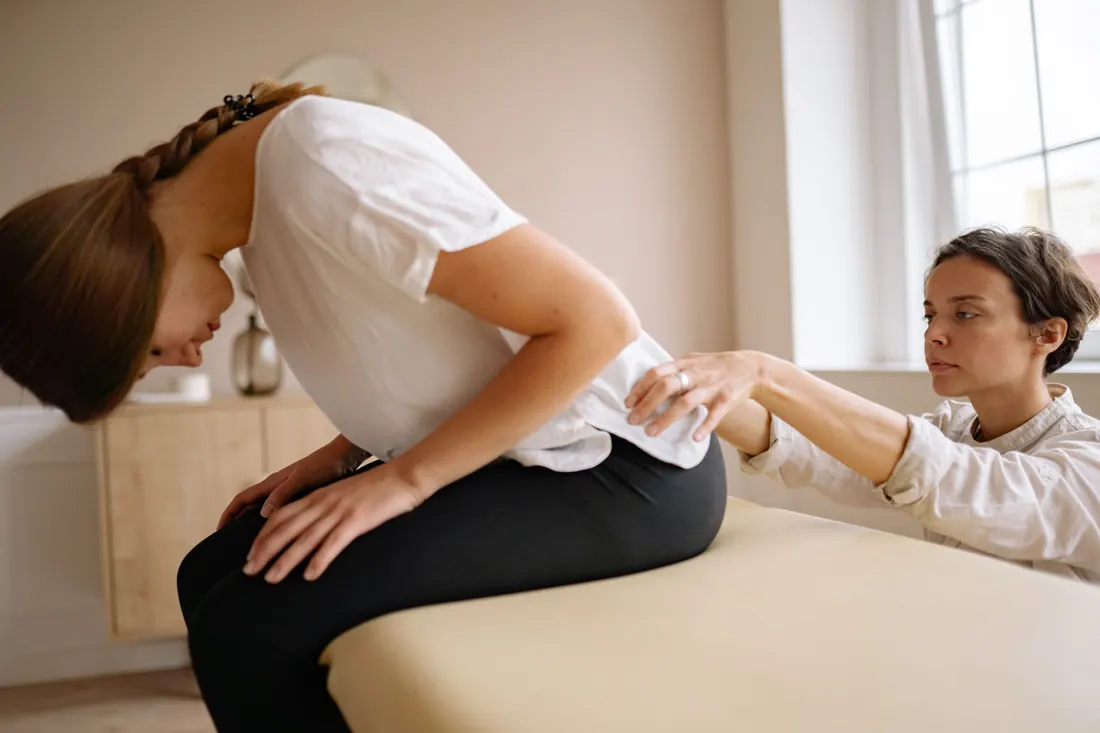
Back spasms are involuntary muscle contractions, often a protective response to a strained muscle, an irritated facet joint or disc, or heavy exertion. Most ease over days to weeks. Spasms with fever, leg weakness, numbness in the groin, bladder or bowel changes, or after major trauma are emergencies.
A back spasm can arrive without warning: you bend to pick up a sock and the lower back locks. The muscles along the spine tighten hard and may hold a bent or twisted posture. They feel rock-solid to the touch, and breathing or turning can make the pain jump. Often the spasm is the visible part of a smaller problem underneath. This guide explains the common triggers, what to watch for, and how a clinician looks at it. It is not a diagnosis.
Red flags to check against
Call 911 or go to an emergency room if spasms come with new trouble controlling the bladder or bowels, numbness in the groin or inner thighs, sudden leg weakness, fever with severe back pain, or after a car crash, serious fall or blow to the spine. Spasms with chest pain, trouble breathing, severe abdominal pain or a pulsing belly mass need emergency attention too, since pain from other organs can be felt in the back.
Be seen within days if spasms are recurring without a clear cause, if pain travels below the knee or the leg is numb or tingly, if you cannot stand upright after a few days, if pain is worse at night and at rest, if there is unintended weight loss, or if you have osteoporosis, a cancer history or long-term steroid use. Muscle spasm that does not ease in a couple of weeks should be examined too.
Common causes
Muscle strain
Lifting with a rounded back, twisting, a sudden awkward step or an unusual workout can strain the back muscles or ligaments. A strained muscle swells slightly and the surrounding muscles tighten to splint it. See also lower back pain for the broader picture, and our guide on back pain after lifting.
Facet joint irritation
The facet joints at the back of the spine can become inflamed from wear or an awkward movement, and nearby muscles spasm in response. Facet joint syndrome is typically worse with backward bending and twisting, and may have a one-sided pattern.
Disc problems
A bulging or herniated disc can irritate nearby nerves and lead to strong protective spasms. Pain may radiate into a buttock or leg, and coughing or sitting may worsen it.
Age-related spinal changes
Degenerative disc disease changes how the spine absorbs load. Muscles work harder to compensate, and spasms can flare after a long day or an uncommon activity.
Fatigue, dehydration and sustained posture
Long periods sitting, a deconditioned core and muscle fatigue make spasms more likely. Some people also notice spasms after heavy sweating or on days with little fluid. These are contributors, not usually the whole explanation, but they matter when spasms recur.
What people commonly try first
- Staying gently active, with short walks, instead of complete bed rest.
- Heat for muscle tightness, or ice in the first day or two if there is a sore spot.
- Changing position often and avoiding the twisting or lifting that set it off.
- Gentle stretches and slow movements as pain allows.
- Massage or physical therapy as the acute phase calms down.
- Over-the-counter pain relievers, used as labeled and if safe for you. Prescription muscle relaxants are a decision for a clinician.
Spasms typically calm over days to weeks, but recurrence is common. The aim after the flare is to work on the strength and mobility that make a repeat less likely.
Why spasms keep coming back
If a spasm repeats in the same spot, the muscle may be reacting to something it is guarding. Weak trunk and hip muscles, tight hips and hamstrings, a stiff mid back and long sedentary hours shift the work onto the lower back. An irritated joint or disc can keep the nerve supply to those muscles on edge. Treating only the muscle may give relief that fades. A clinician can look for the driver and suggest a plan for strengthening and movement that fits your body and job.
What a specialist checks
The clinician asks about the triggering event, the character and pattern of pain, leg symptoms, bladder and bowel function, fever and general health. The exam looks at posture, how you move, areas of muscle tightness and tenderness, spine and hip motion, and strength, reflexes and sensation in the legs. Straight-leg raise tests check for nerve irritation.
Many spasms do not need imaging in the first weeks. X-rays or MRI come into play when red flags are present, when symptoms persist, or when the exam suggests a specific cause such as a nerve root or fracture. Care is built around movement, therapy and, where appropriate, targeted injections or other procedures.
Getting through the first day
When a spasm hits, the instinct is to freeze. Slow breathing, lying on your back with knees bent over a pillow or on your side with a pillow between the knees often lets the muscles loosen enough to move. Getting up by rolling to the side first, and keeping loads close to the body, lowers the chance of a second clench. If you cannot find any comfortable position, cannot stand at all or the pain is escalating, do not wait it out.
Which specialist to see
Spine care is the best fit when the exam points to discs, joints or nerves, and pain management helps when pain recurs or persists. The which-specialist tool can help you decide.
Out-of-network and self-pay
The pages on out-of-network visits and self-pay care explain how billing works. If you are paying yourself, ask whether imaging is likely at the first visit.
Sources
- American Academy of Orthopaedic Surgeons, OrthoInfo. Low Back Pain
- MedlinePlus (National Library of Medicine). Back Pain
- National Institute of Arthritis and Musculoskeletal and Skin Diseases (NIH). Back Pain
- American Academy of Orthopaedic Surgeons, OrthoInfo. Herniated Disk in the Lower Back
This page is general health information and is not medical advice. It does not create a physician-patient relationship. Consult a qualified clinician about your own symptoms and treatment.