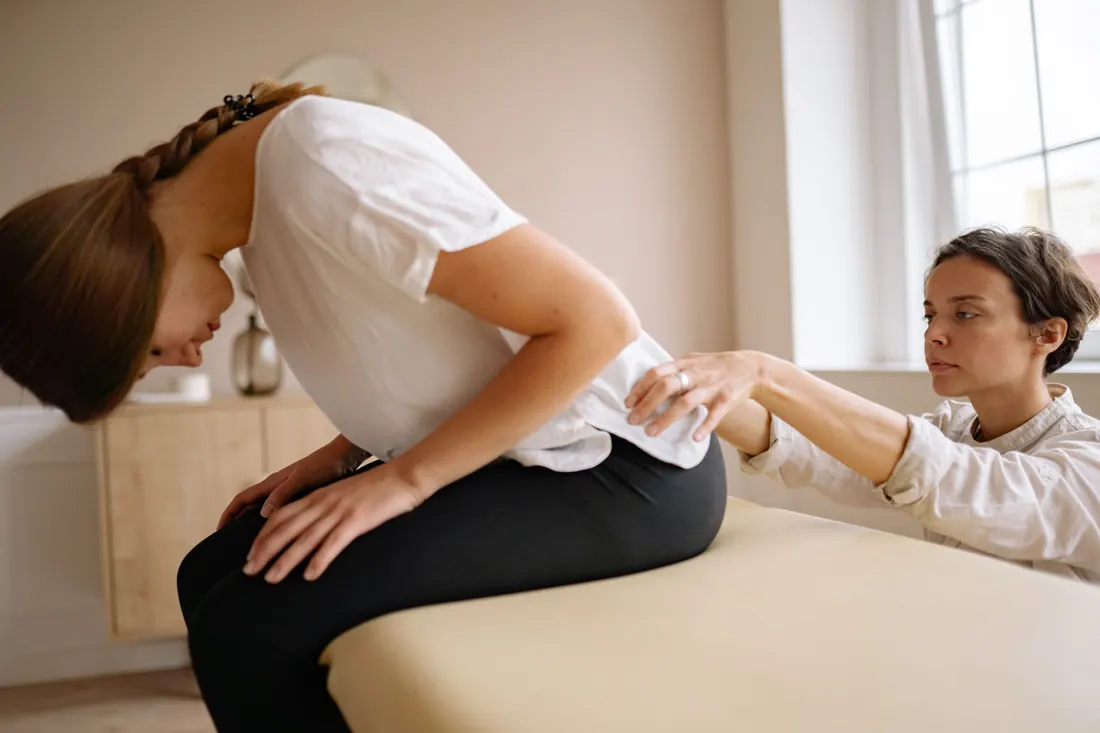
The sacroiliac (SI) joints connect the base of the spine to the pelvis. When they become irritated, pain is felt low in the back, often on one side and sometimes into the buttock or thigh. Many people improve with therapy and activity changes; targeted injections help some.
Low back pain has dozens of sources, and the sacroiliac joint is one that is easy to miss. It is often blamed too quickly and ruled out too quickly. Sorting out whether the SI joint is actually the culprit is most of the work.
Where the SI joints are and what they do
You have two sacroiliac joints, one on each side, where the sacrum (the triangular bone at the bottom of the spine) meets the iliac bones of the pelvis. They move only a little. Their job is to transfer load between the upper body and the legs and to absorb shock when you walk, climb stairs or run. Strong ligaments hold them in place, and they loosen somewhat during pregnancy.
What SI joint pain feels like
- A one-sided ache just below the beltline, often near the dimple over the back of the pelvis.
- Pain that can spread into the buttock, groin, hip or back of the thigh, usually stopping above the knee.
- Pain with standing up from a chair, climbing stairs, rolling in bed or standing on one leg.
- Stiffness after sitting for a long period, or discomfort when sitting on the affected side.
- A feeling that the pelvis is unstable or about to give way.
Pain that travels below the knee with numbness or tingling is more typical of a spinal nerve problem, which is why the two are sorted out during examination.
Common causes
Several things can irritate the joint: a fall onto the buttocks, a car crash, repetitive twisting or lifting, differences in leg length, a limp from a hip or knee problem, pregnancy and childbirth, and arthritis. Fusion of the lower lumbar spine can shift extra stress onto the SI joints next door. Inflammatory conditions such as ankylosing spondylitis can also affect them, particularly in younger people with morning stiffness that eases with movement.
When to be seen, and when to go to the emergency room
An appointment makes sense if pain lasts more than a few weeks, interferes with sleep or work, or returns repeatedly. Morning stiffness lasting over half an hour in a younger adult is worth mentioning, as is pain with eye redness or bowel symptoms.
Go to an emergency room or call 911 for loss of bladder or bowel control, numbness around the groin, new weakness in both legs, severe pain after a fall or crash, or low back pain with fever, chills or unexplained weight loss. Those are not typical for a sprained SI joint and need urgent assessment.
How it is diagnosed
No single test proves SI joint pain. Examination uses several provocation maneuvers, such as pressing on the joint, compressing the pelvis, or moving the hip in specific positions. When three or more reproduce the familiar pain, the joint becomes a more likely source. The physician also checks the hip and lumbar spine, since each can refer pain to the same area.
X-rays and MRI show arthritis, sacroiliitis and other structural clues, and rule out other problems, but they often look normal. The most direct test is a diagnostic injection of local anesthetic into the joint under X-ray or ultrasound guidance. If the usual pain drops sharply for a short time, the joint is confirmed as a main source.
Treatment from conservative to surgical
Conservative care
Treatment usually begins with relative rest from aggravating activities, ice or heat, and a short course of anti-inflammatory medication if it is suitable for you. Physical therapy then focuses on hip and core strength, gluteal activation and pelvic control. A pelvic support belt can help some people briefly. Correcting a leg-length difference with a shoe lift is considered when one is found.
Injections and nerve procedures
An image-guided corticosteroid injection into the joint may calm inflammation and give a window to participate in therapy. If relief returns each time but fades, treatment of the small nerves that supply the joint with radiofrequency ablation may be discussed. The response differs from person to person, and results can be temporary.
Surgery
SI joint fusion exists for carefully selected patients with confirmed joint pain who have not improved after a thorough trial of non-surgical care. It is an uncommon choice, and the decision depends on diagnostic evidence, not imaging alone.
What recovery usually looks like
Mild strains often settle over several weeks. Persistent cases improve more slowly and need a steady rehab plan. Relief after an injection may last days to months. Recovery after fusion takes weeks to months with activity limits. These are general ranges, not predictions for you.
What to expect at a first visit
Expect questions about when the pain began, what position or activity provokes it, whether you have had a fall, a pregnancy, or a spine procedure, and whether any morning stiffness or other joint symptoms are present. You will be asked to stand, walk, bend and lie on the table while the clinician presses and moves the pelvis and hips. Bring any previous imaging and a list of medicines. Often the plan is shaped by the first visit alone, with imaging added only if it will change the decision.
It also helps to bring a short description of your usual day, including how long you sit, drive or stand, because load and posture are a large part of why this joint stays irritated.
Related problems often confused with it
Pain in this region may also come from a lower back source, a hip joint problem or a sciatica-type nerve irritation. Naming the right one matters because the treatments differ.
Out-of-network and self-pay care for SI joint pain
Pain care can involve examination, imaging, diagnostic injections and therapy over several visits. Elite MD Care is out-of-network and also sees self-pay patients, which lets you weigh the likely steps against your plan benefits or your own budget before committing.
Learn how out-of-network billing works, read about paying directly, estimate reimbursement with the out-of-network cost calculator, or browse pain management.
Sources
- National Institute of Arthritis and Musculoskeletal and Skin Diseases (NIH). Back Pain
- MedlinePlus (National Library of Medicine). Back Pain
- American Academy of Orthopaedic Surgeons, OrthoInfo. Low Back Pain
This page is general health information and is not medical advice. It does not create a physician-patient relationship. Consult a qualified clinician about your own symptoms and treatment.