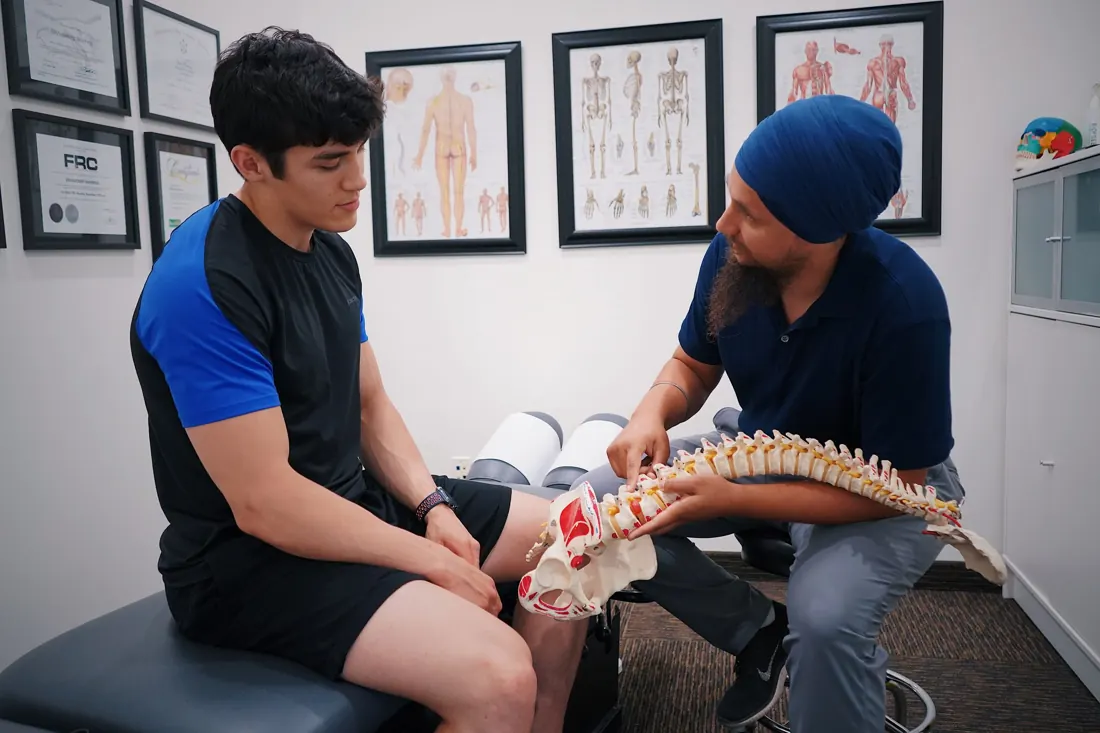
Degenerative disc disease is the gradual wear of the spinal discs with age. Despite the name, it is a normal process that causes pain in some people and none in others. Treatment focuses on exercise, therapy and medication, with injections or surgery reserved for pain that persists or nerve involvement.
The name sounds alarming, and it is misleading in two ways. It is not really a disease, and it does not always degenerate toward disability. Disc wear shows up on MRI in a large share of adults without any back pain, and its presence alone says little about how someone feels. The clinical task is to decide whether the discs are the source of your pain, and if so, what to do about it.
What changes in an aging disc
Each disc has a firm outer ring and a water-rich gel center. From young adulthood, discs slowly lose water and height. The outer ring can crack, the disc can bulge, and the neighboring joints and bone take more load, sometimes forming bone spurs. These changes are most common at the lower lumbar levels and in the lower neck, where the spine moves the most.
Symptoms
When degenerated discs hurt, the pain tends to follow some recognizable patterns.
- Aching in the low back or neck that comes and goes, with episodes lasting days to weeks.
- Pain that is worse with sitting, bending or lifting, and eased by walking or changing position.
- Stiffness, especially after rest or first thing in the morning.
- Pain into the buttock or thigh without true nerve symptoms.
When disc changes irritate a nerve, you may also have radiating pain, numbness or weakness, as in sciatica or a pinched nerve in the neck. If degeneration narrows the canal, it can cause spinal stenosis.
Emergency warning signs: loss of bladder or bowel control, numbness in the groin or saddle area, rapidly worsening leg or arm weakness, or back pain with fever or unexplained weight loss need prompt medical care.
Risk factors
Age is the main factor, and genetics play a large role. Smoking reduces the already limited blood supply to discs. Heavy physical work, repeated vibration, past spine injury and higher body weight can add load. Being inactive tends to make symptoms worse rather than better, because weak trunk muscles give the spine less support.
How it is diagnosed
Diagnosis begins with your history and a physical examination of movement, strength, reflexes and sensation. X-rays show reduced disc height, bone spurs and alignment. MRI shows disc hydration, tears and nerve contact in more detail and is typically reserved for persistent pain, nerve symptoms or when a procedure is being planned. In some cases, a diagnostic injection or discography is used to identify whether a specific level is generating the pain, though these tests are used selectively and read with caution.
Treatment, in the order it is usually tried
Self-management and rehabilitation
- Staying moving: walking, swimming and cycling are well tolerated by many people.
- Physical therapy for core, hip and back strength and for posture and lifting mechanics.
- Heat, short-term anti-inflammatory medication and, for some, other prescription options.
- Weight management and smoking cessation, which both support disc health.
Targeted procedures
If pain persists, image-guided injections may be used. Epidural steroid injections can help when a nerve is inflamed. Facet joint injections or radiofrequency ablation are options when the small joints behind the discs are generating pain. These aim to reduce pain enough to allow rehabilitation and do not reverse disc wear.
Surgery
Surgery is not the usual answer to disc degeneration alone. It is considered for nerve compression with persistent symptoms or weakness, or for selected people with severe, disabling pain localized to one or two levels after months of well-delivered non-surgical care. Options include discectomy, spinal fusion, and in selected cases artificial disc replacement in the neck or lower back. Fusion for pain alone has mixed results, so a careful, second-opinion-friendly discussion is worthwhile.
What to expect over time
Disc-related back and neck pain commonly improves over weeks, and flare-ups are common. Many people learn which activities trigger symptoms and manage them with a regular exercise routine. Recovery from procedures varies: after an injection, people often return to usual activity within days, while fusion recovery is generally measured in months. These are broad ranges, and individual results differ.
What the MRI report can and cannot tell you
Phrases such as disc desiccation, disc space narrowing, annular tear, bulge and Modic change appear often in reports. Many of these describe changes that are common in people with no pain. A report that lists several degenerated levels does not mean all of them are painful, and it does not by itself mean surgery is needed. Ask your clinician which findings match your symptoms and which are incidental. A second opinion on images, rather than on a written report alone, can be a sensible step before any invasive procedure.
Cervical and lumbar versions
In the neck, disc degeneration is often called cervical spondylosis and may cause stiffness, headaches and, when a nerve root or the cord is involved, arm symptoms or balance changes. In the lower back it can cause local aching or contribute to nerve irritation. The same principles apply in both regions: stay active, strengthen the muscles that support the spine and escalate care only when symptoms and findings justify it.
Being seen out-of-network or self-pay
Because many people have disc wear that is not the real source of their pain, a clear explanation of what your imaging does and does not mean is valuable, particularly before a procedure.
Elite MD Care sees patients who use out-of-network benefits and patients who pay directly. Find out how out-of-network visits work or how self-pay care works, explore spine care, and check locations near you.
Sources
- National Institute of Arthritis and Musculoskeletal and Skin Diseases (NIH). Back Pain
- American Academy of Orthopaedic Surgeons, OrthoInfo. Herniated Disk in the Lower Back
- American Academy of Orthopaedic Surgeons, OrthoInfo. Cervical Spondylosis (Arthritis of the Neck)
- MedlinePlus (National Library of Medicine). Back Pain
This page is general health information and is not medical advice. It does not create a physician-patient relationship. Consult a qualified clinician about your own symptoms and treatment.