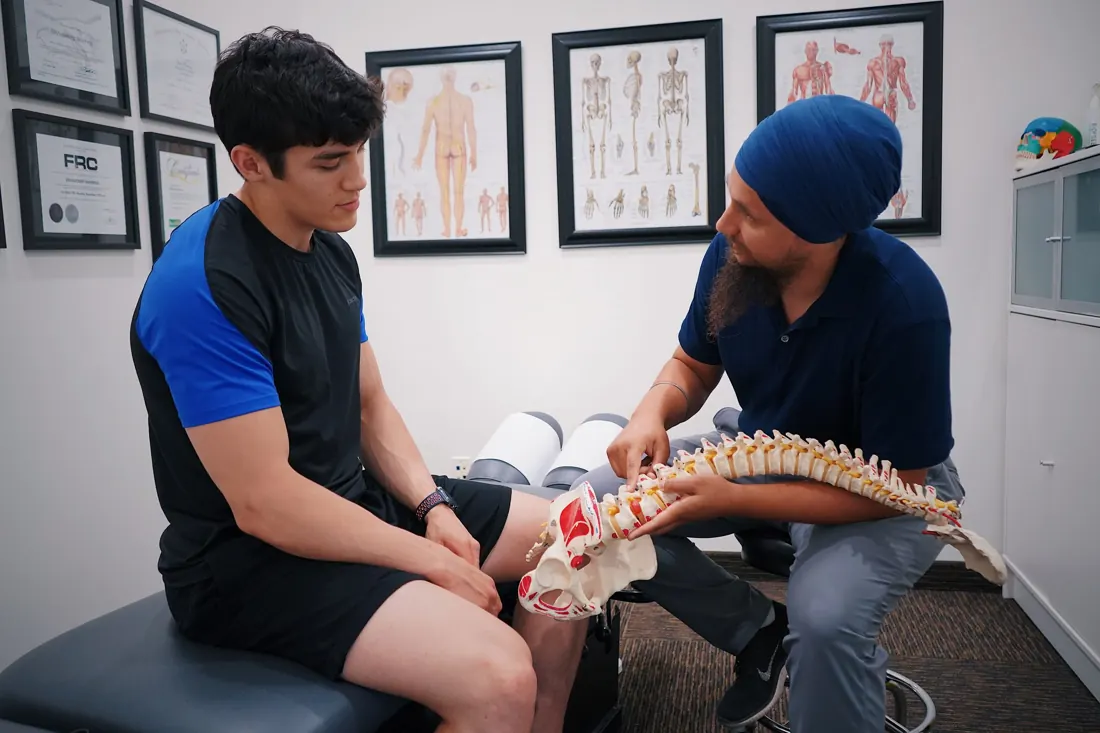
Scoliosis is a sideways curve of the spine of more than ten degrees, measured on X-ray. Most curves are mild and are watched over time. Bracing may be used in growing adolescents, and surgery is for larger or progressing curves. Adults may also have pain from curve-related arthritis.
A spine viewed from behind should look straight. In scoliosis it bends to one side, and the vertebrae often twist as well, which can make a shoulder, shoulder blade or hip look uneven. Many people with scoliosis never need treatment, while others need careful tracking or an operation. What matters is the age of the patient, the size of the curve and whether it is changing.
What scoliosis is
Doctors define scoliosis as a curve measured at more than ten degrees on a standing X-ray, using the Cobb angle. Most cases in children and teenagers are idiopathic, meaning no specific cause is found, and are most often discovered in the early teen years during growth. Other forms include congenital curves, present from birth, and neuromuscular curves related to conditions affecting nerves and muscles. In adults, curves can persist from adolescence or arise from degeneration of discs and joints, called degenerative or de novo scoliosis.
Signs and symptoms
- One shoulder, shoulder blade or hip that looks higher or more prominent.
- A waist that looks uneven, or clothes that hang unevenly.
- A rib hump when bending forward, which screening exams look for.
- In adults, back pain, stiffness or fatigue after standing.
- Leg pain, numbness or weakness if the curve narrows the space for nerves.
Adolescent curves usually do not hurt, so pain in a young person should prompt a closer look for another cause.
Causes and risk factors
Idiopathic scoliosis tends to run in families, and girls are more likely than boys to have curves that progress. Rapid growth raises the chance of progression. In adults, disc and facet joint wear on one side of the spine, osteoporosis and previous spine surgery can lead to or worsen a curve.
When to see a specialist, and when to go to the emergency room
See a specialist if a curve is noticed, if a school or pediatric screening flags one, or if an adult develops new back or leg pain with a visible curve. Early assessment allows monitoring during growth.
Go to an emergency room or call 911 for new weakness or numbness in the legs, loss of bladder or bowel control, numbness in the groin, back pain with fever or unexplained weight loss, severe back pain after significant trauma, or trouble breathing. A sudden change in a known curve with neurological symptoms also needs urgent attention.
How it is diagnosed
The physical exam includes the forward bend test, checking for a rib prominence, along with posture, leg lengths, reflexes, strength and skin findings. A standing full-spine X-ray measures the curve and shows its shape and the maturity of the bones. MRI is used when the curve is atypical, painful, rapidly progressing, associated with neurological findings, or when surgery is planned. In adults, imaging also looks for arthritis, slippage and narrowing over the nerves.
Treatment: observation, bracing and surgery
Observation
Mild curves in growing teenagers are usually followed with exams and X-rays every few months to a year, because most will not need treatment. Adults with mild curves and little pain are followed less often.
Bracing and exercise
For adolescents who are still growing and have moderate curves, a brace may reduce the chance of the curve worsening. Its benefit depends on wearing it as prescribed. Specialized physical therapy may be used alongside, and general fitness is encouraged. Bracing does not typically straighten a curve, and it is not used to treat adult curves.
Pain care in adults
For adults, treatment aims at pain and function: core and hip strengthening, low-impact exercise, anti-inflammatory medication if suitable, and image-guided options such as an epidural steroid injection or facet joint injection when a specific pain source is identified. These ease symptoms but do not change the curve.
Surgery
Spinal fusion, described under spinal fusion, is considered for large or progressing curves, usually in adolescents above about forty-five to fifty degrees, and for adults with disabling pain or nerve compression that has not improved with non-surgical care. Surgery uses rods and screws and bone graft to correct and hold the curve, with a hospital stay of several days. It carries real risks, and the decision is made carefully with the family or patient.
What recovery usually looks like
Observation and bracing run over years during growth. After fusion, people often return to school or desk work within a few weeks to a few months, and to contact sports later, with full recovery taking up to a year. Adults often have a longer recovery. These are general ranges and depend on the extent of surgery and your health.
Living with a spinal curve
- Stay active: swimming, walking and strength training are encouraged.
- Keep follow-up appointments, since growth spurts change the plan.
- Adults should maintain bone health, which supports the spine.
Related conditions include spinal stenosis and lower back pain, both common in adults with curves.
What to expect at a first visit
For a young person, expect a posture and forward-bend exam, a check of growth stage, and standing X-rays if a curve is suspected. Parents should bring prior school screening notes and previous films. For an adult, expect questions about when the curve was found, current pain, walking tolerance and leg symptoms, and a review of any earlier spine surgery. Because decisions depend on change over time, bring old X-rays so curves can be compared with the same measuring method.
Out-of-network and self-pay care
Scoliosis care can mean repeated exams and X-rays over time, with therapy or procedures as needed. Elite MD Care is out-of-network and welcomes self-pay patients, so families and adults can plan around benefits or a direct payment.
See how out-of-network visits work, how self-pay is handled, try the out-of-network cost calculator, and learn about spine care.
Sources
- National Institute of Arthritis and Musculoskeletal and Skin Diseases (NIH). Scoliosis
- MedlinePlus (National Library of Medicine). Scoliosis
- MedlinePlus. Back Pain
This page is general health information and is not medical advice. It does not create a physician-patient relationship. Consult a qualified clinician about your own symptoms and treatment.