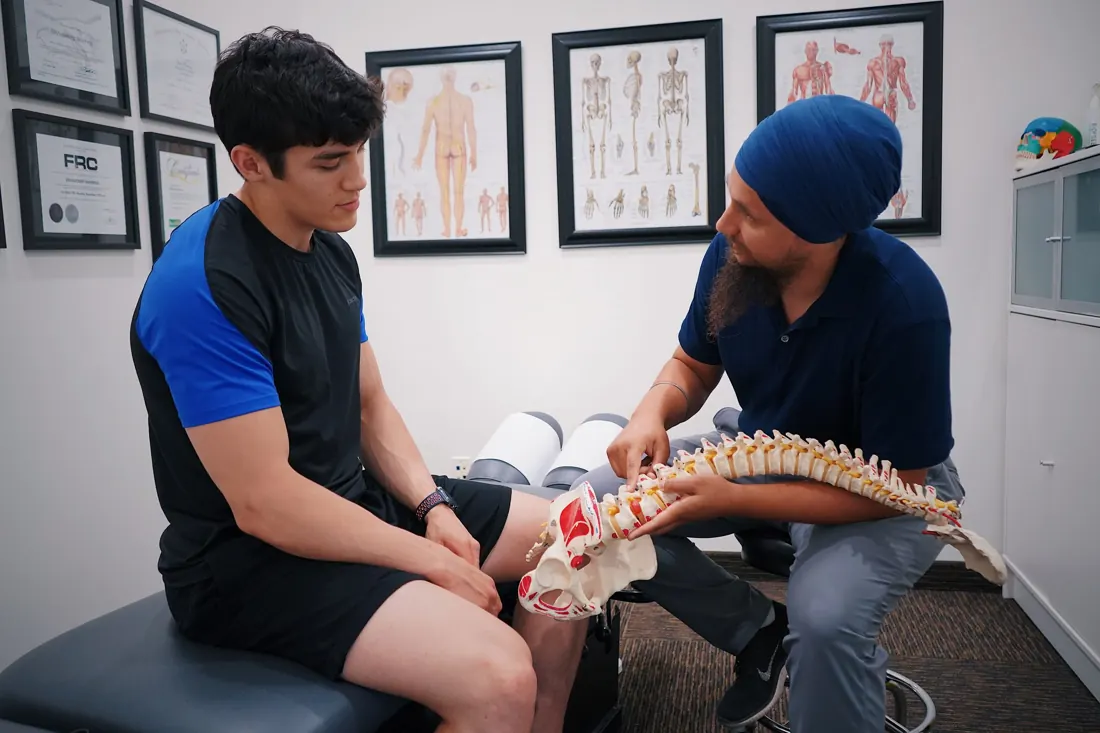
A bulging disc is a spinal disc that extends past its normal edge without a full tear of its outer wall. Many bulges cause no symptoms. When one presses on a nerve it can cause back or neck pain and arm or leg symptoms, and most people improve with non-surgical care.
"Bulging disc" is one of the most frightening phrases in an MRI report, and one of the least informative. Whether it matters depends on where it is, how big it is and, most of all, whether it matches your symptoms.
Bulge, protrusion and herniation
Each disc has a tough outer ring and a softer, gel-like center. In a bulge, the disc extends evenly beyond the edge of the vertebrae, often around a wide part of its circumference, while the ring stays intact. A herniation is more focal and involves a tear through which the center can push. Radiologists and clinicians do not always use these words in the same way, so the label on a report is less important than the nerve findings. If a bulge presses on a nerve root, symptoms can resemble those of a herniated disc.
What a bulging disc can feel like
- Dull or achy low back or neck pain, worse with sitting, bending or lifting.
- Pain that travels into a buttock, leg, shoulder or arm when a nerve is irritated.
- Tingling or numbness in a specific part of the limb.
- Weakness, such as a foot that catches or a weaker grip.
- No symptoms at all, discovered by accident on imaging.
When leg pain is the main feature, see sciatica.
Why discs bulge
Discs lose water and flexibility with age, the rings weaken and the disc can spread outward. Repetitive heavy lifting, twisting, long hours of sitting or driving, higher body weight, smoking and genetics play a role, and an injury such as a fall can bring on a bulge. Bulges are common in people who feel fine. Studies of adults with no back pain show that a large share have bulging discs on MRI, which is why scans are interpreted with the exam instead of on their own.
Urgent warning signs
Go to an emergency room or call 911 for loss of bladder or bowel control, numbness in the groin or inner thighs, weakness or numbness in both legs, rapidly worsening leg weakness, or severe back pain after significant trauma or with fever or a history of cancer. For the neck, trouble walking, clumsy hands or weakness in both arms with neck pain also calls for urgent attention. These can signal serious nerve compression, infection or other disease.
Arrange to be seen within days if pain travels below the knee or into the hand with numbness or weakness, if pain wakes you at night and is not related to position, or if symptoms are worsening quickly. Back or neck pain without those features can often be managed with self-care for a few weeks, and booking an evaluation after about four to six weeks without improvement is reasonable.
How it is diagnosed
The examination matters most: reflexes, strength, sensation, how the spine moves and whether stretching a nerve reproduces your leg or arm pain. MRI shows discs and nerves well and is typically reserved for symptoms that persist, are severe or involve weakness. CT or X-rays show bone alignment and changes. Electrodiagnostic testing can help sort out whether a nerve is truly affected. See MRI for back pain to understand what a scan can and cannot tell you. The goal is to match imaging findings to a symptom pattern instead of treating the picture alone.
Treatment, from conservative to surgical
First steps
- Staying active within comfort, since prolonged bed rest does not help.
- Heat or ice, short walks, and changes to how you sit, lift and sleep.
- Physical therapy for core and hip strength, posture and nerve mobility.
- Medication tailored to your history. Nerve pain responds differently from muscle pain, so ask your clinician.
Procedures
If pain is severe or keeps you from therapy, an image-guided epidural steroid injection may calm an irritated nerve for a period of time, and a selective nerve root block can help pinpoint the painful level. Neither removes the bulge, and relief varies.
Surgery
Surgery is rarely needed for a bulge alone. It is considered if leg or arm pain persists despite appropriate non-surgical care, if weakness is progressing, or in an emergency. Options include removing the part of the disc pressing on a nerve, widening the space around the nerve, and in selected neck or back cases fusing or replacing a disc. Ask us whether specific procedures are offered at the office nearest you.
Recovery in general terms
Many people with disc-related pain feel clearly better within about six to twelve weeks, often without procedures. Injection relief ranges from days to months. After surgery for nerve compression, leg or arm pain commonly eases early, while return to desk work takes days to weeks and to heavy labor longer. These ranges vary by cause, job and health, and your physician can estimate yours.
Protecting your back over time
- Break up long sitting with short movement breaks.
- Lift with your legs, keep loads close and avoid twisting while carrying.
- Build trunk and hip strength once pain allows.
- Quit smoking, which is linked with faster disc degeneration.
Reading your MRI report
Reports use words such as bulge, protrusion, extrusion, annular tear and degeneration, and several of them appear in people with no pain. Ask which level is involved, whether a nerve root or the spinal cord is touched, and whether that level fits the area where you feel symptoms. If the answer to the last question is no, the disc may be a bystander, and other sources such as the facet joints, the sacroiliac joint or muscles deserve attention. A mismatch between the scan and your pain is common and is not a sign that anything was missed.
Out-of-network and self-pay questions
Disc pain often runs through an exam, an MRI, therapy and sometimes an injection, so it helps to know how each step is handled. Elite MD Care sees patients who use out-of-network benefits and patients who pay directly. Read about out-of-network care and self-pay care, use the out-of-network cost calculator to plan, and learn about spine care.
Sources
- American Academy of Orthopaedic Surgeons, OrthoInfo. Herniated Disk in the Lower Back
- MedlinePlus (National Library of Medicine). Herniated Disk
- National Institute of Arthritis and Musculoskeletal and Skin Diseases (NIH). Back Pain
This page is general health information and is not medical advice. It does not create a physician-patient relationship. Consult a qualified clinician about your own symptoms and treatment.