A high ankle sprain is an injury to the ligaments that bind the two lower leg bones together just above the ankle. It causes pain above the joint, pain when pushing off or twisting, and often a longer recovery than a usual sprain. Stable cases use a boot and rehab, while unstable ones need surgery.
Most ankle sprains involve ligaments on the outer side of the ankle and heal in a few weeks. A high ankle sprain is a different injury with a different timeline. It tends to hurt higher on the leg, it is easy to under-treat, and it is a common cause of an athlete who is "still not right" a month after a sprain.
What is injured
The shinbone (tibia) and the thinner bone beside it (fibula) are held together just above the ankle by a group of ligaments called the syndesmosis. These ligaments keep the bones snug around the top of the ankle so it works like a mortise. A high ankle sprain occurs when forceful outward rotation of the foot, or the foot planted while the body twists, stretches or tears these ligaments. Sometimes the fibula is also fractured or the deltoid ligament on the inner ankle is injured. Football, hockey, skiing, soccer and basketball are common settings, but a slip on stairs can do it too.
How it differs from a regular sprain
- Pain is above the ankle joint, often along the front between the two bones, instead of mainly below the outer ankle bone.
- There may be less swelling and bruising than expected for the amount of pain.
- Pushing off, running, cutting, squatting and going up stairs hurt.
- Squeezing the lower leg bones together or twisting the foot outward reproduces the pain.
- Walking may be possible but feels unstable or sore in a way that does not follow the usual pattern of improvement.
- Recovery is often slower than for a typical outer ankle sprain.
See ankle sprain for the common pattern.
Grades and stability
Doctors consider whether the injury is mild with intact stability, partial, or a complete disruption in which the two bones can spread apart. Stability is the key question, because an unstable syndesmosis that is not corrected can lead to chronic pain and, over time, to arthritis. Imaging and sometimes stress testing are used to decide.
When to go to the ER, and when to book within days
Go to an emergency room or call 911 if the ankle is visibly deformed, if you cannot bear any weight, if the foot becomes numb, cold or blue, or if there is an open wound. A fracture, a dislocation or a circulation problem needs prompt care. A look at the ankle fracture page explains why swelling with inability to walk matters.
See a specialist within days if pain sits above the ankle after a twisting injury, if you cannot push off or hop, if swelling continues beyond about a week, or if the ankle feels like it is spreading or shifting. A sprain that has not clearly improved by about two weeks should also be reassessed. Early diagnosis helps because the treatment path depends on whether the syndesmosis is stable.
How it is diagnosed
The examination uses specific maneuvers: squeezing the leg above the ankle, rotating the foot outward while the leg is held steady, and a single-leg hop or heel raise if tolerated. X-rays, usually with weight bearing, look for fractures and for widening between the bones. Comparing with the other ankle may help. MRI shows ligament tears and bone bruising, and CT can measure small differences in how the bones line up. Sometimes a stress X-ray or a test done under anesthesia is used when stability is uncertain.
Treatment, from conservative to surgical
Stable injuries
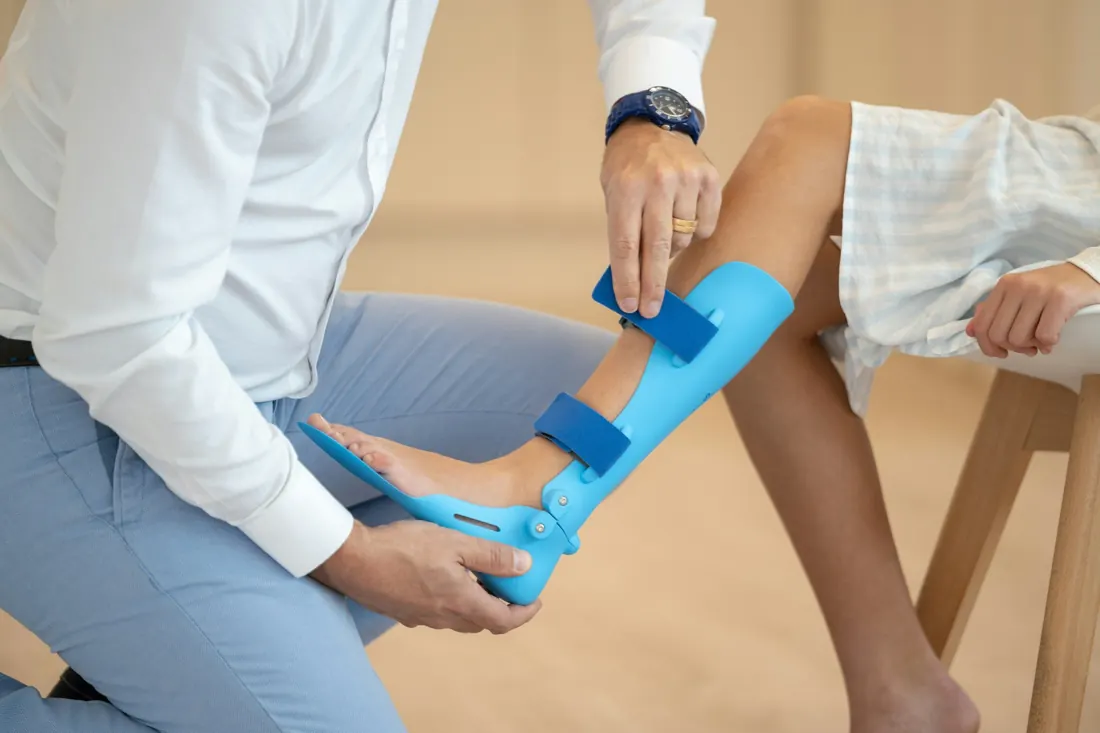
- Protection in a walking boot or brace, with crutches until walking is comfortable.
- Ice, elevation and compression for swelling.
- Pain relief with over-the-counter medication when it is safe for you.
- A progression from gentle motion to balance, strength and sport-specific work with a therapist. See physical therapy after injury.
Unstable injuries
If the bones spread apart or the ankle is clearly unstable, surgery stabilizes them while the ligaments heal. A screw or a flexible suture button device holds the bones in proper position. Sometimes a fracture is fixed at the same time, and arthroscopy may be used to look inside the joint (see ankle arthroscopy). Screws may be removed later in some cases. Ask us whether specific procedures are offered at the office nearest you. Risks include stiffness, infection, hardware irritation and persistent pain.
Recovery in general terms
A stable high ankle sprain commonly takes longer than a lateral sprain: many athletes are out for several weeks to a couple of months, and some need longer. After surgery, weight bearing is typically delayed for several weeks, with a return to sport frequently considered at about three to six months. Swelling and stiffness may linger. These are rough ranges, and your clinician will set milestones based on strength, balance and the demands of your sport.
Coming back safely
- Return to cutting and jumping only when you can hop and push off without pain.
- Work on balance and calf strength, not only the injured area.
- Consider taping or bracing for the first season back, if your clinician advises it.
- Report persistent pain above the ankle that does not improve with time.
Questions worth asking at your visit
Ask whether the bones above the ankle are stable on your imaging, whether a stress test is needed, what weight-bearing is safe this week, and which milestones will signal readiness to run and cut. Bring details of how the injury occurred, including which way the foot turned, and mention any earlier ankle sprains, since repeated injuries change both the exam and the plan. If you play a sport with a season, tell the clinician what dates matter, so that the options can be weighed honestly against the likely timeline.
Out-of-network and self-pay
A high ankle sprain can mean imaging, a boot, several rehab visits and sometimes surgery, so the cost path is not obvious at the start. Elite MD Care sees patients who use out-of-network benefits and patients who pay directly. Read about out-of-network care and self-pay care, use the out-of-network cost calculator, and learn about sports medicine. If swelling is the main issue, see ankle swelling after injury.
Sources
- American Academy of Orthopaedic Surgeons, OrthoInfo. Sprained Ankle
- MedlinePlus (National Library of Medicine). Ankle Injuries and Disorders
- MedlinePlus (National Library of Medicine). Strains and Sprains
This page is general health information and is not medical advice. It does not create a physician-patient relationship. Consult a qualified clinician about your own symptoms and treatment.