Ankle arthroscopy uses a small camera and thin instruments through tiny incisions to look inside the ankle and treat problems such as loose fragments, scar tissue, impingement or some ligament and cartilage injuries. It is generally considered after nonsurgical care has not worked. Recovery ranges from days to months depending on what is done.
Some ankle problems persist long after the original sprain or injury, with swelling, catching, pain with certain movements, or a joint that gives way. Imaging shows part of the story, but the inside of the joint can be seen and treated directly with a camera. That is ankle arthroscopy.
What the procedure is
MedlinePlus describes ankle arthroscopy as surgery that uses a tiny camera and surgical tools to examine or repair the tissues inside or around the ankle. The camera, called an arthroscope, is passed through a small incision and connected to a video monitor so the surgeon can see cartilage, bone, tendons and ligaments. Additional small incisions let other instruments in to repair or remove damaged tissue. Compared with open surgery, MedlinePlus says you may have less pain and stiffness, fewer complications and a faster recovery, though your surgeon may need to convert to open surgery if there is a great deal of damage.
What it can address
MedlinePlus lists the following reasons for ankle arthroscopy:
- Ankle pain, where arthroscopy lets the surgeon explore the cause.
- Ligament tears, which may be repaired or cleaned up.
- Impingement, in which swollen or overgrown tissue limits motion.
- Scar tissue after an injury.
- Arthritis, where it may help reduce pain and improve movement in some cases.
- Cartilage injuries.
- Loose fragments of bone or cartilage that can make the joint lock up.
It is not a cure for advanced ankle arthritis, and large reconstructions may call for open techniques.
Who is generally considered
Candidates are people with a diagnosed problem inside the joint that explains their symptoms and who have not improved with nonsurgical care. Many start as an ankle sprain that never fully settled, or a past ankle fracture. If your symptoms are what brought you here, ankle swelling after injury and ankle pain after running describe common patterns.
AAOS notes that nearly all isolated low ankle sprains can be treated without surgery, and that surgery is rare, reserved for injuries that do not respond to nonsurgical treatment and for people with continuing instability and pain after months of rehabilitation. Some high ankle sprains with instability, or sprains with other injuries such as cartilage damage or a tendon rupture, can also lead to surgery.
What is usually tried first
- Rest, ice, compression and elevation after the injury. AAOS describes a three-phase program that begins with brief immobilization and moves to range of motion, balance and strengthening work.
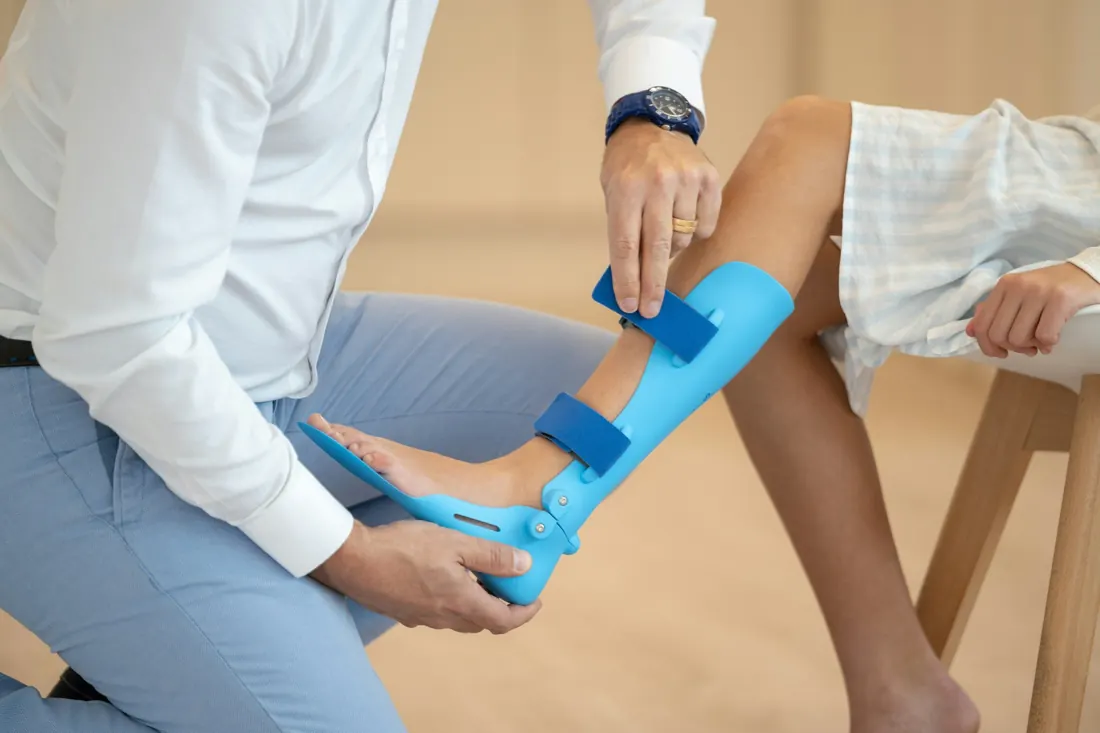
- A walking boot, brace or tape for support during recovery. See braces and orthotics for how supports are chosen.
- Physical therapy for strength, balance and proprioception; see physical therapy after injury.
- Anti-inflammatory medicine, or an injection into the joint, when appropriate.
AAOS says this rehabilitation program may take 2 weeks for minor sprains and up to 6 to 12 weeks for more severe injuries.
How the operation is done
- You receive anesthesia, general or regional, and your leg is positioned and often placed in a holder or distraction device to give access to the joint.
- The surgeon makes small incisions at the front of the ankle, passes the arthroscope and inspects all tissues in the joint.
- One to three more small incisions allow instruments to repair a tear, remove damaged tissue, trim impinging tissue or take out loose fragments, per MedlinePlus.
- The incisions are closed with stitches and covered with a bandage, and a splint or boot may be applied.
Many people go home the same day. Ask us whether this is offered at the office nearest you, as ankle arthroscopy is not one of the procedures the practice has specifically published.
Recovery, in general terms
MedlinePlus advises elevating the ankle above the heart for 2 to 3 days to reduce swelling and pain, keeping the bandage clean and dry, and using a walker or crutches while keeping weight off the foot unless told otherwise. It says you may need a splint or boot for a few weeks or longer, and that if only small cuts were needed you may be able to resume normal activities in a few days, while a larger repair can take several weeks to heal. Physical therapy is often recommended to regain full use. Recovery tends to be longer after ligament repair or cartilage work than after simple cleanup.
Risks
- Allergic reaction to medicines, breathing problems, bleeding, blood clot or infection, which MedlinePlus lists as general surgical risks.
- Failure of the surgery to relieve symptoms.
- Failure of a repair to heal.
- Weakness of the ankle.
- Injury to tendons, blood vessels or nerves, which can cause numbness over the top of the foot.
- Stiffness or ongoing swelling.
Cost for out-of-network and self-pay patients
Ankle arthroscopy brings several separate bills: the surgeon's fee, the facility fee for the surgery center or hospital, the anesthesia professional's fee, and charges for imaging, any implants or anchors used in a repair, a boot or crutches, and physical therapy. Plans may require documentation of failed nonsurgical care or prior authorization, so check your plan before scheduling.
With out-of-network benefits, the plan pays based on its allowed amount for each service. Our allowed amount guide explains this and the out-of-network cost calculator estimates your share. Self-pay patients may request a Good Faith Estimate before scheduled care; see the Good Faith Estimate guide. Related procedures with published pages include knee arthroscopy and Achilles tendon repair.
When to seek emergency care after surgery
Call 911 or go to the nearest emergency room for chest pain or sudden shortness of breath, which can signal a blood clot in the lung. Call your surgeon the same day for fever, spreading redness, drainage from the incisions, calf pain and swelling, or a foot that turns cold, pale or numb.
Sources
- MedlinePlus (NIH). Ankle arthroscopy
- American Academy of Orthopaedic Surgeons, OrthoInfo. Sprained Ankle
- MedlinePlus (NIH). Ankle Injuries and Disorders
This page is general health information and is not medical advice. It does not create a physician-patient relationship. Consult a qualified clinician about your own symptoms and treatment.