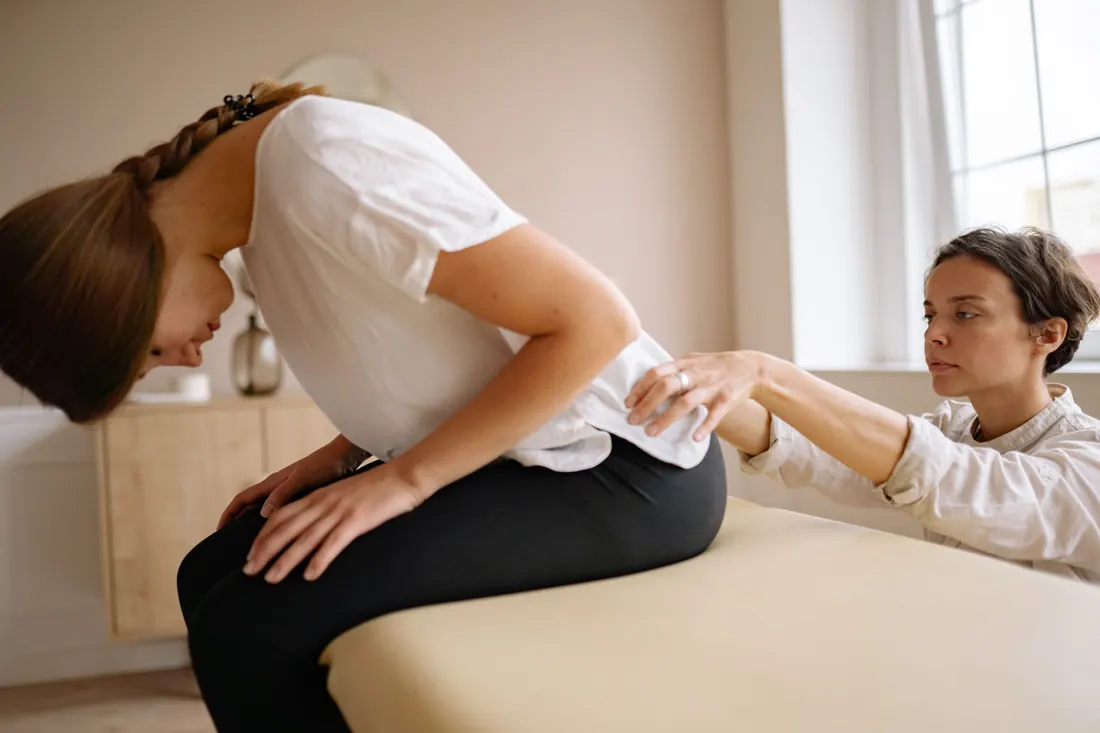
Pain when bending forward often points to a muscle strain or a disc problem, while pain when leaning back often points to the facet joints or a slipped vertebra. A sudden sharp catch, pain with leg weakness or numbness, or any loss of bladder or bowel control needs prompt medical attention.
Not all back pain with bending is the same. A back that hurts as you reach for your shoes is often a different problem from a back that hurts as you arch to look up. Doctors use that distinction every day. This page uses it too. It describes the common causes, what should prompt faster care and what an exam looks at. It cannot diagnose you. Only an exam can tell.
Bending forward hurts
Flexion rounds the spine, stretches the muscles and ligaments at the back, and presses on the front of the discs, pushing disc material toward the back.
Muscle or ligament strain
This is the most common cause of low back pain overall. It follows lifting, twisting or an unaccustomed workout, and brings pain with forward bending and a feeling of tightness or spasm. It is usually felt on one or both sides, rarely goes below the buttock, and usually improves over days to weeks. See the general lower back pain guide for more.
Disc problems
A herniated disc can cause back pain that is sharply worse with forward bending, and leg pain, numbness or weakness if a nerve is irritated. Pain may spike with coughing, sneezing or sitting. A disc that is simply worn, as in degenerative disc disease, can produce a deep ache that flares on and off over the years.
Leaning backward hurts
Extension narrows the openings where nerves leave the spine and compresses the small joints at the back of each vertebra.
Facet joint irritation
The facet joints guide spinal movement, and they can become arthritic or inflamed. Facet joint syndrome typically hurts when you arch backward, twist, or stand for a long time, and is often relieved by bending forward or sitting. Pain is felt to one or both sides of the spine, sometimes spreading into the buttock or thigh, but usually not below the knee.
A slipped vertebra
In spondylolisthesis one vertebra slips forward on the one below. It is seen in young athletes who have had repeated stress, and in older adults with degenerative changes. Pain with extension, a feeling of instability and tight hamstrings are common.
Both directions hurt, or neither
Pain in all directions of movement with stiffness suggests broad muscle guarding or spinal arthritis. Pain at rest, at night or with no clear positional pattern deserves a closer look for other causes, including inflammatory, infectious or other non-mechanical problems.
Warning signs
Call 911 or go to an emergency room immediately for loss of bladder or bowel control, numbness in the groin or inner thighs, weakness or numbness in both legs, rapidly worsening leg weakness, or back pain after a serious fall or accident. These can point to cauda equina syndrome or a fracture. Fever with back pain, or back pain with unexplained weight loss and a history of cancer, also needs prompt medical attention.
Be examined within days if pain travels below the knee with numbness, if a foot is dragging, if pain keeps you awake, or if you have osteoporosis and developed sudden back pain after a minor strain. Pain that has not improved after four to six weeks also deserves an appointment.
Common first steps
- Keep moving. Short walks are generally better than lying in bed.
- Bend at the hips and knees when picking things up, and keep loads close to the body.
- Avoid sudden twisting while holding weight.
- Use heat for muscle tightness or ice after a flare, depending on what feels better.
- Use the position that eases pain for short breaks. People with a disc irritation often prefer to stand, while people with facet pain often prefer to sit or lean forward.
Over-the-counter medicines are widely used for strains, but only as labeled and only if they are safe for you. Ask a clinician if you are unsure.
Lifting, sport and work
Many bending injuries follow a pattern: a load that is too heavy, held too far from the body, with a twist added. Golfers, gardeners, parents lifting children and people loading cars are common examples. Young athletes who do repeated back extension, such as gymnasts and football linemen, are prone to stress injuries of the vertebra. If your pain began with a particular activity, tell the clinician exactly what you were doing, since the mechanism often points to the structure involved.
What the exam covers
The clinician will ask which movements hurt, whether pain moves into a leg, and whether you have numbness, weakness or bladder changes. They examine posture, motion in each direction, and tenderness over the muscles, spine and sacroiliac joints. A neurological check of strength, reflexes and sensation follows, along with maneuvers such as raising the straightened leg while lying down to see whether a nerve root is irritated. The hips are checked as well.
Imaging is not needed for every episode. When symptoms are severe, persist, or come with neurological changes, an MRI shows the discs and nerves, and X-rays show alignment and slippage. Flexion and extension X-rays can check for instability when a slipped vertebra is suspected. Because many pain-free people have disc bulges on MRI, a scan is only meaningful when it fits the exam.
Which specialist
Back pain is most directly addressed by spine care. When pain is persistent and a nerve focused procedure may help, pain management may be involved. The which-specialist tool can narrow it down.
Coverage questions
Read how out-of-network care works if you intend to file with your plan, or how self-pay works if you pay directly. Having a rough idea of whether imaging will be needed makes that conversation easier.
Sources
- American Academy of Orthopaedic Surgeons, OrthoInfo. Low Back Pain
- National Institute of Arthritis and Musculoskeletal and Skin Diseases (NIH). Back Pain
- American Academy of Orthopaedic Surgeons, OrthoInfo. Herniated Disk in the Lower Back
- MedlinePlus (National Library of Medicine). Back Pain
This page is general health information and is not medical advice. It does not create a physician-patient relationship. Consult a qualified clinician about your own symptoms and treatment.