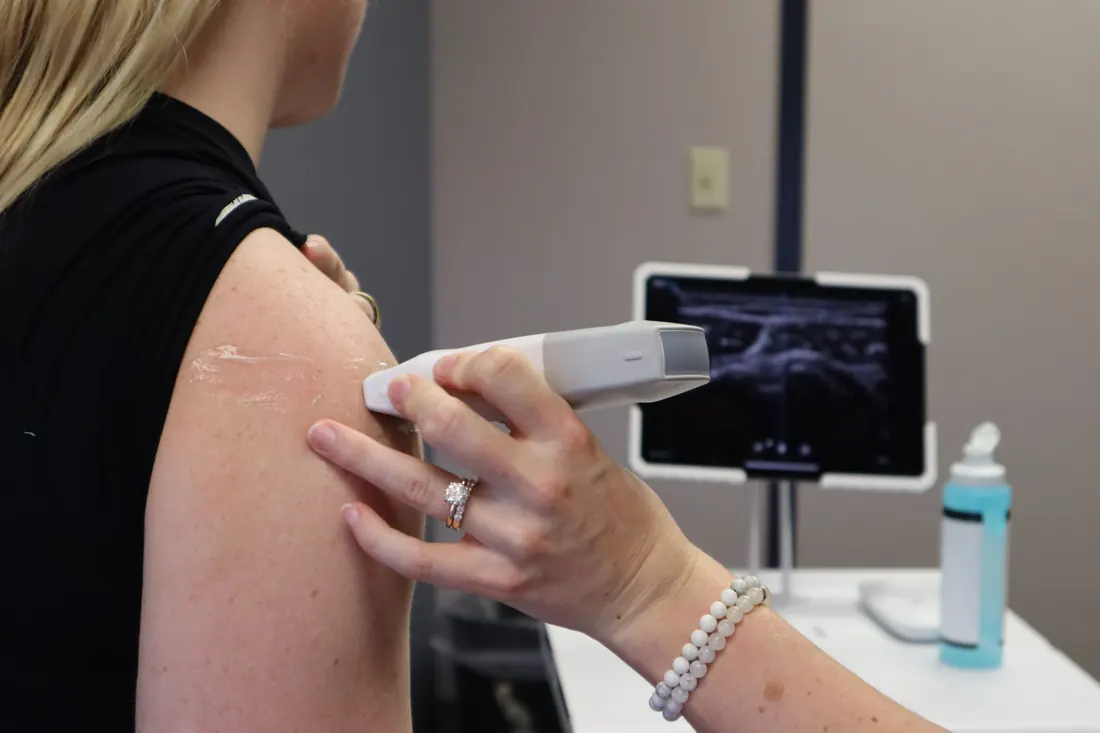
The cost of a cortisone injection depends on the joint or site, whether imaging guidance is used, the medication, any same-day visit charge, and the setting. No honest page can name your total. Ask for a quote or Good Faith Estimate that lists the visit, procedure, medication and guidance separately.
A cortisone shot is one of the most familiar procedures in orthopedics, and one of the hardest to price from the outside, because the label covers a visit, a needle, a medication and sometimes an imaging machine. This page lists those parts and explains what pushes a total up or down.
What is billed for a cortisone injection
OrthoInfo describes therapeutic injections as placing an anesthetic and an anti-inflammatory medication, such as a steroid (cortisone), near the affected area. Each element has its own place on a bill.
| Piece | What it is | When it is separate |
|---|---|---|
| Office visit | The evaluation that leads to the decision | Billed on its own when the visit goes beyond deciding on the shot |
| Injection procedure | The act of placing the needle | Coded by the type of joint or site injected |
| Medication | The steroid and any anesthetic | Often a separate supply line |
| Image guidance | Ultrasound or fluoroscopy to confirm placement | May be a separate line, or bundled, depending on the office |
| Facility fee | The room and staff when done in a hospital department or surgery center | Only in those settings |
What changes the total
Which joint or site
A small joint of the hand, a shoulder and a hip are not coded the same way. The treatment page on cortisone injections lists the places they are commonly used.
With or without guidance
A shot placed by feel in an office is a different bill from one placed under imaging. OrthoInfo says spinal injections are performed under X-ray guidance, called fluoroscopy, to confirm placement and improve safety. For other joints, guidance is a clinical choice that also changes the price.
Number of sites in one session
Two joints in one visit are two procedures, and plans often reduce the second line when they price it.
Setting
An injection in an office has no facility line. The same injection in a hospital outpatient department or surgery center usually does.
Out-of-network benefits for an injection
When the practice is out of network, your plan evaluates each line against its own allowed amount. It subtracts your out-of-network deductible, then pays its coinsurance on what is left, and the provider may bill the remainder as balance billing. Because a cortisone injection is several lines, a plan can recognize the procedure and the medication at different rates. Ask for each billed code in advance and ask the plan what it allows for each. The out-of-network cost calculator takes those numbers. For related coverage questions, see how many steroid injections you can have.
Self-pay and the Good Faith Estimate
For a scheduled injection you pay for yourself, CMS says you generally must be given a good faith estimate when you schedule at least 3 business days ahead or ask for one. The estimate should list the visit, the procedure, the medication and any guidance. CMS says you may be able to dispute a bill that is at least $400 more than the estimate. Read the Good Faith Estimate guide and the self-pay page. Ask us whether injections are offered at the office nearest you.
Hypothetical example: an out-of-network cortisone injection
These numbers are invented, round and labeled as illustration only. They are not a price from any provider.
| Line | Charge | Plan allowed amount |
|---|---|---|
| Injection procedure, one joint | $300 | $150 |
| Medication and anesthetic | $100 | $40 |
| Ultrasound guidance | $200 | $100 |
| Total | $600 | $290 |
- Say your out-of-network deductible is already met.
- The plan pays 70% of the allowed $290, which is $203.
- Your 30% coinsurance is $87.
- The provider bills the $310 gap between charge and allowed amount.
In this invented case you owe $87 plus $310, or $397. Without the guidance line the arithmetic would be smaller, which is why asking what is included matters.
Plan limits and what to check
Some plans limit how often or in what circumstances they pay for injections, so check your plan. HealthCare.gov defines excluded services as health care services that a plan does not pay for or cover. Ask whether guidance is covered, whether there is a limit on the number of injections in a year, and whether the plan needs prior approval. Our page on how long a cortisone shot lasts explains what clinicians discuss when they decide on timing.
Repeat injections and follow-up
Many people have more than one injection over time, and each one is a new billed service rather than a continuation of the last. Our page on how many steroid injections you can have explains why clinicians space them out, and plans may also set their own limits on how often they pay. If you expect a return visit, ask whether the follow-up is billed as a visit and whether a second injection is priced the same as the first. Keep the medication name and the date from each visit so you can answer a plan or a new clinician accurately. MedlinePlus notes that corticosteroids are strong medicines with side effects and are usually taken for as short a time as possible, which is general background and not advice for your case. Your clinician decides what is right for you, and the office can tell you whether anything about your history changes the plan or the quote.
Questions to ask before you book
- Which joint is quoted, and how many sites are included?
- Is the medication a separate line?
- Is imaging guidance used, and is it included?
- Is there a separate visit charge the same day?
- Is this done in an office or a hospital department?
- Does my plan limit injections or require approval first?
If the problem is arthritis or a tendon, background is on knee arthritis and shoulder bursitis. Contact us to talk through the questions.
Sources
- OrthoInfo (AAOS): Spinal injections
- MedlinePlus: Steroids
- HealthCare.gov glossary: Excluded services
- CMS: Understanding costs in advance
General information, not legal, tax or insurance advice. Your plan documents and insurer decide coverage; we confirm your actual benefits before you book.