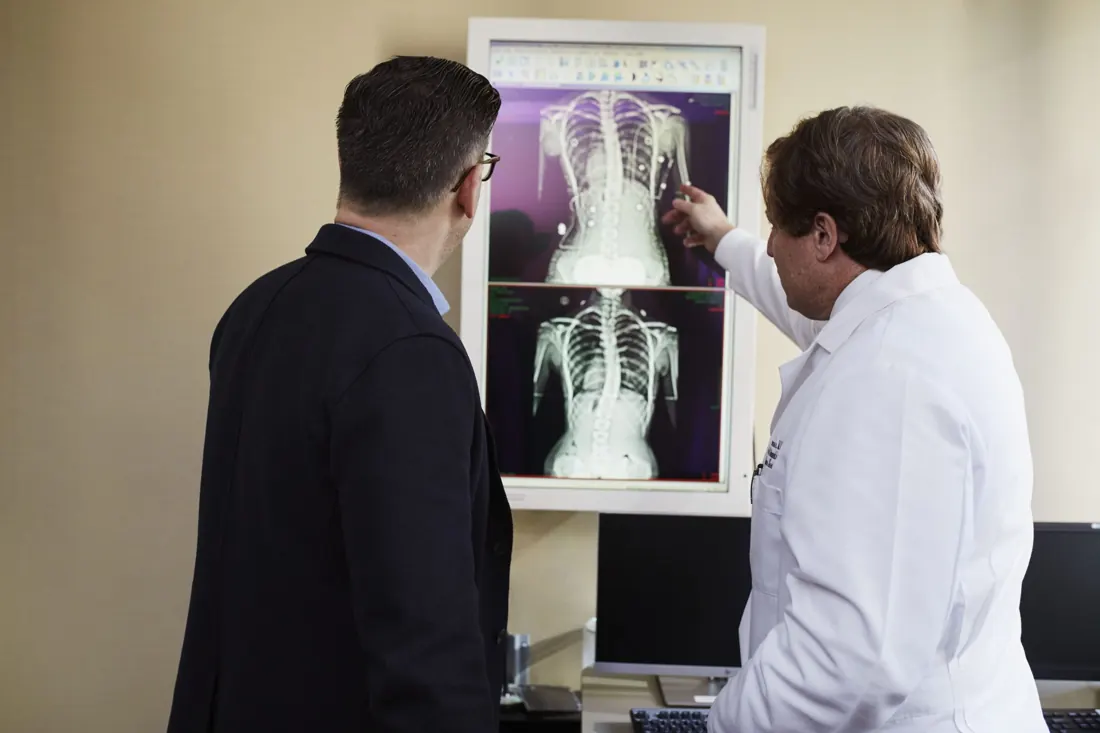
The cost of a bone density scan depends on the sites scanned, the setting that owns the scanner, whether a separate physician reads it, and your coverage. Medicare.gov describes its own rules. Ask for a written quote or Good Faith Estimate that lists the technical fee, the reading fee and the visit.
A bone density scan, often called a DXA or DEXA scan, is usually a short, quiet test with no needle. The price conversation is rarely short. Coverage rules, the site where the scan is done and who reads it all change what you owe, and for adults with Medicare the rules are specific. This page separates the parts so you can ask about each.
What the scan measures and what is billed
MedlinePlus defines bone density as a measure of the amount of calcium and other minerals in bone, and says that bones containing more minerals tend to be stronger and less likely to fracture. The scan is how that measure is taken, and the bill typically has these parts:
- Technical fee. The scanner, the room and the technologist, billed by the site that owns the equipment.
- Professional fee. The physician who interprets the scan and writes the report, which may be a separate bill.
- Body sites. Hip and spine are the common sites, and a forearm may be added. More sites can mean more billed units.
- Ordering visit. The appointment where the test was ordered is its own charge.
- Comparison with a prior scan. If you had an earlier scan elsewhere, the reader may want it, and that can affect the report.
What changes the total
The site that owns the scanner
A hospital outpatient department, a radiology group and a physician office can all own a scanner. They bill differently, and each may be in or out of your plan's network on its own. Ask for the site's status, not just the ordering doctor's.
Screening versus diagnostic reasons
Plans often cover a scan more readily for certain listed reasons. The reason on the order can therefore change what the plan recognizes. Ask what reason the order carries and whether it matches your plan's criteria.
Timing since the last scan
Plans and Medicare both look at how long it has been since the previous scan. If you have had one recently, ask the office whether a new one is likely to be paid.
If you have Medicare
Medicare.gov lists bone mass measurements as covered by Part B as a preventive service, once every 24 months or more often if medically necessary, when you meet certain conditions. It says you pay nothing for the test if the doctor or other provider accepts assignment, and that the amount you could owe depends on other insurance, what your doctor charges, assignment, the facility type and where you get the test. Our dedicated page on Medicare and bone density tests lists the conditions in full.
Out-of-network benefits and bone density scans
For a commercial plan, the logic follows the same path as other imaging. The plan reduces each billed line to its allowed amount, applies what remains of your out-of-network deductible, and pays its coinsurance. If a plan treats the scan as preventive, some or all of the cost-sharing may differ in-network, but an out-of-network site may not be covered the same way. Call the plan with the scan's name and ask how an out-of-network site and reader are handled. Run what you hear through the out-of-network cost calculator.
Paying yourself and the Good Faith Estimate
If you are not using insurance, CMS says providers generally must give you a good faith estimate when you schedule care at least 3 business days in advance or ask for one. For a scan, ask that it names the sites scanned, the reading fee and the visit. Our Good Faith Estimate guide explains the document, and self-pay explains how paying yourself works here. Ask us whether bone density scans are offered at the office nearest you.
Hypothetical example: out-of-network bone density scan
These are invented round numbers for illustration only. They are not a price from any provider.
| Line | Charge | Plan allowed amount |
|---|---|---|
| Scan of hip and spine, technical fee | $400 | $200 |
| Interpretation and report | $100 | $50 |
| Total | $500 | $250 |
- Suppose the out-of-network deductible has been met.
- The plan pays 60% of the allowed $250, which is $150.
- Your 40% coinsurance is $100.
- The provider bills the $250 gap between charge and allowed amount.
In this case you owe $100 plus $250, or $350. If the plan treated the scan as not covered at all, the full $500 charge would be yours, which is why asking beforehand matters.
Comparing quotes fairly
Two quotes for a bone density scan are comparable only if they cover the same sites, the same reading arrangement and the same visit. A quote that lists a scan of the hip and spine is not the same as one that adds a forearm. A quote that leaves out the reading fee is not a smaller bill, only an unfinished one. Write down, for each quote, the sites, whether interpretation is included, whether an ordering visit is needed, and who the reader is. Then the numbers can be set side by side without guessing.
It also helps to bring earlier scan reports. A reader who can compare today's scan with an older one at the same type of site can say more than one who sees a single scan, and you avoid being asked to repeat a test only because the earlier report could not be found.
Questions to ask before you book
- Which sites are being scanned, and are both fees in the quote?
- Does the order name a reason that matches my plan or Medicare conditions?
- When was my last scan, and does that affect payment?
- Is the site in my plan's network, and is the reader?
- Does the provider accept assignment, if I have Medicare?
- Can I get the quote or estimate in writing?
After the result
Ask for a copy of the report and keep it for later comparison. If a spine fracture is found, see osteoporotic compression fracture for background, and ask the clinician about next steps. To go over these questions with us, contact us.
Sources
- MedlinePlus: Bone density
- Medicare.gov: Bone mass measurements
- CMS: Understanding costs in advance
- HealthCare.gov glossary: Allowed amount
General information, not legal, tax or insurance advice. Your plan documents and insurer decide coverage; we confirm your actual benefits before you book.