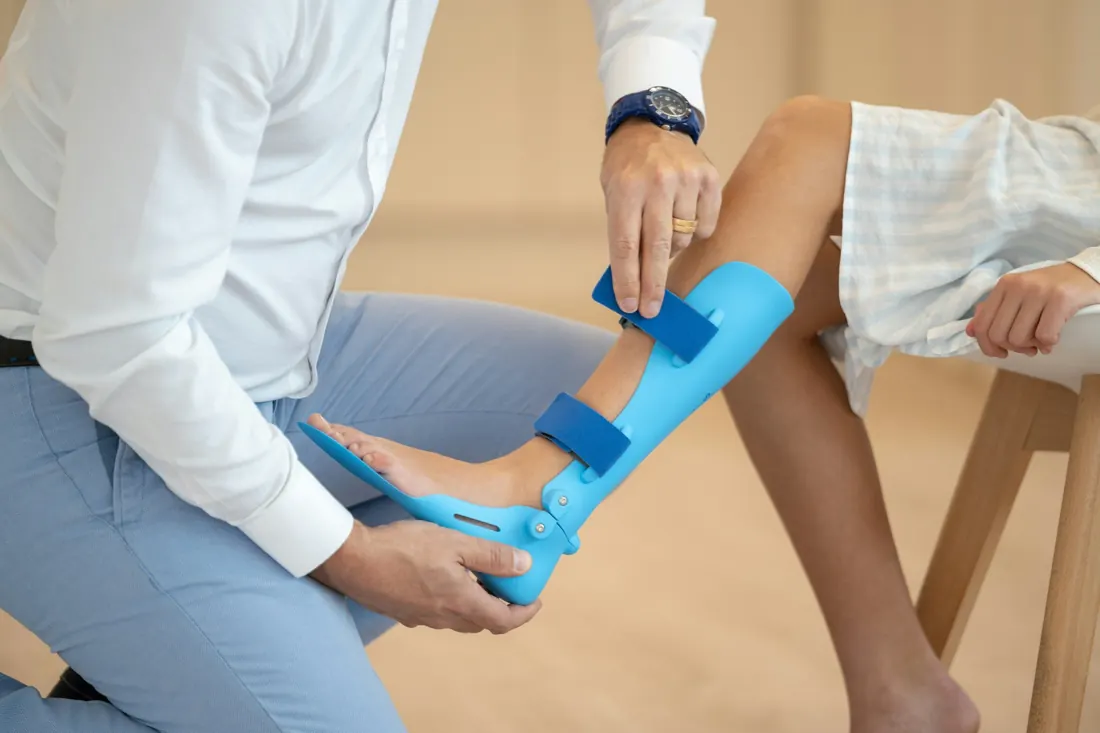
Turf toe is a sprain of the soft tissue under the big toe joint, usually from the toe being forced upward while the forefoot is planted. It causes pain at the base of the big toe, swelling and trouble pushing off. Most cases heal without surgery, while severe tears or instability may need repair.
The big toe joint carries a large share of the force every time you push off. Because of that, a small injury there can sideline an athlete longer than the size of the joint suggests, and it is easy to push it too early.
What the injury is
Turf toe is an injury to the plantar complex, a group of soft tissues on the underside of the joint at the base of the big toe: the plantar plate and the collateral ligaments, along with their attachments to the two small sesamoid bones. When the toe is bent sharply upward, those structures can stretch or tear. The name comes from football played on artificial turf, which is firmer and grips the shoe, but the injury occurs on any surface and in sports such as soccer, basketball, dance, wrestling and running.
Grades of severity
- Grade 1: the tissue is stretched, causing pinpoint tenderness and slight swelling.
- Grade 2: a partial tear with broader tenderness, moderate swelling, bruising and painful, limited motion.
- Grade 3: a complete tear with severe tenderness and swelling, bruising, and difficult, painful movement. The joint can be unstable.
The grade guides treatment and how long it takes to return to play.
How it happens
The typical mechanism is a planted forefoot with the heel lifted, followed by a force that pushes the big toe into hyperextension, such as a player landing on the back of the foot or a fall while sprinting. Flexible athletic shoes that bend easily at the forefoot, hard playing surfaces and a stiff big toe joint can all raise the risk. Repeated smaller stresses can lead to a more gradual version. A history of toe pain is worth mentioning, since arthritis or a stiff joint changes the picture.
When to go to the ER, and when to be seen within days
Go to an emergency room or call 911 if the toe or foot looks deformed after a hard injury, if the toe is dislocated and will not go back, if the foot is cold, pale or blue, or if swelling comes with fever and spreading redness. Severe injuries with inability to bear any weight also deserve same-day evaluation.
Book an evaluation within days if there is significant swelling or bruising under the toe, if the toe drifts or points upward or sideways, if you cannot push off, or if pain is not clearly improving after a few days of rest. Missing a Grade 2 or 3 injury can lead to a stiff, painful or drifting big toe that is harder to correct later.
How it is diagnosed
A clinician asks how the injury happened, then checks swelling, bruising and range of motion at the big toe joint. They may bend the toe up and down and from side to side to look for instability, and compare it with the other foot. Examination can be painful, and sometimes a numbing injection is used first. X-rays rule out small bone fragments and fractures of the sesamoids, and may show the sesamoids sitting in an abnormal position. Weight-bearing views and comparison with the other side are useful. MRI helps in Grade 2 and 3 injuries or when something looks abnormal on X-ray, because it shows soft tissue and cartilage damage.
Treatment, from conservative to surgical
First aid
The RICE approach helps in the first days: rest from the activity, ice for short periods, compression with an elastic wrap and elevation above the heart. Over-the-counter anti-inflammatory medication can help when it is safe for you. Avoid pressing on the toe to see how bad it is.
Non-surgical care by grade
- Grade 1 injuries are commonly treated with rest, taping or a stiff-soled shoe and a gradual return to activity.
- Grade 2 injuries often use a walking boot or crutches for a period to limit motion, then a stiff insole, taping and rehabilitation.
- Grade 3 injuries are usually immobilized, and surgery is frequently discussed, especially in athletes.
- Therapy restores motion and strengthens the foot, with attention to how you push off. See physical therapy after injury.
Surgery
Surgery is considered for complete tears, unstable joints, displaced sesamoid fractures, a toe that drifts, or persistent pain despite appropriate non-surgical treatment. The surgeon repairs the torn plantar plate or fixes the fracture. Ask us whether surgery for this condition is offered at the office nearest you. Risks include stiffness, a big toe that remains weak, and scar tenderness.
Recovery in general terms
A mild injury may settle over days to a few weeks. Moderate injuries often need several weeks, and severe ones can require months before cutting, sprinting or jumping. After surgery, weight bearing is limited at first and return to sport commonly takes a few months or longer. Because the big toe is used constantly, a premature return risks a longer lay-off. These are broad ranges that your clinician will refine for your sport.
Lowering the chance of a repeat injury
- Wear shoes with a stiffer forefoot, and consider an insert that limits upward bending of the toe.
- Keep the calf and foot muscles strong and flexible.
- Follow a graded return, and avoid playing through persistent big toe pain.
Pain at the base of the big toe can have other causes. For related patterns see ball of foot pain and stress fracture.
Out-of-network and self-pay sports care
Athletes often want a clear answer on timing, which depends on the grade and whether imaging is needed. Elite MD Care sees patients who use out-of-network benefits and patients who pay directly. Read how out-of-network care and self-pay care work, use the out-of-network cost calculator, and learn about sports medicine.
Sources
- American Academy of Orthopaedic Surgeons, OrthoInfo. Turf Toe
- MedlinePlus (National Library of Medicine). Foot Injuries and Disorders
- National Institute of Arthritis and Musculoskeletal and Skin Diseases (NIH). Sports Injuries
This page is general health information and is not medical advice. It does not create a physician-patient relationship. Consult a qualified clinician about your own symptoms and treatment.