Shoulder pain most often comes from the rotator cuff, bursa, joint arthritis or stiffness, and many cases improve with activity changes and therapy. See a specialist if pain lasts more than a few weeks or limits sleep or lifting. Shoulder pain with chest pressure or shortness of breath needs emergency care.
The shoulder has the greatest range of motion of any joint, and it trades stability for that freedom. The ball of the upper arm bone sits in a shallow socket held by the rotator cuff, the labrum and ligaments. That design makes the shoulder vulnerable to overuse, injury and wear, and it makes the cause of pain harder to guess without an examination.
Common sources of shoulder pain
- Rotator cuff problems. Tendinitis, impingement and tears cause pain with overhead reach and at night. See rotator cuff tear.
- Bursitis. Inflammation of the fluid sac under the top of the shoulder, often alongside cuff irritation.
- Frozen shoulder. Gradual stiffness and pain with markedly lost motion. See frozen shoulder.
- Arthritis. Wear of the main shoulder joint or the acromioclavicular (AC) joint at the top.
- Labral tears and instability. Catching, clicking or a feeling of the shoulder slipping, more common in younger athletes and after dislocations.
- Biceps tendon irritation. Pain at the front of the shoulder.
- Fractures of the collarbone or upper arm after a fall.
- Referred pain from the neck, or from the chest, gallbladder or diaphragm.
Warning signs
Call 911 or go to an emergency room if shoulder or arm pain comes with chest pressure, shortness of breath, sweating, nausea or lightheadedness, since a heart attack can present as pain in the left shoulder or arm. Go to the emergency room as well for a shoulder that looks deformed after a fall, for sudden severe pain with inability to move the arm, or for a hot, red, swollen joint with fever. Sudden pain in the right shoulder with abdominal pain or yellowing of the skin can come from the gallbladder or liver.
When to see an orthopedic specialist
Book an evaluation if pain has lasted more than a couple of weeks, if it wakes you at night, if you cannot lift the arm or reach behind your back, if there was a significant injury, or if weakness is developing. Younger athletes with a feeling of the shoulder slipping should be assessed before returning to sport.
How the cause is found
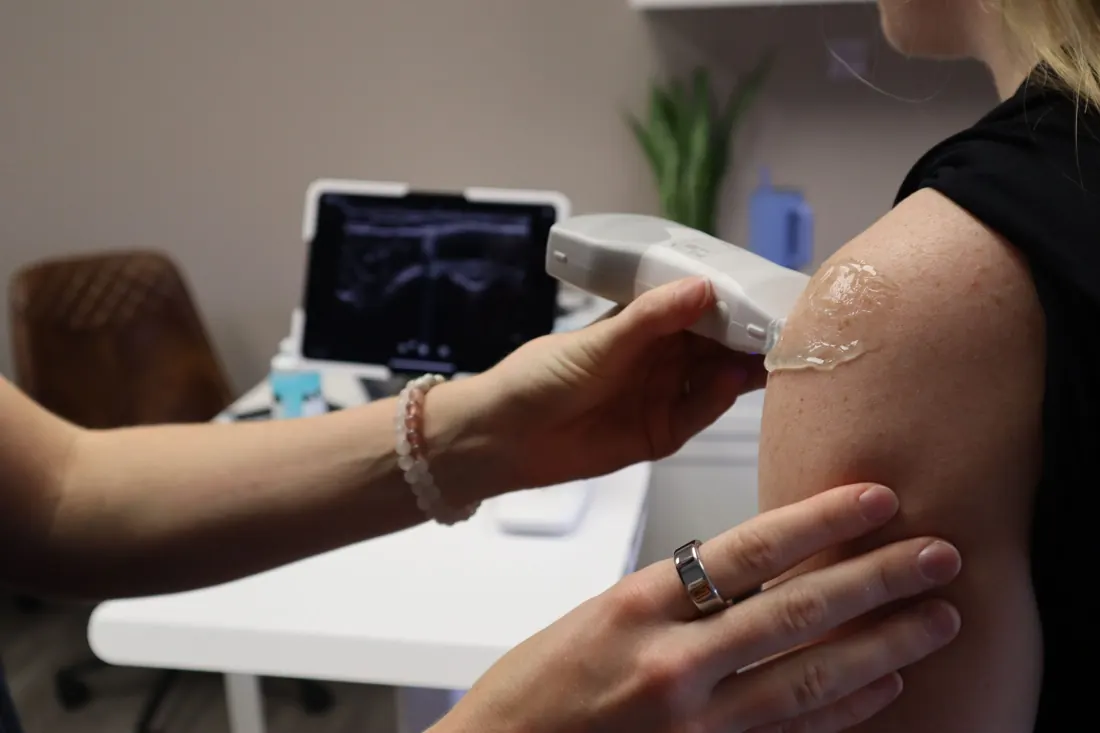
The examination watches how the shoulder and shoulder blade move, compares both sides, and tests strength and specific structures. The neck is checked too, because nerve irritation in the cervical spine can send pain into the shoulder; see neck pain. X-rays show arthritis, bone spurs, fractures and alignment. Ultrasound examines tendons and bursae in motion. MRI gives detail on the cuff, labrum and cartilage and is ordered when the examination and X-rays do not explain the problem or when surgery is being considered. Diagnostic injections of local anesthetic can help determine whether a particular area is the pain source.
Treatment, from simple to surgical
Initial treatment
- Modify overhead and heavy pulling activities, while keeping the shoulder moving through a comfortable range.
- Ice or heat, and anti-inflammatory medication when appropriate for you.
- Physical therapy that strengthens the rotator cuff and the muscles stabilizing the shoulder blade, and corrects posture and technique.
- Adjust sleep position, for example with a pillow supporting the arm.
Injections
A corticosteroid injection into the bursa or joint can reduce pain and make therapy possible. Relief is variable and often temporary, and repeated injections into tendon areas are limited. Ultrasound guidance improves accuracy.
Surgery
Surgery is considered for significant tears, labral tears causing instability, advanced arthritis, or persistent disabling pain after non-surgical care. Techniques range from arthroscopic repair and decompression to shoulder replacement for advanced arthritis, including reverse total shoulder replacement for selected cuff-related conditions.
Timelines in general terms
Tendinitis and bursitis often improve over several weeks to a few months with therapy. Frozen shoulder is slower, often a year or more. After arthroscopic repair, a sling is commonly used for several weeks and return to heavier activity usually takes months. All timelines vary with the diagnosis, your health and the specific treatment, and your physician can tailor an estimate to you.
Everyday protection
Keep loads close to the body, avoid sustained overhead positions without breaks, strengthen the upper back and shoulder blade muscles, and warm up before throwing or racket sports. If you work at a computer, check that the keyboard and mouse allow the arms to rest near the sides rather than reaching forward.
Shoulder pain by age and activity
The likely cause shifts with age. In teenagers and young adults, instability and labral injuries from sport and dislocation are more common. In adults between about 30 and 60, impingement, tendinitis and cuff tears dominate, often related to overhead work or recreation. After 60, rotator cuff degeneration and arthritis are frequent, and many people have cuff tears without symptoms. Throwing athletes, swimmers and weight lifters tend to injure different structures from office workers, which is why an examination that asks about your specific activities pays off.
What to tell the clinician
Describe when the pain started and whether an injury preceded it, what movements and positions provoke it, whether it wakes you at night, and whether the shoulder feels weak, stiff or unstable. Mention neck pain, tingling in the arm, prior shoulder problems, diabetes and any medications such as blood thinners. Bring existing imaging. This history often narrows the possibilities before any test is ordered.
Being seen out-of-network or self-pay
Because shoulder pain has so many sources, a focused examination by an orthopedic clinician can shorten the path to the right treatment.
Elite MD Care sees patients who use out-of-network benefits and patients who pay directly. Read how out-of-network visits and self-pay care work, learn about orthopedics, and see our locations.
Sources
- MedlinePlus (National Library of Medicine). Shoulder Injuries and Disorders
- American Academy of Orthopaedic Surgeons, OrthoInfo. Rotator Cuff Tears
- American Academy of Orthopaedic Surgeons, OrthoInfo. Frozen Shoulder
- National Institute of Arthritis and Musculoskeletal and Skin Diseases (NIH). Tendinitis
This page is general health information and is not medical advice. It does not create a physician-patient relationship. Consult a qualified clinician about your own symptoms and treatment.