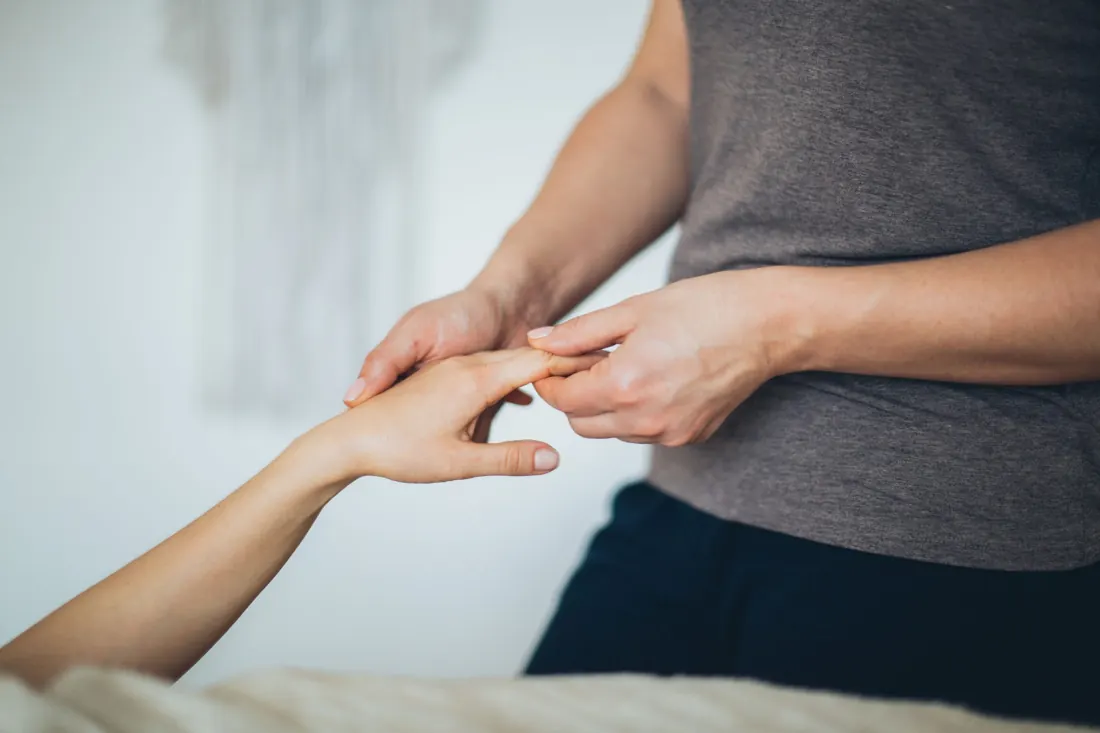
Pain at the base of the thumb most often comes from arthritis of the basal joint, irritation of the thumb tendons on the wrist side (De Quervain), or a sprain. Arthritis tends to bring a deep ache and a bump with pinching, while tendon problems hurt along the wrist edge. A fall with swelling needs an X-ray.
Few joints are used as constantly as the thumb. The joint at its base, where the thumb bone meets a small wrist bone, lets the thumb swing across the palm, and it takes heavy load whenever you pinch or grip. When it hurts, everyday tasks become awkward fast. This page covers what the pain often means and what an evaluation looks at. It cannot diagnose you.
Red flags: when to act quickly
Call 911 or go to an emergency room if the thumb or hand is crooked after a fall or crush injury, if the skin is broken over a deformed joint, or if the thumb is pale, cold or blue. Go the same day for a hot, red, swollen thumb with fever, since a joint or tendon infection needs prompt treatment.
Be seen within days if you cannot move the thumb through its normal range after an injury, if pain follows a fall onto an outstretched hand, if the thumb is numb, or if pain is waking you at night. A scaphoid wrist bone fracture can feel like a mild sprain and may not show on early X-rays, so persistent soreness after a fall deserves a proper look.
Three zones to check
- The fleshy base of the thumb, near the wrist crease. This is the usual zone for basal joint arthritis.
- The thumb side of the wrist, along the edge. This is where irritated tendons produce pain with gripping or twisting.
- The joint closest to the thumbnail or the middle joint. Pain there points elsewhere, such as a ligament sprain or a different arthritic joint.
Common causes
Basal joint arthritis
Cartilage in the carpometacarpal joint wears with age and use, and it is more common in women past middle age. The ache is deep and worse with pinching and turning. Over time the base of the thumb can look squared off or bumpy, and the thumb may become weaker. It is one form of osteoarthritis, and symptoms vary a lot from person to person.
Tendon irritation on the wrist side
De Quervain tenosynovitis inflames the sheath around two thumb tendons. It is linked with repetitive hand use, lifting a baby, and hormonal and postpartum changes. Pain sits along the thumb edge of the wrist and sharpens when you make a fist with the thumb tucked in and bend the wrist toward the small finger.
Catching or locking of the thumb
If the thumb snaps or sticks when bending, a nodule on the flexor tendon may be catching in its sheath. That pattern, called trigger finger when it affects the thumb, usually hurts at the crease near the palm side of the thumb base.
Nerve compression
Numbness or tingling in the thumb, index and middle fingers, especially at night, suggests carpal tunnel syndrome. It can coexist with arthritis, which is part of why a hands-on exam matters.
Sprain or ligament injury
A forced bend backward, as in a ski pole fall, can stretch the ligament on the inner side of the thumb knuckle. Swelling, bruising and a feeling of looseness when pinching are the clues.
What people commonly try first
- Resting the thumb from repeated pinching and gripping tasks, and using larger-handled tools or jar openers.
- A removable thumb brace or splint, often worn at night and during heavy use.
- Heat to loosen the joint or ice after a flare.
- Gentle range-of-motion exercises once the sharp pain eases.
- Over-the-counter pain relievers, used as labeled and if they are safe for you.
- Adjusting phone, keyboard and kitchen habits that load the thumb all day.
Pain that does not settle after a few weeks of this, or that keeps coming back, is a reason for an exam rather than more waiting.
How the pain feels, and what it hints at
A dull ache with stiffness after sitting, easing as you move, fits arthritis. Sharp pain with a specific motion, like lifting a cup with the thumb up, fits tendon irritation. A sudden onset after a fall fits a sprain or fracture. Weakness when turning a key can come from either joint pain or nerve involvement. Noting which actions trigger it, and what time of day is worst, gives a clinician a useful head start.
What a specialist checks
The exam starts with history: hand dominance, work and hobbies, past injuries and when the pain began. The clinician presses along the joint and tendons, moves the thumb through its range, tests pinch and grip strength and may do a grind test, rotating the thumb while pressing on the base to see whether it reproduces pain and a gritty feel. Tests for tendon irritation and nerve compression are done at the same visit.
X-rays show joint space narrowing, bone spurs and fractures, and special views can show the base joint more clearly. If a scaphoid fracture is suspected but the X-ray looks normal, a repeat film, MRI or CT may follow. Treatment options are matched to the finding and may include splinting, therapy, injections or, if function is limited, surgery.
Habits that load the thumb
Many people notice that phones, game controllers, knitting, gardening and long stretches of texting concentrate force on the thumb. Hand tools with thin handles make the joint work harder than a thicker, padded grip does. Small changes, such as voice dictation, a pop socket or a wider pen, spread the load without giving up the activity. If you use your hands for a living, a short list of the tasks that hurt most is worth bringing to a visit.
Which specialist to see
Orthopedics covers hand and wrist problems in the bone and joint category, and sports medicine is a fit for overuse and racquet or gaming injuries. If you are unsure which door to knock on, the which-specialist tool offers a starting point.
Paying out of network or self-pay
You can read how out-of-network visits are billed and how self-pay works before booking. A hand evaluation often includes X-rays, so ask what is likely to be done at the first visit.
Sources
- American Academy of Orthopaedic Surgeons, OrthoInfo. Arthritis of the Thumb
- American Academy of Orthopaedic Surgeons, OrthoInfo. Scaphoid Fracture of the Wrist
- MedlinePlus (National Library of Medicine). Hand Injuries and Disorders
- American Academy of Orthopaedic Surgeons, OrthoInfo. Trigger Finger
This page is general health information and is not medical advice. It does not create a physician-patient relationship. Consult a qualified clinician about your own symptoms and treatment.