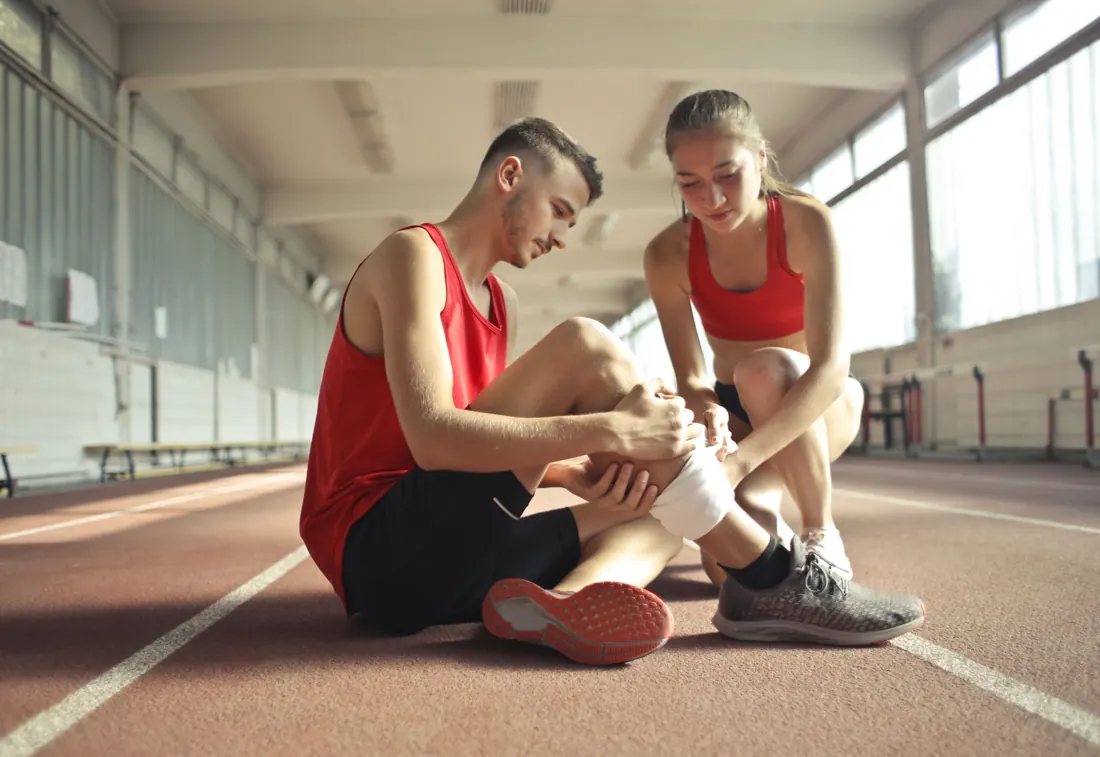
Knee pain when bending usually comes from the meniscus, the fluid-filled bursa at the front of the knee, irritated cartilage, or tight tissue at the back of the joint. Pain that comes with locking, a swollen knee or a feeling of instability should be examined soon. Only an exam can tell which one applies.
Bending the knee does two things at once. At the front, it compresses the kneecap and the cartilage behind it. At the back, it squeezes the rear part of the meniscus and the soft tissue behind the joint. Pain that shows up in a deep squat, in kneeling, or when you pull your heel toward your buttock narrows the list of suspects. This page walks through that list. It cannot diagnose you, because only an exam can tell.
Start with where the pain sits
- Inner or outer joint line. This points to the meniscus or to the cartilage on that side of the joint.
- Front of the knee, on or around the kneecap. This points to the kneecap joint, a bursa, or the tendon.
- Back of the knee. This points to the back of the meniscus, a swollen joint lining, a Baker cyst or the hamstring tendons.
- Everywhere, with stiffness. This points to arthritis or a general joint irritation.
The usual suspects
Meniscus tear
A meniscus tear often hurts when you squat or twist on a planted foot. Some people feel catching, a clunk, or a sense that something is in the way when they try to straighten the leg. In younger people a tear usually follows a clear twisting injury. In older adults it can develop gradually from wear and may appear after something as ordinary as getting up from a low seat.
Bursitis at the front of the knee
A bursa is a thin cushion that lets tissues glide. When the one over the kneecap becomes inflamed, kneeling and deep bending hurt, and the front of the knee may look puffy. Knee bursitis is common in people who kneel for work, such as tilers, gardeners and floor installers. A bursa that is hot, red and rapidly swelling can be infected and should be seen the same day.
Arthritis
In knee arthritis the joint surface wears and the lining becomes irritated. Deep bending is often limited and painful, and the knee may feel stiff after rest. It is common after age 50, and earlier after a previous knee injury.
Tendon irritation
If the pain is just under the kneecap and builds with jumping or running, patellar tendinitis is possible. Behind the knee, tight hamstring or calf tendons can ache with a deep bend, especially after a sudden jump in training.
Signs that call for faster action
Go to an emergency room now, or call 911, if the knee is hot and red with fever, if the calf is swollen, tender and warm, if the leg is pale, cold or numb, or if you have severe pain after trauma and cannot put weight through the leg. A swollen painful calf may be a blood clot, and a hot joint with fever may be infected.
Be seen within days if the knee locks in a bent position, gives way, swells within hours of an injury, or looks out of shape. A locked knee can mean a torn piece of meniscus is caught in the joint, and early evaluation gives more choices.
Pain with bending that lingers beyond a few weeks, or keeps returning after each flare, is also worth an appointment.
What makes the picture different
Age and activity shift the odds. A young athlete who feels a sharp pinch in a deep squat often has a meniscus or cartilage issue, or a tendon that is overloaded from training. A middle-aged person who notices stiffness and deep aching when bending, especially after sitting, is more likely to have early arthritis. A tiler or carpet fitter with a puffy front of the knee points toward a bursa. Previous injuries matter as well, because a knee that was hurt years ago may develop wear earlier than the other side.
Things people try before an appointment
- Avoiding deep squats, kneeling and low seats while the knee is irritated.
- Kneeling on a pad, or using a stool to reduce time on the knees if your work involves floor level tasks.
- Ice after activity, or heat before, depending on what feels better.
- Walking on level ground to keep the joint moving rather than resting it completely.
- Over-the-counter pain relievers, only if they are safe for your health history and used as the package directs.
If swelling is increasing, or the knee catches or locks, skip home care and get it examined.
What the exam looks for
A clinician will ask whether a twist or fall started it, whether the knee catches, and what positions hurt. The physical exam includes looking for swelling, checking range of motion, pressing along the joint lines, and using specific maneuvers that stress the meniscus and ligaments. The thigh, hip and calf are checked too, since weakness there changes how the knee is loaded.
Standing X-rays show joint space and alignment and are often the first imaging step. An MRI shows the meniscus, ligaments and cartilage and is used when the history or exam suggests a tear, or when a patient has locking. If fluid or a bursa is the question, ultrasound or a sample of the joint fluid may help. Imaging is interpreted with the exam, not in place of it.
Choosing a specialist
A bending-related knee problem fits orthopedics. If it began during sport, sports medicine is another route. The which-specialist tool is a quick way to check, and the main knee pain overview covers the wider picture.
Paying for the visit
Patients who have a plan with out-of-network benefits can read how out-of-network visits are handled, and those paying directly can see how self-pay care works. Knowing whether an exam alone or an exam with imaging is likely helps you plan for either route.
Sources
- American Academy of Orthopaedic Surgeons, OrthoInfo. Meniscus Tears
- American Academy of Orthopaedic Surgeons, OrthoInfo. Arthritis of the Knee
- MedlinePlus (National Library of Medicine). Knee Injuries and Disorders
- MedlinePlus (National Library of Medicine). Bursitis
This page is general health information and is not medical advice. It does not create a physician-patient relationship. Consult a qualified clinician about your own symptoms and treatment.