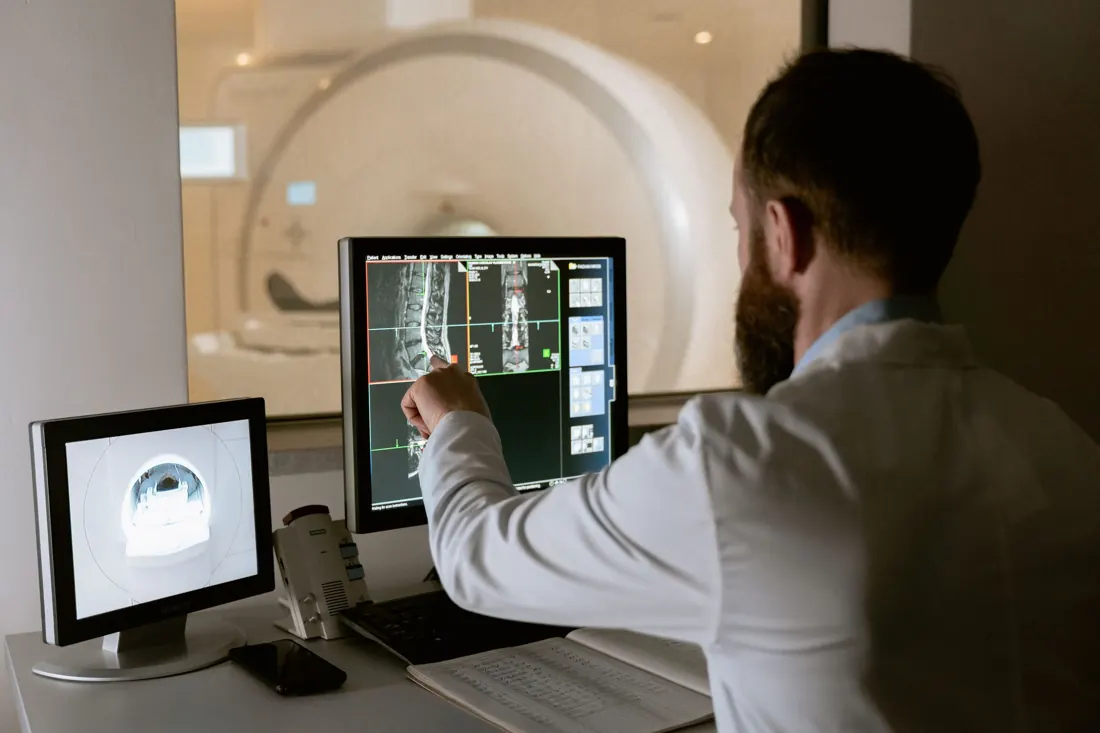
Ultrasound cost depends on whether it is a diagnostic study or guidance for an injection, how many areas are scanned, who reads the images, and the setting. Nobody can name your total without those details. Ask for a quote or Good Faith Estimate that says what guidance and the reading fee include.
Ultrasound is the imaging test people expect to be inexpensive because the machine is small and there is no radiation. In orthopedics and pain care it shows up in two quite different ways on a bill: as a diagnostic study of a tendon, muscle or joint, and as guidance for a needle. Knowing which one you are being quoted for is the first step.
Two ways ultrasound appears on a bill
As a diagnostic study
MedlinePlus describes ultrasound as an imaging test that uses sound waves to make pictures of tissues and structures inside the body, and says it is best used to learn about soft tissues. For a shoulder, elbow, heel or knee, that means a study of tendons, fluid and soft tissue. This is billed like any imaging study, with a technical component and a professional reading component.
As needle guidance
MedlinePlus also says ultrasound can guide certain biopsy procedures by showing where to place the needle. In an injection visit, ultrasound guidance can be a separate line on the bill, or it can be bundled into the procedure depending on how the practice and your plan code it. Our page on ultrasound-guided injections describes the procedure itself.
What is billed
- The scan. A limited study of one area, such as one shoulder, is a different study from a larger or two-sided one.
- The reading. Someone interprets the images and writes a report. If the treating clinician does it at the visit, it may be folded into one bill. If a radiologist does it, expect a separate one.
- The visit. The appointment where the test was ordered or performed is its own charge.
- Guidance for a procedure. If the scan is used to place a needle, ask whether guidance is included in the procedure price or listed separately.
- Documentation. Some payers want saved images and a written report before they pay, which is a question to put to the office early.
What changes the total
The number of areas scanned matters most, because each region is its own study and a bilateral request means both sides. Setting matters next: a hospital outpatient department and a freestanding office are priced differently. Finally, timing matters. A study done during a visit you are already attending is a different bill from one booked as a separate imaging appointment, since the second can add a separate visit-like charge from the imaging site.
Out-of-network benefits and ultrasound
Plans often write coverage rules for ultrasound by body area and by reason. Out-of-network, those rules are layered over the plan's own allowed amount, so the number that counts is not the practice's charge. Our guide to the allowed amount explains the term, and HealthCare.gov's glossary gives the same idea in plain language. After that, the deductible and coinsurance apply, and balance billing can add the gap.
Some plans ask for preauthorization on certain scans. HealthCare.gov says preauthorization is a decision that a service is medically necessary and is not a promise the plan will cover the cost. Ask whether your plan wants it for an ultrasound in your case. The out-of-network cost calculator can turn the answers into a rough share.
Self-pay and the Good Faith Estimate
When you pay yourself, the estimate should say whether a reading fee and guidance are inside the number. CMS says that if you do not have or use health insurance, providers usually must give you a good faith estimate when you schedule care in advance or ask for one, and that you may be able to dispute a bill that runs at least $400 over it. See the Good Faith Estimate guide and the self-pay page. Ask us whether ultrasound is offered at the office nearest you.
Hypothetical example: an ultrasound-guided shoulder visit
The figures below are invented round numbers, labeled as illustration only. They are not a quote or a market price.
| Line | Charge | Plan allowed amount |
|---|---|---|
| Office visit | $300 | $150 |
| Limited shoulder ultrasound with report | $500 | $250 |
| Total | $800 | $400 |
- Say the unmet out-of-network deductible is $100, so the first $100 of allowed charges is yours.
- The plan pays 50% of the remaining $300, which is $150.
- Your coinsurance is the other $150.
- The provider bills the $400 gap between charge and allowed amount.
Here you would owe $100 plus $150 plus $400, or $650. A different plan, or a bundled self-pay price, changes every line.
How ultrasound compares with other imaging on a bill
Ultrasound is not a substitute for every scan, and the quote should not be read as if it were. It shows soft tissue in real time, which is why it is useful for tendons and for watching a needle, but a different question may need an MRI or an X-ray. If you are weighing options, read MRI vs CT vs X-ray for joint pain and compare quotes only for tests that answer the same question. A lower price for a test that does not answer your clinician's question is not a saving.
Keeping the report
Ask for a copy of the written report and the saved images. A second clinician can use them, and an insurer may ask for them if a claim is questioned. Request them at the visit, not months later.
Questions to ask before you book
- Is this a diagnostic study, needle guidance, or both?
- Which area and which side is the quote for?
- Who reads the images, and is that fee included?
- Is the study done at the visit or as a separate appointment?
- Does my plan want preauthorization?
- Can I see the written quote before I come in?
If the reason for the scan is a sore tendon, see rotator cuff tear or Achilles tendinitis for background on what the test looks for. Contact us if you want help with the questions above.
Sources
- MedlinePlus: Ultrasound
- NIBIB: Ultrasound
- HealthCare.gov glossary: Preauthorization
- CMS: Understanding costs in advance
General information, not legal, tax or insurance advice. Your plan documents and insurer decide coverage; we confirm your actual benefits before you book.