A rotator cuff tear is damage to one or more of the four tendons that hold the shoulder joint and lift the arm. It causes shoulder pain, night pain and weakness overhead. Many partial tears improve with therapy, while larger or acute tears, especially in active people, may be repaired surgically.
The rotator cuff is a group of four muscles and their tendons that wrap the top of the upper arm bone, keeping it centered in the shoulder socket and powering lifting and rotation. Tears are common with age, and many shoulders with tears have little pain. The practical questions are how much the tear is affecting function and whether it is likely to progress.
Two ways cuffs tear
Acute tears follow a fall, a heavy lift or a sudden pull, often with a sharp pain and sudden weakness. Degenerative tears develop over time from repetitive overhead use, age-related changes in the tendon, reduced blood supply and bone spurs that rub on the tendon, a pattern called impingement. They are increasingly common after about age 40 and are often found in the dominant arm. An acute injury can also tear a tendon that was already degenerated.
Symptoms
- Dull, deep ache in the shoulder, often spreading down the upper arm.
- Pain at night, especially lying on the affected side.
- Weakness lifting or rotating the arm, trouble reaching overhead or behind the back.
- Catching or clicking with movement.
- In larger tears, difficulty raising the arm at all.
Not all shoulder pain is the cuff. See shoulder pain for other causes and frozen shoulder for a stiff, painful shoulder with lost motion. Go to the emergency room for shoulder pain with chest pressure, shortness of breath or sweating, which can be a heart problem, and for a visibly deformed shoulder after a fall.
Diagnosis
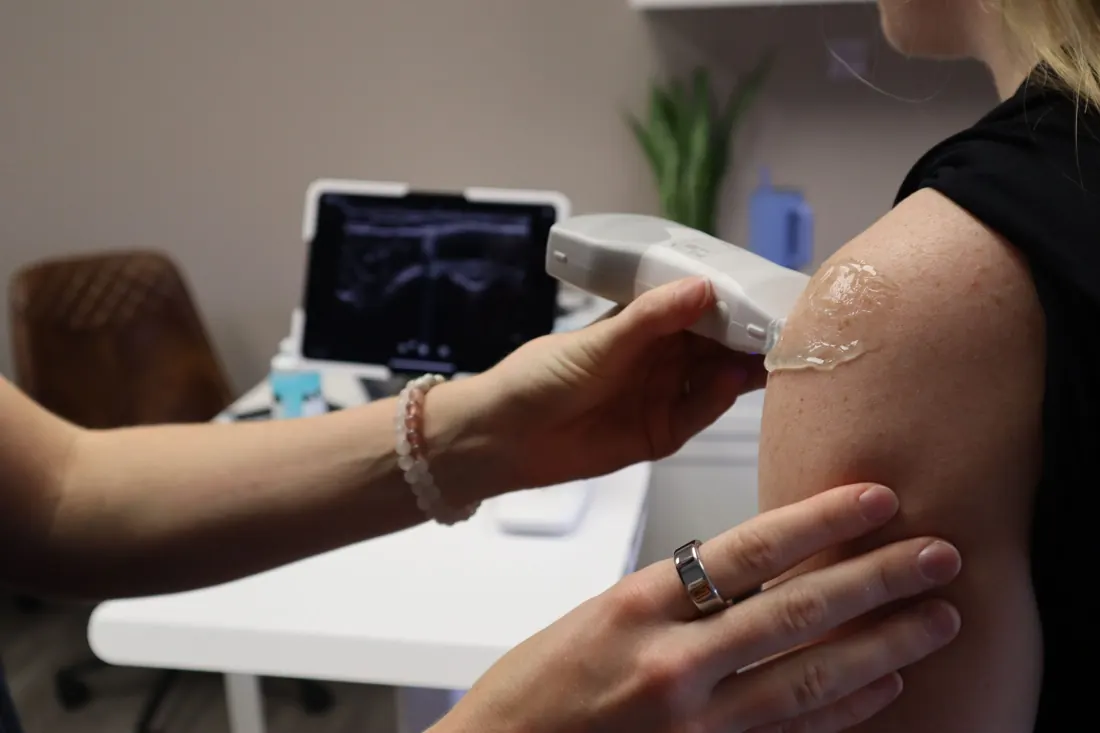
The examination tests strength in each cuff muscle, range of motion and special tests such as the drop-arm and empty-can tests. X-rays rule out arthritis, fractures and bone spurs and may show how high the upper arm bone sits in the socket. Ultrasound can show cuff tears in real time and is useful in experienced hands. MRI shows tear size, tendon retraction and muscle quality, which strongly influence the treatment plan. As with other joints, MRI often shows cuff tears in people without symptoms, so findings are matched with the examination.
Partial versus full-thickness tears
A partial tear does not go all the way through the tendon, while a full-thickness tear does. Partial tears can often be treated without surgery. Full-thickness tears do not heal on their own, but many are tolerated for long periods, and some enlarge over time. Muscle quality matters too: when the muscle has turned fatty and shrunk after a long-standing tear, repair is less likely to succeed.
Treatment options
Non-surgical
- Activity changes, avoiding painful overhead work while keeping the shoulder moving.
- Physical therapy for the remaining cuff muscles and the muscles around the shoulder blade.
- Anti-inflammatory medication when appropriate.
- Corticosteroid injection for pain relief, used sparingly because repeated injections may weaken tendon tissue.
Surgery
Repair is generally considered for acute tears in active people, for large or enlarging tears, for significant weakness, and when months of non-surgical care have not worked. Most repairs are arthroscopic, reattaching the tendon to bone with anchors. For large, irreparable tears with arthritis, options include tendon transfers, a superior capsule reconstruction or reverse total shoulder replacement. Which is appropriate depends on tear size, muscle quality, age and goals.
Recovery in general terms
After repair the arm is usually kept in a sling for several weeks while the tendon heals, followed by progressive motion and then strengthening. Many people return to desk work within a few weeks, driving after the sling is off, and many return to heavier use at around four to six months, with continued gains through a year. Tendon healing is not guaranteed, and results vary with tear size and tissue quality. Non-surgical recovery often takes weeks to a few months.
Why therapy often comes first for degenerative tears
When a tear is degenerative, the shoulder has often been compensating for a long time. Strengthening the intact cuff muscles and the muscles that stabilize the shoulder blade can restore function and reduce pain even when the tear remains. A structured program usually runs for at least six to twelve weeks, with check-ins to see whether pain, strength and sleep are improving. If they are not, or if the tear is large and the muscle is still healthy, the discussion turns toward surgery before the muscle deteriorates further.
Protecting a healing or damaged cuff
- Avoid sleeping on the injured side, and use pillows to support the arm at your side.
- Keep objects close to the body when lifting rather than at arm's length.
- Limit repetitive overhead work and heavy pulling until you are cleared.
- Do not stop moving the shoulder entirely, since prolonged immobility can lead to stiffness.
When pain is not coming from the cuff
Pain in the shoulder can also come from the neck. A pinched nerve in the cervical spine can send pain into the shoulder and arm, and the shoulder examination will usually be normal in that case. Checking the neck is part of a careful shoulder evaluation when the findings do not fit a cuff problem.
Arthritis of the shoulder joint and of the joint at the top of the shoulder can also produce pain with overhead reach, and their treatment differs from cuff repair.
Being seen out-of-network or self-pay
A well-timed evaluation can matter with rotator cuff tears, because acute tears in active people are often best repaired earlier, while degenerative tears allow time for a trial of therapy.
Elite MD Care sees patients who use out-of-network benefits and patients who pay directly. Read how out-of-network visits and self-pay care work, see orthopedics, and locate an office on the locations page.
Sources
- American Academy of Orthopaedic Surgeons, OrthoInfo. Rotator Cuff Tears
- MedlinePlus (National Library of Medicine). Rotator Cuff Injuries
- MedlinePlus (National Library of Medicine). Shoulder Injuries and Disorders
- National Institute of Arthritis and Musculoskeletal and Skin Diseases (NIH). Tendinitis
This page is general health information and is not medical advice. It does not create a physician-patient relationship. Consult a qualified clinician about your own symptoms and treatment.