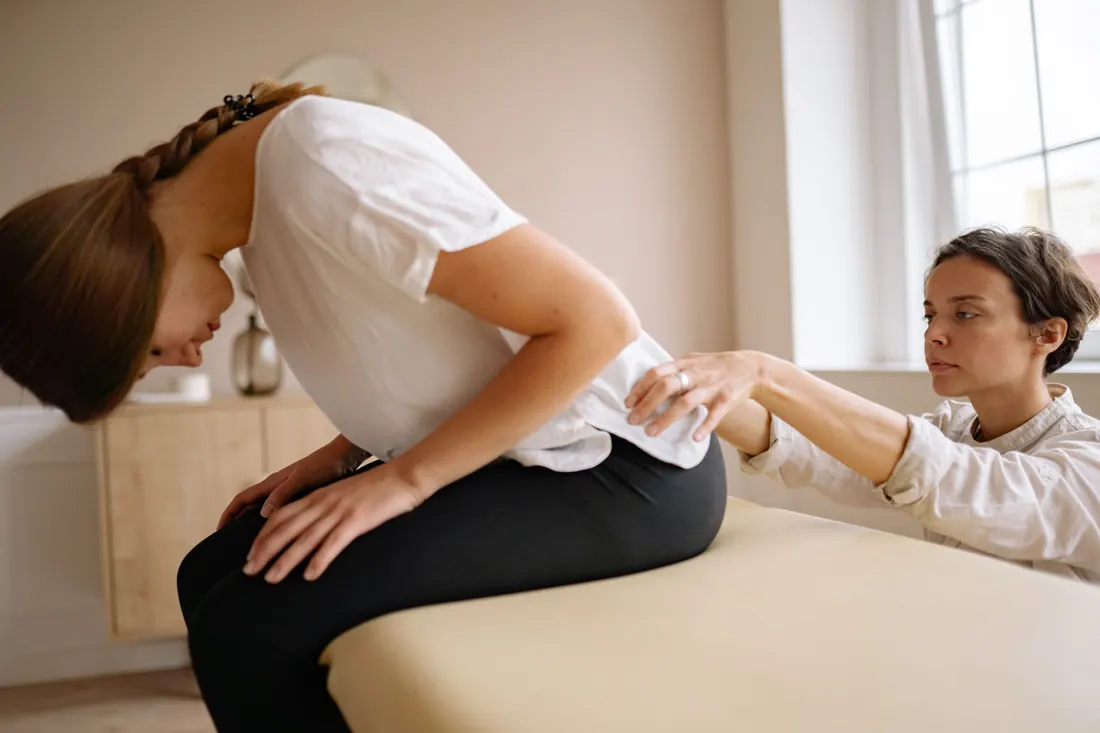
Sit with your hips back in the seat, feet flat, knees about level with your hips, and the low back supported by the chair or a small rolled cushion. Change position every 30 minutes or so. No single posture is ideal for everyone, so movement breaks matter as much as setup. Pain that spreads to the leg needs evaluation.
Many people with back pain say sitting is the worst part of the day. Research does not support a single "perfect" sitting posture, and the posture that feels best often differs between people. What is consistent is that staying in any one position for a long stretch tends to aggravate a sore back, and NIAMS notes that a desk job may play a role in back pain, especially with poor posture or sitting all day. The practical answer combines a sensible setup with regular changes in position.
Setting up the chair
- Hips and back. Slide your hips toward the back of the seat so the lower back is supported by the backrest.
- Lumbar support. If the chair lacks it, a small rolled towel or lumbar cushion at belt level can help.
- Feet and knees. Keep feet flat on the floor or a footrest, with knees roughly level with or slightly below the hips.
- Seat depth. Leave a couple of finger widths between the seat edge and the back of the knees.
- Armrests. Let your forearms rest lightly, so the shoulders are not hunched.
- Screen height. Set the top of the screen near eye level, an arm's length away.
Different seats, different tweaks
| Where you sit | What often helps |
|---|---|
| Office desk | Adjustable chair height, keyboard close to the body, screen at eye level, regular breaks |
| Car | Seat moved close enough to avoid reaching, lumbar support, headrest aligned, stops on long drives |
| Couch | Firm cushion behind the lower back, avoid slouching deep into soft cushions |
| Airplane or train | Small cushion at the low back, walk the aisle when permitted, change leg positions |
| Stool or hard chair | Limit time and add support; shift often |
Movement beats posture
A common suggestion is to change position about every 30 minutes. That can mean standing for a minute, walking to refill water, doing a gentle stretch or switching to a standing desk for part of the day. These are mini-breaks, not exercise sessions, and they interrupt the stiffening that builds up when the spine does not move. Many people who sit for work find a combination of sitting, standing and short walks more comfortable than any one of them alone. The American Academy of Orthopaedic Surgeons points to regular exercise and conditioning as an important part of managing and preventing low back pain.
Gentle moves to try
- Stand and take a few steps every half hour.
- Shift your weight, roll the shoulders and straighten gently, without forcing.
- Try a brief standing hip stretch if it does not provoke leg symptoms.
- Walk during phone calls when possible.
- Ask a physical therapist for a short routine that suits your back.
If a particular movement sends pain down the leg, stop and ask a clinician. Our page on lower back pain when sitting explains why it often flares, and heat or ice for back pain covers comfort measures.
When sitting is the clue
Where the pain shows up when you sit can hint at the cause. Pain in the buttock or down the back of the thigh when sitting can reflect nerve irritation, as with sciatica. Pain that eases when you stand and walk may fit disc-related problems, while pain that eases when you sit or lean forward is more typical of narrowing of the spinal canal. Pain around the tailbone is a separate pattern. These are clues, not diagnoses, and a clinician can sort them out. See lower back pain and sciatica.
Red flags: do not self-adjust
Call 911 or go to the emergency room if back pain comes with numbness in the groin or inner thighs, new loss of bladder or bowel control, or rapidly worsening leg weakness. Also seek urgent care for back pain after a fall or crash, back pain with fever, unexplained weight loss, or a history of cancer, and for sudden severe pain in an older adult or someone with osteoporosis, which can signal a spinal fracture.
When to book a visit
A visit is reasonable if the pain has not improved after a couple of weeks of better seating and movement, if it travels down a leg, if it wakes you at night, or if it keeps returning. A clinician can look for the source, and imaging is used selectively, as discussed in our guide on when to get an MRI for back pain. For a broader view of timing, see when to see a spine specialist.
Sitting after a flare or an injury
During an acute flare, a firm chair with arms is often easier than a deep couch, because arms let you lower and raise yourself with less strain. Getting up from sitting is a common trigger, so scoot forward, place your feet under you and push through your legs rather than twisting. Short, frequent walks tend to be more comfortable than long ones. If sitting for more than a few minutes is unbearable, tell your clinician, since that detail helps narrow down the cause.
Working from home and on the road
Kitchen tables and sofas were not designed for eight-hour days. A laptop on a stack of books with a separate keyboard, a firm chair and a timer reminding you to move go a long way. Truck drivers, commuters and frequent flyers can plan stops, pack a small cushion and do a quick standing stretch whenever the vehicle stops. Consistency with small habits beats occasional big efforts.
Small purchases that may help, and ones that may not
A simple lumbar roll, a footrest, a laptop stand with a separate keyboard and a chair with adjustable height are modest investments that help many people. Expensive "ergonomic" gear is not essential. A good chair that you never get out of is less helpful than an ordinary chair you leave every half hour. If your employer offers an ergonomic assessment, take it, and mention your symptoms. To work out which clinician fits your problem, try the which specialist tool, or contact us.
Sources
General information, not legal, tax or insurance advice. Your plan documents and insurer decide coverage; we confirm your actual benefits before you book.