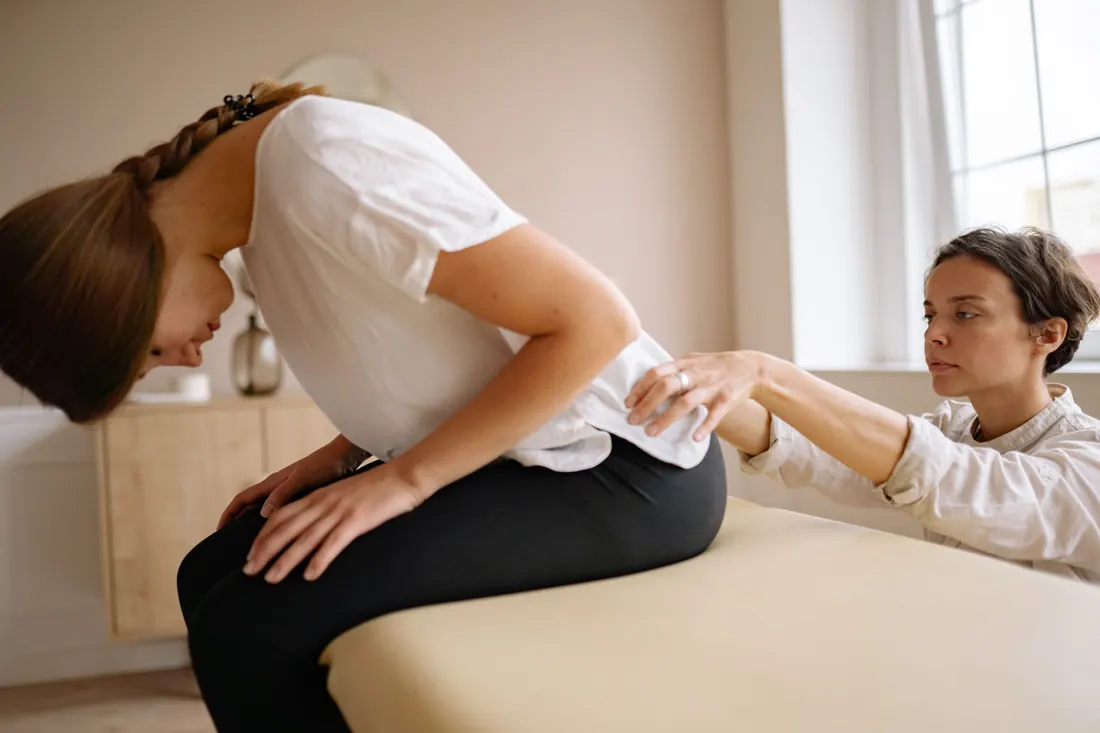
Spondylosis is the medical term for wear and tear of the spine: discs that thin and dry out, joints that develop arthritis, and bone spurs that form with age. It is very common and often painless. When it does hurt, most people improve with exercise-based care, medication and time rather than surgery.
Spondylosis sounds alarming, but it is mostly a description of how spines age. Look at enough scans of adults over fifty and nearly all show some of it, including people who have never had a sore back. The real question is whether the changes are the source of your pain, and that takes an examination, not just a report.
What spondylosis means
The word covers several related changes that tend to travel together. Discs lose water and height. The small facet joints at the back of each vertebra develop arthritis. The body lays down extra bone, called osteophytes or spurs, along the edges of vertebrae and joints. The neck and lower back are affected most because they move the most.
You may see it written as cervical spondylosis (neck), thoracic spondylosis (mid back) or lumbar spondylosis (low back). Spinal osteoarthritis and degenerative changes are everyday synonyms. None of these terms says how much pain to expect.
Symptoms people notice
- Stiffness that is worst in the morning or after sitting, then loosens with movement.
- A dull, aching pain in the neck or low back that flares with activity or long days.
- Reduced range of motion, such as trouble checking a blind spot while driving.
- Grinding or clicking with movement, which is common and usually harmless on its own.
- Arm or leg symptoms such as tingling, numbness or weakness if a spur or disc narrows the space around a nerve.
Why it develops
Age is the main driver, but it is not the only one. Earlier spine injury, repetitive heavy work, a family history of early disc degeneration, smoking and excess body weight all play a part. Genetics explain a surprising share. Two people with the same job can end up with very different spines.
When to see a specialist, and when to go to the emergency room
Book an evaluation if pain lasts beyond a few weeks, keeps waking you at night, limits work or sleep, or comes with tingling, numbness or weakness in an arm or leg. Gait changes, a feeling that your legs are clumsy, or dropping things can point to pressure on the spinal cord in the neck and deserve prompt attention.
Call 911 or go to an emergency room for new loss of bladder or bowel control, numbness in the groin or inner thighs, rapidly worsening weakness in both legs, or neck or back pain after significant trauma. Fever with severe spine pain, or unexplained weight loss with night pain, also needs urgent medical review.
How it is diagnosed
The visit starts with your history and a physical examination: posture, motion, reflexes, strength and sensation. X-rays show disc height and spurs and are often enough for a first look. MRI is added when nerve symptoms are present, when pain is out of proportion to the X-ray, or when procedures or surgery are being considered. Nerve conduction studies are sometimes used to separate spine-related symptoms from other nerve problems.
Because imaging findings are so common in people without pain, a good clinician matches the picture to the story. A scan that shows spurs at three levels does not prove which one hurts. Targeted injections are sometimes used partly for this reason, since a response can help localize the pain source.
Treatment from conservative to surgical
First line
Staying active is the most consistent advice. Walking, swimming, gentle strengthening and mobility work protect the spine better than rest does. Physical therapy teaches posture, trunk and shoulder-blade strength and movement patterns that reduce load on painful segments. Heat, short courses of over-the-counter anti-inflammatory medication when appropriate for you, and ergonomic changes to your workstation often help. Your physician can tell you which medicines are safe with your other conditions.
Procedures
If pain persists, image-guided options may be considered. A facet joint injection can calm arthritic joints, and if relief is short-lived, radiofrequency ablation may be discussed. When a pinched nerve root causes arm or leg pain, an epidural steroid injection may reduce inflammation around it. Responses vary, and injections are one part of a plan rather than a standalone fix.
Surgery
Surgery is uncommon and reserved for specific problems: progressive weakness, spinal cord compression, or nerve pain that has not responded to adequate non-surgical care and matches the imaging. Decompression removes bone or disc that crowds a nerve or the cord. Fusion is added when a segment is unstable. For most people with spondylosis, none of this is needed.
What recovery usually looks like
Spondylosis is a long-term condition, so the goal is usually control rather than a one-time fix. Many flares ease over several weeks, and a steady exercise habit often reduces how often they return. After an injection, any benefit may be felt over days to weeks and can last a variable amount of time. After spine surgery, recovery spans weeks to months. These are general ranges, and your own timeline depends on your health, the level involved and the procedure.
Everyday habits that protect an aging spine
- Change position often, and stand or walk for a few minutes out of every hour of desk work.
- Keep screens at eye level and your chair supporting the curve of your lower back.
- Build leg, hip and core strength, which share the load that discs and joints would otherwise carry.
- Do not smoke, since it is linked with faster disc degeneration.
Out-of-network and self-pay care for spondylosis
Care for spinal wear often spans an examination, X-rays or MRI, therapy and, for some patients, a procedure. Elite MD Care is an out-of-network practice that also welcomes self-pay patients, so you can plan each step with the benefits you hold or the amount you choose to pay directly.
See how out-of-network visits work, how self-pay care is arranged, and try the out-of-network cost calculator to understand how your plan may reimburse. Our spine care page lists related services.
Sources
- MedlinePlus (National Library of Medicine). Cervical spondylosis
- National Institute of Arthritis and Musculoskeletal and Skin Diseases (NIH). Back Pain
- National Institute of Arthritis and Musculoskeletal and Skin Diseases (NIH). Osteoarthritis
- MedlinePlus. Back Pain
This page is general health information and is not medical advice. It does not create a physician-patient relationship. Consult a qualified clinician about your own symptoms and treatment.