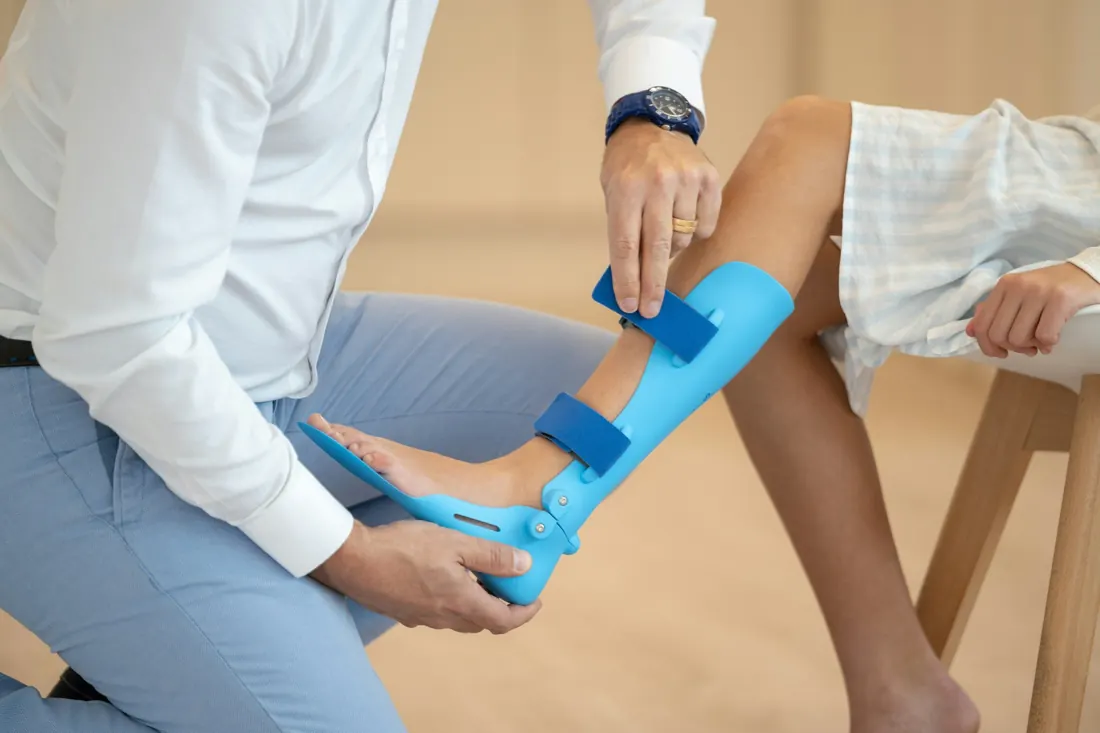
Posterior tibial tendon dysfunction is a condition in which the tendon that holds up the arch becomes inflamed, torn or stretched. It causes inner ankle pain and a gradually flattening foot. Early stages usually respond to orthotics, bracing and therapy, while advanced deformity may need reconstructive surgery.
One tendon does a surprising amount of work in keeping the arch lifted when you push off the ground. When it weakens, the arch can fall slowly, and the foot becomes progressively harder to control. Recognizing it early changes the options.
The tendon and what it does
The posterior tibial tendon connects a calf muscle to bones on the inner side of the foot. It runs behind the bony bump on the inside of the ankle and is a main support of the arch. It helps you rise onto your toes and turn the foot inward. A strong ligament called the spring ligament works alongside it. Medical groups now often use the broader term progressive collapsing foot deformity, because the condition involves not only the tendon but also ligaments and joints that gradually give way, and the foot can go from a mild change to a painful, stiff flatfoot.
How it shows up
- Pain and swelling along the inside of the ankle and arch, worse with standing and walking.
- An arch that looks lower than it used to, or only on one side.
- A heel that tilts outward when you look from behind.
- Pain on the outside of the ankle in later stages as bones press together.
- Difficulty rising on the toes of the affected foot, or inability to do a single-leg heel raise.
- An ankle that feels unstable on uneven ground.
Early symptoms are easy to dismiss as a sprain or sore arch, which is why people sometimes wait for months.
Why it develops
The tendon is a common site of overuse injury in middle-aged and older adults, particularly women. Risk factors include obesity, diabetes, high blood pressure, prior ankle or foot injuries, inflammatory arthritis, and long-term steroid use. A sudden injury can also tear the tendon in some people. The tendon has a limited blood supply along the curve behind the ankle, which may explain why it wears down there. Once weakness begins, the arch loses support, which puts more strain on the tendon, so the cycle feeds on itself.
When to go to the ER and when to be seen within days
Go to an emergency room or call 911 if the ankle or foot is hot, red and swollen with fever, if an injury has left it deformed and unable to bear weight, or if the foot turns cold, pale or blue. In people with diabetes, a swollen, warm foot with little pain is also worth same-day evaluation.
Be seen within days after a sudden pop on the inner ankle, a sudden drop of the arch, or new swelling with a heel that tilts outward. Stage matters: tendon problems caught while the foot is still flexible have more non-surgical options, and a stiff, collapsed foot is harder to treat. Inner ankle pain that has persisted for several weeks is also a reason to book.
How it is diagnosed
The clinician examines your foot from behind while you stand, looking for the heel tilt and for the "too many toes" sign, where more toes than normal are visible from behind. You will be asked to rise on your toes on one foot and then on both, and the strength of the tendon is tested. Weight-bearing X-rays show how the bones line up under load. MRI or ultrasound can show inflammation, splitting or a tear of the tendon and the state of the spring ligament. Findings help place the condition in a stage, from a tendon that hurts but still supports the arch to a stiff, arthritic flatfoot.
Treatment, from conservative to surgical
Early stages
- Rest from the activities that provoke pain, and sometimes a boot for a short period to calm inflammation.
- Custom orthotics or an ankle brace that supports the arch and heel.
- Supportive, stable shoes.
- Physical therapy for tendon loading, calf flexibility and balance.
- Anti-inflammatory medication when it is safe for you. Corticosteroid injections into the tendon are generally avoided because they can weaken it.
Most people in the early stages can be treated without surgery. A stiff brace that extends above the ankle may be recommended for more advanced cases.
Surgery
If orthotics and braces do not relieve pain, surgery may be recommended. Options range from cleaning out inflamed tissue or repairing a tendon tear to reconstructive procedures: transferring a neighboring tendon to take over the work, shifting the heel bone to realign the foot, lengthening tight structures and fusing joints when arthritis has set in. Surgery is often complex, and most people notice some activity limits afterward. Ask us whether specific procedures are offered at the office nearest you.
Recovery in general terms
With bracing and therapy, many people notice improvement over several weeks to a few months, and some wear the support long term. After reconstruction, a cast and a period without weight on the foot for several weeks are typical, followed by a boot and months of rehabilitation. Full recovery can take close to a year, and strength and swelling may continue to improve beyond that. These are general ranges for planning, not predictions for your foot.
How it differs from simple flat feet
A lifelong flexible low arch is a normal variation and rarely painful. In contrast, an arch that falls in adulthood with inner ankle pain is a sign of a changing problem. If you have a longstanding flat foot that has recently become painful, a tendon evaluation is still sensible. For background on the other end of the spectrum, see plantar fasciitis, which can coexist, and Achilles tendinitis, since tightness of the Achilles contributes to flatfoot stress.
Practical steps while waiting for your visit
- Switch to stable shoes with a firm sole, and avoid walking barefoot on hard floors.
- Cut back on high-impact activity until the cause is clear.
- Do not stretch aggressively through inner ankle pain.
- Take a photo of your heels from behind to track change over time.
Out-of-network and self-pay care
A tendon problem can involve imaging, custom orthotics, bracing and follow-up, so ask about each step. Elite MD Care sees patients who use out-of-network benefits and patients who pay directly. Read how out-of-network care and self-pay care work, use the out-of-network cost calculator to prepare questions for your plan, and learn about orthopedic care. Rehabilitation after injuries is covered in physical therapy after injury.
Sources
- American Academy of Orthopaedic Surgeons, OrthoInfo. Posterior Tibial Tendon Dysfunction
- American Academy of Orthopaedic Surgeons, OrthoInfo. Adult-Acquired Flatfoot
- MedlinePlus (National Library of Medicine). Foot Injuries and Disorders
This page is general health information and is not medical advice. It does not create a physician-patient relationship. Consult a qualified clinician about your own symptoms and treatment.