Platelet-rich plasma is made from a sample of your own blood, spun to concentrate platelets, then injected into an injured tendon or joint. AAOS says it could hold promise but that research backing the claims is lacking. It may be considered after standard care, and many plans do not pay for it.
PRP has moved from sports pages into ordinary orthopedic offices, and with that move has come a lot of enthusiasm that outruns the research. This page explains what the treatment is, what the American Academy of Orthopaedic Surgeons (AAOS) actually says, and how to think about it as a patient.
How PRP is made
Blood is mostly liquid plasma, along with red cells, white cells and platelets. Platelets are best known for clotting, but they also carry growth factors involved in healing. To prepare PRP, a small amount of your blood is drawn and spun in a centrifuge so the platelets are separated and concentrated. AAOS notes the concentration of platelets and growth factors can be roughly 5 to 10 times higher than in ordinary blood. The concentrate is then injected, usually with a local anesthetic, into or around the injured tissue.
Laboratory studies suggest the added growth factors may help healing, but AAOS is plain that it is not exactly clear how PRP works.
What the research does and does not show
The honest summary is promising in places, unproven in many others. AAOS reports that recent research has shown improved outcomes with PRP for certain tendon problems, singling out tennis elbow, and that studies have looked at low to moderate knee arthritis with some studies reporting results that lasted up to two years. For chronic Achilles or patellar tendon problems it calls the evidence "promising" but says it is hard to say PRP is more effective than traditional treatment. For rotator cuff and ACL surgery, it reports little or no benefit, and for fracture healing no significant benefit.
Its conclusion is worth quoting: "Treatment with PRP could hold promise; however, current research studies to back up the claims in the media are lacking." AAOS also says it has not yet been determined whether the two main types of preparation, leukocyte rich and leukocyte poor, differ in effectiveness. Nothing here justifies expecting a specific result.
How PRP compares with cortisone
A corticosteroid works faster and wears off sooner, and repeated doses can weaken tendon. PRP works, if at all, over weeks, and AAOS notes that PRP does not carry the same risk of plantar fascia rupture that cortisone shots do. That difference is part of why some people consider it. It does not mean PRP is better, only that the trade-offs differ. See cortisone injections for the other side of the comparison.
Who it is generally considered for
- Chronic tendon problems such as tennis elbow, patellar tendinitis and Achilles tendinitis, when months of standard care have not been enough.
- Mild to moderate knee arthritis, as one of several injection choices.
- Plantar fascia pain, where AAOS notes PRP avoids the rupture risk of cortisone but that more research is needed on effectiveness.
It is not a good fit if you have a bleeding disorder, a low platelet count, active infection at the site, or a condition that clearly needs surgery.
What is usually tried first
- Activity modification and a progressive loading or stretching program.
- Physical therapy and, where relevant, bracing or orthotics.
- Anti-inflammatory medication, if suitable for you.
- Other injections, such as a corticosteroid, weighed against their own limits.
How the visit goes
- You review the diagnosis and the realistic expectations, and stop certain medicines only if your physician says so.
- Blood is drawn, usually from the arm, and processed in the office, which takes a short time.
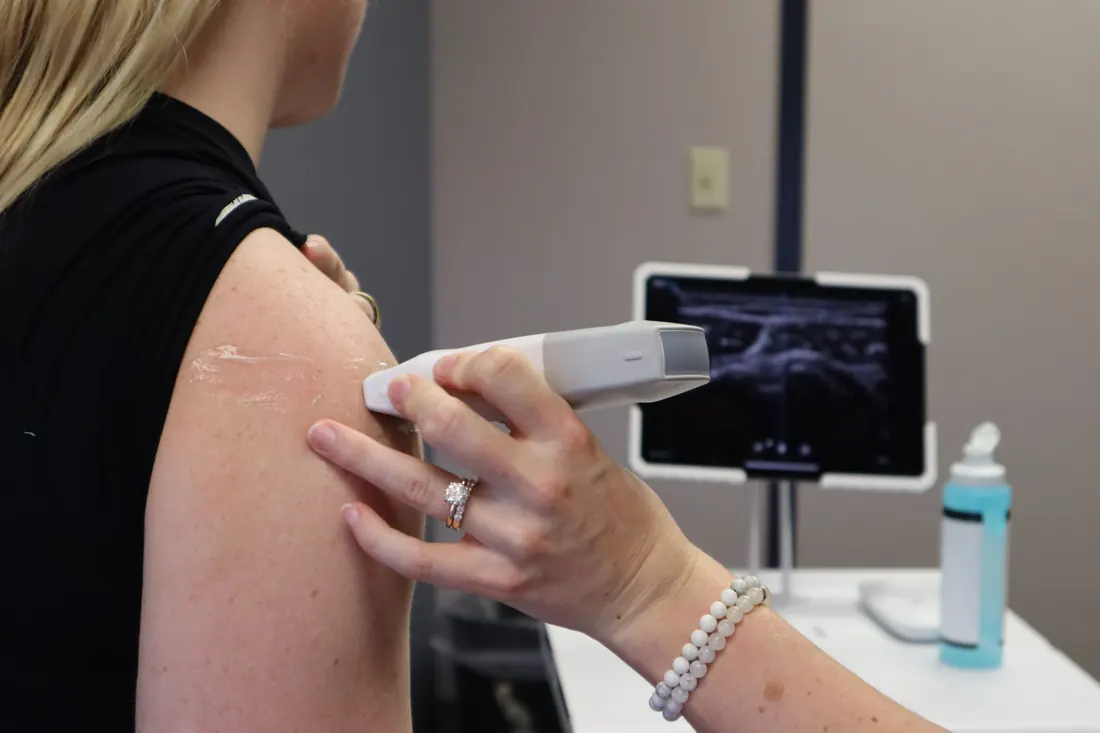
- The area is cleaned and numbed, and the PRP is placed using ultrasound guidance when the target is small or deep. See ultrasound-guided injections.
- You go home the same day with activity instructions.
The practice's published materials mention PRP "if offered," so ask us whether this is offered at the office nearest you and which preparation system is used.
Recovery and expectations
Soreness at the injection site is expected and can be worse than before for the first week or two. Some clinicians advise avoiding anti-inflammatory pills in that window and easing back into activity gradually while rehabilitation continues. Benefit, if it comes, tends to appear over weeks. Some people need more than one injection, and some get little change.
Risks
AAOS describes the risks as minimal, with increased pain at the site and no difference in infection, tissue damage or nerve injury compared with cortisone injections. Still, any needle can cause infection, bleeding or bruising, and the preparation is only as consistent as the system and technician producing it. Cost and unmet expectation are real risks too.
Questions worth asking before you agree
- What is the diagnosis, and does the research support PRP for that specific problem?
- Which preparation system is used, and is the platelet concentration measured?
- How many injections do you expect, and what happens if I notice no change?
- Will you recommend rehabilitation alongside it?
- What is every charge, and what will my plan likely not pay?
Good answers acknowledge the limits of the evidence. If a provider describes PRP as a cure or as a way to avoid surgery with certainty, that is a reason to slow down and get a second opinion.
Cost for out-of-network and self-pay patients
PRP is often billed in parts: the consultation, the blood draw and preparation kit, the injection itself, and any imaging guidance. Many plans may not cover it. AAOS itself advises checking eligibility with your carrier and notes that few plans give even partial reimbursement, so check your plan before you schedule and ask for the charges in writing.
If part of your visit is reimbursed out of network, the plan works from its own allowed amount, explained in the allowed amount guide, and the out-of-network cost calculator helps you estimate your share. If you pay directly, you can request a Good Faith Estimate; see the Good Faith Estimate guide.
When to seek emergency care
Call 911 or go to the emergency room for trouble breathing or swelling of the face or throat. Contact the office the same day for fever, spreading redness, a hot, increasingly swollen joint, or severe pain that is climbing instead of easing after the first couple of weeks.
Sources
- American Academy of Orthopaedic Surgeons, OrthoInfo. Platelet-Rich Plasma (PRP)
- American Academy of Orthopaedic Surgeons, OrthoInfo. Tennis Elbow (Lateral Epicondylitis)
- American Academy of Orthopaedic Surgeons, OrthoInfo. Plantar Fasciitis and Bone Spurs
- American Academy of Orthopaedic Surgeons, OrthoInfo. Arthritis of the Knee
This page is general health information and is not medical advice. It does not create a physician-patient relationship. Consult a qualified clinician about your own symptoms and treatment.