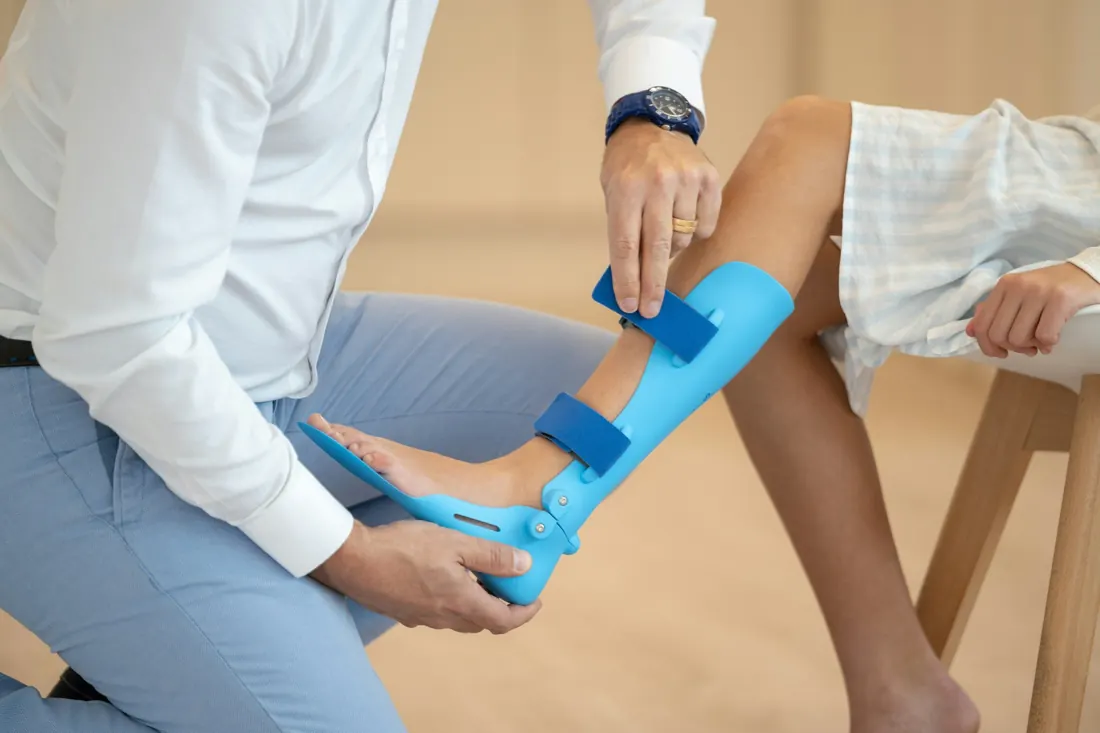
Achilles tendon repair sews the ends of a ruptured tendon back together, usually through an open or small-incision approach. Surgery and non-surgical treatment with a boot are both accepted options for many ruptures, and the choice depends on your age, activity, health and how soon you are seen.
An Achilles rupture often happens suddenly: a pop at the back of the ankle, a feeling like being kicked, and difficulty pushing off. It is more common in weekend athletes in their thirties through fifties. The Achilles tendon rupture page describes the injury, and this page explains repair.
Surgery or a boot?
This is the central decision, and reasonable specialists differ. Both paths can work, and the trade-offs are different:
- Non-surgical treatment puts the ankle in a boot with the foot pointed down, then gradually brings it up over weeks. It avoids surgical risks such as wound problems, but a re-rupture may be somewhat more likely, and the healed tendon may be a little longer and weaker for some people.
- Surgical repair may lower the chance of re-rupture and may restore push-off strength more reliably for some athletes, at the cost of surgical risks.
Modern accelerated rehabilitation has narrowed the gap, so the choice often comes down to your goals, health and preferences. People with poor circulation, diabetes, smoking or skin problems may be steered toward non-surgical care, since wound healing is a concern.
Who may lean toward repair
- Younger or highly active people who want to return to running or cutting sports.
- Those with a re-rupture, or a rupture that was missed and has been present for weeks.
- Patients whose imaging shows a large gap between the tendon ends.
The diagnosis is usually made at the bedside with a squeeze test of the calf, and ultrasound or MRI can confirm the tear and show the gap. A tendon that is merely inflamed is a different matter, covered under Achilles tendinitis. Achilles problems fall under the practice's published sports medicine scope, but ask us whether surgical repair is offered at the office nearest you.
What happens first
- Protect the ankle in a splint or boot with the toes pointed down, and keep weight off the leg.
- See a specialist within days if possible, because earlier decisions are easier.
- Get imaging if the diagnosis or the gap is unclear.
- Decide between surgery and a boot after a candid discussion of risks and goals.
How the repair is done
Surgery is usually outpatient, under regional or general anesthesia, with you lying face down. The surgeon makes an incision over the back of the lower leg, finds the torn ends, and stitches them together with strong suture, sometimes reinforcing with an anchor in the heel bone. Some surgeons use a smaller incision or a percutaneous technique, which may reduce wound problems but carries a higher chance of nerve irritation. A splint holds the foot pointed down afterward.
Recovery as a rough guide
Protocols differ among surgeons, and these ranges are general.
- A splint, then a boot with heel wedges, for roughly the first six to eight weeks, with crutches in the early period.
- Weight bearing may begin sooner in some accelerated programs, under your surgeon's direction.
- Therapy starts in the boot phase and focuses on gentle motion, then calf strengthening later.
- Walking in regular shoes often returns around two to three months, though the calf stays weaker for longer.
- Running and sports are commonly delayed for around four to six months or more, and a full return can take close to a year.
Risks, in plain terms
- Wound healing problems or infection, since the skin there is thin.
- Re-rupture of the repair.
- Injury or numbness of the sural nerve along the outside of the foot.
- Blood clots in the leg, a particular concern after immobilization.
- Calf weakness, stiffness, or a thick, tender scar.
Preparing for the plan
You will likely be non-weight-bearing for a stretch, so rehearse the logistics: crutches or a knee scooter, a seat in the shower, a way to carry things, and help with driving. A right-sided injury commonly means no driving for a time. Bring a medicine list, mention clotting history, and ask about blood clot prevention, which some surgeons address with medicine or with exercises. Smoking cessation helps wound healing considerably.
Questions worth asking
If you are weighing surgery against a boot, ask your specialist to describe both honestly for someone like you. Useful questions include how big the gap is on imaging, what the re-rupture risk is for each option in your age group, which rehabilitation protocol they use and why, and when you could expect to return to your particular sport or job. If a surgeon recommends one path, it is reasonable to ask what would change that advice, and whether a second opinion would be sensible given how time-sensitive the decision is.
What gets billed
Surgical care adds several separate bills. The surgeon bills for the repair and the global follow-up period. A hospital or surgery center bills for the facility and implants, and anesthesia bills separately. Ultrasound or MRI, a boot, crutches and therapy come from others. Non-surgical care has its own mix, mainly the visits, boot and therapy.
When you use out-of-network benefits, the allowed amount guide shows how your plan prices each item, and the out-of-network cost calculator lets you compare scenarios, for example surgery against a boot. If you pay directly, request a Good Faith Estimate as described in the Good Faith Estimate guide. Because ruptures are urgent, ask early about estimates, since delays can shape your options.
Emergency symptoms
Call 911 or go to the emergency room for chest pain, sudden shortness of breath, or a calf that is swollen, warm and painful, since these can signal a blood clot. Call your surgeon promptly for fever, wound drainage, a sudden pop with new weakness, or a foot that turns pale or numb.
Sources
- American Academy of Orthopaedic Surgeons, OrthoInfo. Achilles Tendinitis
- MedlinePlus (NIH). Tendon Repair
- MedlinePlus (NIH). Foot Injuries and Disorders
- NIAMS (NIH). Sports Injuries
This page is general health information and is not medical advice. It does not create a physician-patient relationship. Consult a qualified clinician about your own symptoms and treatment.