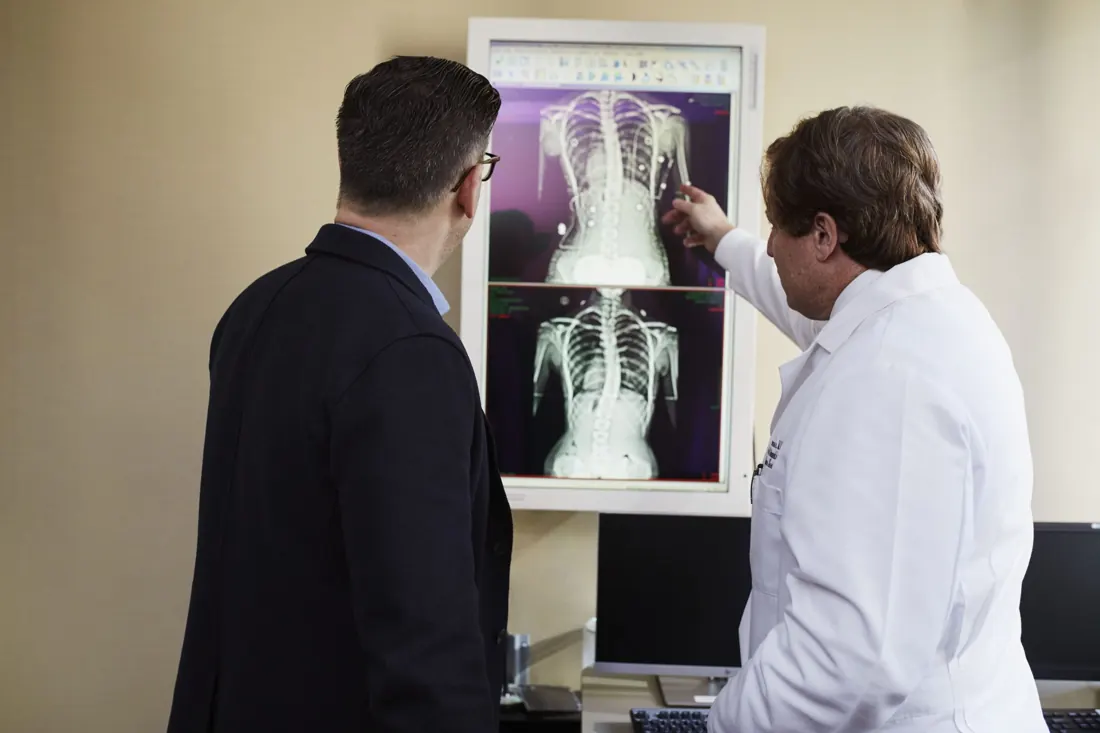
The cost of an X-ray depends on how many views are taken, which body parts, the setting, and whether the physician who reads the images bills separately. No honest page can name your number. Ask for a written quote or Good Faith Estimate that lists the technical fee, the reading fee and the visit.
An X-ray is the cheapest-sounding test in orthopedics, which is exactly why the bill can surprise people. The picture is quick. The paperwork around it is not. This page explains which charges can sit behind a plain film, so a quote you collect can be compared line by line with another one.
What is billed for an X-ray
MedlinePlus describes an X-ray as a painless imaging test that sends a small amount of radiation through the body to make pictures of bones and organs. Billing splits that simple test into pieces.
| Piece | Who bills it | Notes |
|---|---|---|
| Technical fee | The office, imaging center or hospital | Covers the equipment, the room and the technologist who takes the pictures |
| Professional (reading) fee | The physician who interprets the images | A radiologist may bill this separately, or the treating clinician may read the films in the office |
| Number of views | Counted per body part | A knee with three angles is coded differently than a single view |
| Ordering visit | The clinician who decided films were needed | Billed as its own visit, not as part of the X-ray |
| Weight-bearing or stress views | Same imaging team | Standing films or films with the joint positioned under load can add views |
What moves the total up or down
Where the films are taken
The Medicare.gov page on X-rays notes that in a hospital outpatient setting a separate facility copayment applies on top of the clinician charge. Commercial plans often treat hospital departments the same way, so the building matters as much as the film.
One body part or several
A request for "my spine" can mean the neck, mid-back and lower back, each its own study. Ask which regions and how many views the quote covers.
Same-day with a visit
Films taken during an office visit are usually billed on the same date as the visit, with the visit and the X-ray as two lines. A quote for "the appointment" may or may not include them.
Comparison films and outside images
If you already have recent films, ask whether the office can use them. Repeating a study only because the images are not on hand adds a charge that was avoidable. Our guide to getting records and imaging sent covers the request.
How out-of-network benefits treat X-rays
With out-of-network benefits, the question is not the sticker charge but what your plan will recognize. The plan applies its allowed amount to each line, counts any deductible you still owe, and pays its coinsurance share of the remainder. Anything above the allowed amount can be billed to you as balance billing. HealthCare.gov defines balance billing as a provider billing you for the difference between the provider's charge and the allowed amount.
X-rays are a place where two lines can have two different network answers: the facility that takes the films and the physician who reads them. Ask your plan about both. The out-of-network cost calculator lets you try the arithmetic with your own deductible and coinsurance once you have the charge.
Medicare and X-rays
Medicare.gov says Part B covers medically necessary diagnostic X-rays, and that your treating doctor or provider must order them. After the Part B deductible, you pay 20% of the Medicare-approved amount, and in a hospital outpatient setting a separate facility copayment applies. Medicare.gov also says the amount you owe depends on other insurance, how much your provider charges, whether the provider accepts assignment, the type of facility and where you get the test.
Paying yourself and the Good Faith Estimate
If you are not using insurance, CMS says providers must give you a good faith estimate when you schedule care at least 3 business days ahead or ask for one. Request it in writing, and make sure the estimate names the views, the reading fee and the visit. Our Good Faith Estimate guide explains what a complete estimate contains, and the self-pay page covers how paying yourself works here. Whether in-office films are offered at the location nearest you is something to ask us directly.
Hypothetical example: out-of-network X-rays at a visit
These numbers are invented and round. They are an illustration only and not a price from any provider.
| Line | Charge | Plan allowed amount |
|---|---|---|
| Technical fee, two views of one knee | $300 | $120 |
| Reading fee | $100 | $40 |
| Total | $400 | $160 |
- Suppose the plan's out-of-network deductible is already met.
- The plan pays 60% of the allowed $160, which is $96.
- Your 40% coinsurance is $64.
- The provider bills the gap between charge and allowed amount, $240.
In this invented case you owe $64 plus $240, or $304. If the plan's deductible were not yet met, you would pay the allowed $160 toward it first. Your own plan's numbers will differ.
Reading the bill afterward
When the explanation of benefits arrives, match each line to the quote. An X-ray visit often produces a facility statement, a clinician statement and, if a separate reader was used, a third. Seeing three names is normal. Seeing a charge for a body part or number of views you did not expect is the signal to call the office and ask for the itemized statement before paying. Keep the written quote next to the bill so the comparison takes minutes, not weeks.
Questions to ask before you book
- How many views and which body parts are in the quote?
- Is the reading fee included or separate, and who is the reader?
- Are the films taken in a hospital department or an office?
- Can you use films I already have, and how do I send them?
- Will the visit and the X-ray appear as separate lines on my bill?
- Can I get the quote or a Good Faith Estimate in writing first?
For X-ray results that point to a next step, the page on MRI vs CT vs X-ray explains which test answers which question. If your problem is a stiff or swollen joint, see knee pain or hip pain. To have us look at your questions, contact us.
Sources
- MedlinePlus: X-rays
- Medicare.gov: X-rays
- CMS: Understanding costs in advance
- HealthCare.gov glossary: Balance billing
General information, not legal, tax or insurance advice. Your plan documents and insurer decide coverage; we confirm your actual benefits before you book.