Shoulder impingement is pinching of the rotator cuff tendon and bursa in the narrow space under the bony roof of the shoulder. It causes pain lifting the arm, reaching behind the back and lying on that side. Most cases improve with activity changes and strengthening therapy, with injections or surgery for those who do not.
Shoulder impingement describes pinching of the soft tissues in the narrow space between the top of the upper arm bone and the bony roof of the shoulder, called the acromion. The tissue most often involved is the rotator cuff tendon, along with the bursa that cushions it. It is one of the most common reasons adults develop pain when lifting an arm.
How the pinching happens
When you raise your arm, the cuff tendons slide through a tight tunnel. If the tunnel is crowded, the tendon and bursa can be squeezed and irritated with every overhead movement. Crowding comes from a hooked or spurred acromion, a thickened bursa, tendon swelling, a stiff joint capsule, or weakness in the muscles that hold the shoulder blade steady, so the space narrows more than it should. Repetitive overhead work and sports such as swimming, tennis, baseball and weightlifting are common triggers, but it also affects people with desk jobs and poor shoulder posture.
Symptoms
- Pain on the front or side of the shoulder when lifting the arm, especially between about 60 and 120 degrees of elevation.
- Pain reaching behind the back, fastening a bra or putting on a coat.
- Night ache, particularly lying on the affected side.
- A weak or tired feeling in the arm, usually from pain rather than a torn tendon.
- Tenderness at the top and outer edge of the shoulder.
Red flags
Call 911 or go to the emergency room for shoulder pain with chest pressure, shortness of breath, sweating or pain spreading into the jaw or left arm, which can signal a heart problem. Go to the emergency room after a fall or collision if the shoulder looks deformed or you cannot move the arm. Be seen within a few days if you suddenly cannot lift the arm after a lift or fall, since that can mean a tendon tear, or if pain is severe at night, lasts more than a few weeks, or comes with fever or a hot, red joint.
How it is diagnosed
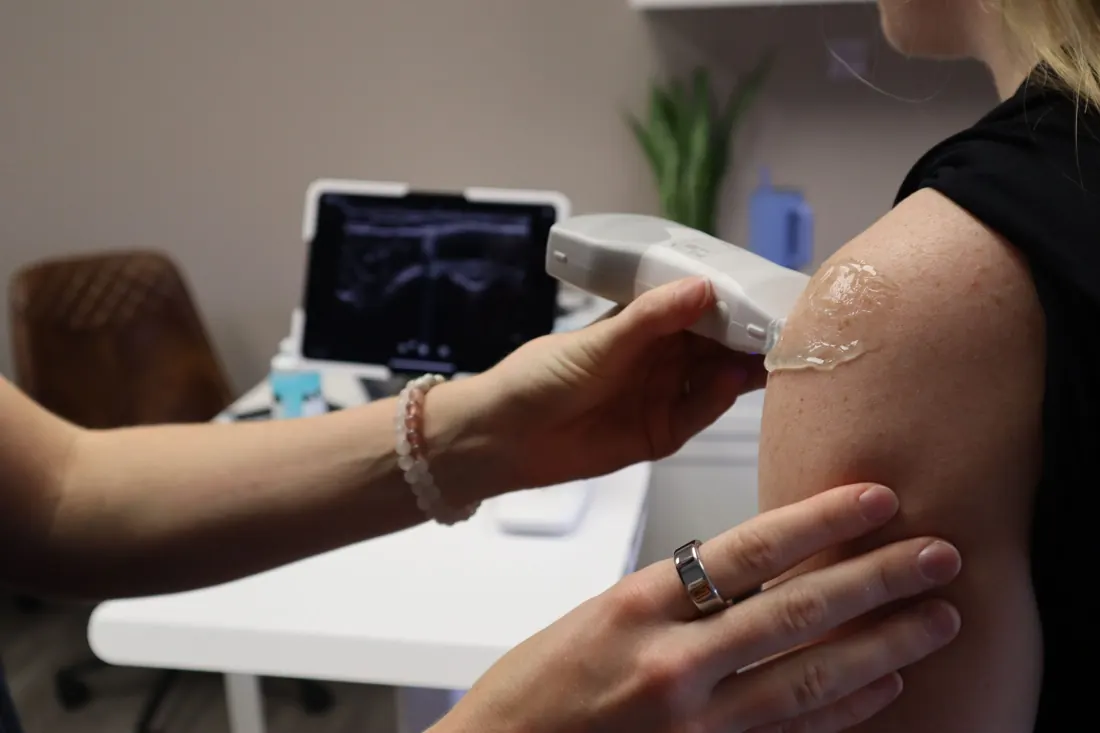
Impingement is mainly a clinical diagnosis. The examiner checks motion, strength and tender points, and uses maneuvers that deliberately narrow the space to see if they reproduce your pain. X-rays can show the shape of the acromion and any spurs, or reveal arthritis. Ultrasound can view the tendon in motion and guide an injection. MRI is used when a tear is suspected, when weakness is significant, or when symptoms persist despite treatment. The neck is also examined, because nerve irritation in the cervical spine can send pain into the shoulder.
Treatment, from conservative to surgical
- Relative rest. Reduce overhead and repetitive activity for a period, without immobilizing the shoulder, which risks stiffness.
- Therapy. A program usually focuses on shoulder blade control, rotator cuff strengthening and stretching the tight back of the capsule. This is the foundation of care and often takes six to twelve weeks to judge.
- Anti-inflammatory medication. Over-the-counter options may help short term, but they are not suitable for everyone; ask a clinician if you have stomach, kidney, heart or blood pressure issues.
- Corticosteroid injection. Placed in the bursa space, sometimes with ultrasound guidance, it can quiet pain enough to let therapy progress. Repeated injections into the same area are generally limited because steroid can weaken tendon. See ultrasound-guided injections.
- Surgery. Considered when well-run non-surgical care over several months has not helped. Arthroscopic decompression removes inflamed bursa and, in some cases, shaves a portion of the acromion; a torn cuff, if found, can be repaired at the same time. Ask us whether this is offered at the office nearest you. See shoulder arthroscopy.
Recovery
Most people with impingement improve with therapy and activity changes over weeks to a few months, though symptoms can return if the underlying strength and mechanics are not addressed. After arthroscopic decompression, a sling is often used for a short time, early motion starts within days to weeks, and many people return to desk work within a couple of weeks and to overhead sports after roughly three to four months. Timelines vary with whether a cuff repair was also needed.
Why it tends to come back
Impingement is rarely just a problem of the shoulder joint. The shoulder blade has to rotate and tilt as the arm rises, and when the muscles that control it are weak or fatigue early, the roof of the shoulder drops down onto the tendon. A stiff upper back and rounded posture add to this. That is why therapy usually addresses the blade, the upper back and the cuff together, and why symptoms often return when exercises stop too soon. A maintenance routine of a few short sessions per week is a common recommendation after pain has settled.
Sorting out what else it could be
Several conditions mimic impingement. A cuff tear causes more weakness; see rotator cuff tear. A stiff, painful shoulder that loses motion in every direction points toward frozen shoulder. Arthritis of the shoulder or the collarbone joint, a labral injury and a pinched neck nerve can all look alike, which is why examination matters more than any single scan.
Protecting the shoulder while it settles
- Keep work close to the body and at or below chest height when you can.
- Take breaks from repetitive overhead tasks and raise your work surface instead of your arm.
- Sleep with a pillow supporting the arm, and avoid lying on the sore side.
- Warm up before throwing or lifting, and build load gradually.
Being seen out-of-network or self-pay
Shoulder impingement often calls for a trial of therapy first, and then possibly imaging and an injection. Because each step is billed separately, it is worth asking in advance which parts of that sequence you want to pursue.
Elite MD Care sees patients who use out-of-network benefits and patients who pay directly. We can explain the expected steps so you can ask your plan about out-of-network coverage for the visit, imaging and any procedure. Read how out-of-network visits and self-pay care work, estimate your own share with the out-of-network cost calculator, and see our orthopedics page.
Sources
- American Academy of Orthopaedic Surgeons, OrthoInfo. Rotator Cuff Tears
- MedlinePlus (National Library of Medicine). Shoulder Injuries and Disorders
- National Institute of Arthritis and Musculoskeletal and Skin Diseases (NIH). Tendinitis
This page is general health information and is not medical advice. It does not create a physician-patient relationship. Consult a qualified clinician about your own symptoms and treatment.